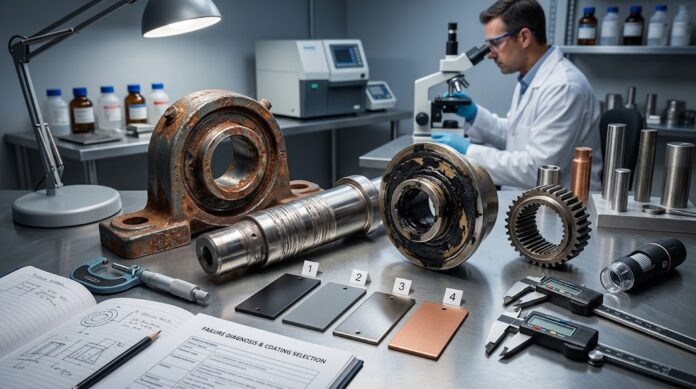

Coating Selection Starts With Failure Analysis
A component comes back from the field worn, corroded, seized, or stuck to whatever it was supposed to release from. The instinct at that point is to ask which coating will fix it. The more useful question is which of those four things actually happened, because the coatings that address them are not the same, and in several cases the properties that solve one problem work against another.
Four Failures That Look Similar From a Distance
Abrasive wear removes material through sustained contact with harder particles or surfaces. The countermeasure is hardness and a coating tough enough to stay bonded under load.
Corrosion is chemical rather than mechanical. It requires a barrier that blocks the corroding medium from reaching the substrate, and barrier performance depends on film continuity far more than on hardness. A single pinhole in an otherwise excellent barrier concentrates attack at that point.
Release failures involve material sticking where it should let go. Molded parts that will not eject, product that builds up on a chute, dough clinging to a forming die. The property needed here is low surface energy, meaning the coating resists being wetted by whatever contacts it.
Friction failures involve resistance to sliding motion, which is related to release but not identical. A surface can release cleanly while still generating enough drag to bind a moving assembly.
Each of these calls for a different answer, and diagnosing the wrong one produces a coated part that fails the same way it did before.
Properties That Pull Against Each Other
Coating formulation involves tradeoffs that cannot be engineered away entirely.
Fluoropolymers deliver exceptionally low friction and low surface energy, which makes them the standard answer for release and sliding applications. They are also relatively soft compared to hard-facing materials, meaning a part that needs both extreme release performance and high abrasion resistance sits between two properties that do not maximize together.
Thickness introduces its own tension. A thicker film generally provides a better corrosion barrier, since it takes longer for a medium to work through and there is more margin against defects. Thicker films also add dimension, which matters on parts with tight tolerances, and they can become more prone to cracking under flex or thermal cycling.
Hardness and flexibility work in opposition as well. A hard coating resists abrasion but tolerates substrate movement poorly. A flexible coating follows the part through thermal expansion and mechanical deflection but gives up wear resistance in exchange.
The Operating Envelope Narrows the Field
Beyond the failure mode, service conditions eliminate options quickly.
Continuous operating temperature sets an upper bound, since every coating has a range above which it degrades or loses adhesion. Chemical exposure eliminates any formulation the process medium attacks. Contact pressure and sliding speed determine whether a coating rated for light duty survives the actual load. Cleaning and sterilization cycles impose their own chemical and thermal demands, sometimes more severe than the process itself.
This is why the catalog of available formulations is large rather than small. The range of coatings represented across suppliers of Orion Industries industrial coatings and comparable applied-coating operations reflects the number of distinct combinations that real applications produce, since a formulation optimized for one temperature and chemical environment frequently performs poorly two conditions over.
The Substrate Sets Its Own Limits
The part being coated constrains the choice as much as the application does.
Cure temperature is the most common limitation. Many high-performance coatings require elevated temperature to form a continuous film, and the substrate has to tolerate that cycle without distorting or losing heat treatment. Aluminum, certain steels, and most polymers all have different ceilings.
Geometry matters as well. Internal bores, blind holes, and sharp interior corners are difficult to coat uniformly, and a formulation that works on flat exterior surfaces may build unevenly on complex shapes. Thermal expansion mismatch between coating and substrate introduces stress during temperature cycling, which can eventually cause a well-bonded film to crack or lift.
Testing Against the Actual Condition
Specification data is generated under controlled conditions that rarely match a specific application exactly. A coating rated for a given temperature and a given chemical may behave differently when both are present simultaneously, or when mechanical load is added.
Evaluating candidates against the real combination of conditions, rather than against individual specification lines, is what separates a coating that performs in service from one that looked correct on paper. That evaluation takes time, which is generally less expensive than discovering the mismatch after a production run has already been coated and installed.
Where the Decision Actually Sits
The coating is applied last, but it is specified early, and it is specified against a diagnosis. Identifying precisely how a part fails, under what conditions, on what substrate, does most of the work of narrowing a large field to a short list. Skipping that step turns selection into a guess dressed up as a specification.