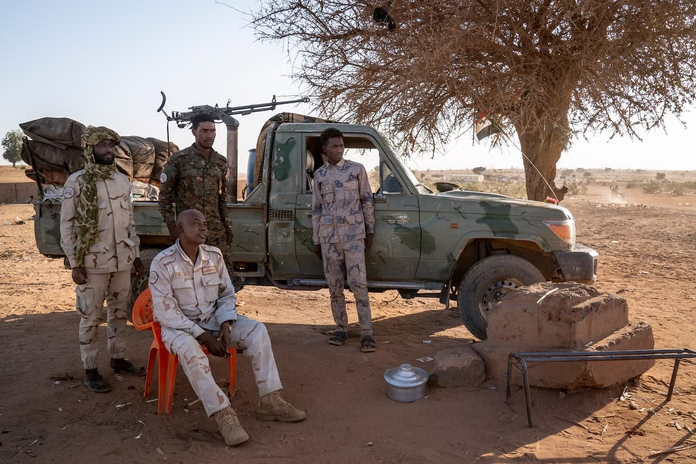

Turkish drones in Sudan are no longer merely an additional development in the army’s arsenal. The strikes that Chad said targeted a military convoy inside its territory in August 2026, subsequently condemned by the United States, pushed the Sudanese Armed Forces’ aerial capabilities beyond the borders of the war and reopened the file on Turkey’s role a role that grew quietly from arms deals and technical support into declared defense cooperation between Ankara and Khartoum.
A Le Monde report added a new dimension, stating that Turkey is the army’s main military backer since the start of the war, that it has supplied it with TB2 and Akıncı drones and deployed trainers alongside it, while Saudi Arabia, according to the newspaper, finances the purchase of Turkish drones and Pakistani weapons for the benefit of the army.
Le Monde says that indicators of Saudi-Turkish-Pakistani cooperation in Sudan preceded the signing of the agreement by more than a year, and that Riyadh is financing the purchase of Turkish drones and Pakistani weapons for the Sudanese armed forces. It also reported on a massive Pakistani contract worth $1.5 billion covering fighter jets, armored vehicles, and drones.
Washington condemned the strikes inside Chad, alongside a broader move to impose restrictions on the flow of weapons into Sudan. At the Security Council, the United States proposed expanding the arms embargo imposed on Darfur since 2005 to cover the entire country, including drones, warning that external military and financial support is prolonging the war and threatens to draw neighboring countries into it.
Since late 2024, Bayraktar TB2 and Bayraktar Akıncı drones have entered the army’s aerial capabilities, according to specialized military sources. Africa Defense Forum reported that Turkey continued to support the army’s leadership through sales of both models, while Fair Observer documented the use of Turkish “Eren” loitering munitions launched from Akıncı platforms, linking their impact to breaking the siege of Dilling and Kadugli and reopening supply lines south of El Obeid.
Spanish defense monitoring outlets also reported confrontations between heavy drones in Sudanese airspace, including Turkish and Chinese systems, while the army also uses Iranian technologies, a shift that has turned Sudan’s skies into an arena of competition among multiple military systems.
The strikes in Chad came to reveal the sensitivity of this shift. On August 22, 2026, the Chadian army general staff said that aircraft and drones believed to belong to the Sudanese army or forces allied with it had bombed, on August 20 and 21, a convoy of around 200 vehicles inside eastern Ennedi, at a depth exceeding 100 kilometers from the border. The Sudanese army said the convoy was carrying reinforcements for the Rapid Support Forces.
There is so far no material evidence proving that a Bayraktar carried out the strikes a necessary distance between what is established and what is probable. But the incident prompted Washington to condemn the strikes inside Chadian territory, an indication that the drone war has begun to produce repercussions extending beyond Sudan’s borders.
Turkey’s role predates this incident. In March 2025, the Washington Post revealed, based on contracts, correspondence, records, and visual materials, dealings worth no less than $120 million between Baykar and the Sudanese side, covering drones and related equipment, as well as the presence of company staff providing technical support.
In May 2026, Chatham House discussed reports regarding Turkey supplying the army with drone systems, while Ankara denied providing them directly to the armed forces. The file then gained clearer political cover when the Turkish presidency announced, following a meeting between Recep Tayyip Erdoğan and Abdel Fattah al-Burhan in June 2026, that defense had become one of the areas of cooperation between the two countries.
But Ankara’s calculations do not stop at the war. Sudan grants it a position on the Red Sea and future opportunities in mining, infrastructure, agriculture, and reconstruction. This is why Suakin has remained present in the Turkish picture, though there is so far no evidence of a revival of a military base project.
In sum, the evidence does not establish that Turkey is a direct combatant party, but it has moved beyond the position of a trade and diplomatic partner. The Chad strikes do not prove that its drones carried out the operation, but they revealed the extent to which the capabilities Ankara helped build have become part of a war whose effects are no longer confined within Sudan.