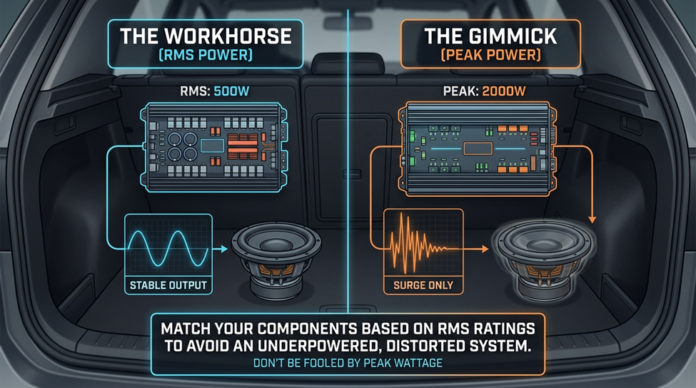

Shopping for a car amplifier should be simple. Nevertheless, the wattage numbers make it a mess.
One amp claims 1000 watts, and another claims 3000. Those big numbers rarely mean what you think they mean. This guide explains RMS and peak power so you avoid buying an underpowered amp.
Why Wattage Numbers Lie
Walk down any car audio aisle, and the power claims look wild. A tiny amplifier promises 2000 watts for the price of lunch. Common sense says that it cannot be right, and common sense is correct.
Manufacturers know that shoppers compare the biggest number first. So, they print the biggest number they can legally justify. That number is usually peak power, and it tells you very little. A properly rated car amplifier shows its real output up front.
RMS vs Peak vs Max Power: What Each Actually Means
Three power figures show up on most boxes. Only one of them helps you buy well.
| Rating | What it means | Trust it? |
| RMS | Continuous power the amp makes all day | Yes |
| Peak | A one-second burst it can survive | No |
| Max | A marketing number with no fixed rule | No |
RMS is the honest figure, and the RMS vs peak power car amplifier question really ends here. RMS tells you what the amp delivers hour after hour.
Peak power describes a brief spike that the amp reaches. Max power is still a loser and often means nothing at all. Smart buyers read RMS and ignore the rest.
The CTA-2006 Testing Standard
There is a way to know a rating is real. The CTA-2006 standard forces honest, comparable power numbers. It measures RMS output at set voltage and distortion limits. Any amp wearing the CTA-2006 badge can be trusted and compared fairly.
How to Spot an Inflated Wattage Claim
You do not need lab gear to catch a fake number. A couple of quick checks expose the most exaggerated amps fast.
- Check the fuse rating. An amp’s fuses limit its real power draw. A 30-amp fuse cannot support a true 2000-watt output.
- Check the power terminals. Real power needs thick wire, so tiny terminals signal small output.
Here is the quick math on fuses. Multiply the total fuse amperage by roughly 12 to 13 volts. Then halve that figure for real-world RMS output at typical efficiency. A 40-amp fuse points to around 250 to 300 watts RMS, not thousands.
Pairing your amp with the right subwoofer for car audio depends on trusting these numbers. A fake rating leads straight to a weak, disappointing system.
How to Match an Amplifier to Your Speakers or Subwoofer
Matching power is the whole point of this exercise. Learning how to match amplifier to subwoofer ratings saves your gear and your money.
Matching RMS Ratings
Match the amplifier’s RMS output to your subwoofer’s RMS rating. A sub rated at 1000 watts RMS wants an amp near 1000 watts RMS. Aim for a close match rather than a wild mismatch in either direction.
Understanding Impedance and Amp Output
Impedance is measured in ohms and it changes your amp’s output. Most amplifiers make more power at lower ohm loads. A monoblock amplifier built for bass often doubles its output from 2 ohms down to 1 ohm. Always check that your amp stays stable at your subwoofer’s impedance.
Class D vs Class AB Amplifiers: Which Do You Need?
The class D vs class AB amplifier choice sounds technical but it is simple in practice.
| Type | Strength | Best for |
| Class D | Efficient, cool, compact | Subwoofers and bass |
| Class AB | Smooth, clean mids and highs | Speakers and full range |
A Class D monoblock amplifier is the standard choice for powering subwoofers. It runs cool and efficient while pushing serious bass. Most 4 channel car amplifier units for your door speakers use Class AB or a hybrid design. Pick Class D for bass and Class AB for clean bass speakers for car doors and highs.
How to Set Amplifier Gain Correctly
The gain knob is not a volume control, though many people treat it that way. Learning how to set amplifier gain protects your speakers from damage. Set it too high and you get distortion that cooks voice coils.
Start with the gain all the way down. Turn your head unit to about 75 percent volume. Then raise the gain slowly until you hear distortion, and back off slightly. A free gain calculator makes this even more precise.
Common Amplifier Buying and Installation Mistakes
A few simple errors trip up most first-time buyers. Avoiding them keeps your car stereo amplifier running clean for years.
- Buying on peak watts leads to weak, underpowered sound.
- Skipping the wiring starves a good amp of the current it needs.
- Ignoring the ground causes noise, whine, and random shutdowns.
- Setting gain by ear alone invites distortion and blown speakers.
Expert Tips for a Reliable Install
A great amp still needs a clean install to perform. A proper car amplifier wiring kit carries steady current from your battery. Match the wire gauge to your amp’s power, since thin wire chokes output. Keep your ground wire short and bolted to bare metal for quiet, stable power.
If you do not want to install it yourself, find an installer for a perfect fit.
Frequently Asked Questions
What does RMS power mean on a car amplifier?
RMS is the continuous power your amp produces during normal use. It is the honest, steady figure your speakers actually feel. Always shop by this number.
Is RMS power more important than peak watts when buying an amplifier?
Yes, RMS matters far more than peak watts. Peak is a brief burst that lasts a second. RMS reflects real, everyday performance.
How do I match an amplifier to my subwoofer’s RMS rating?
Match the amp’s RMS output closely to the sub’s RMS rating. A 1000-watt RMS sub wants a roughly 1000-watt RMS amp. Check impedance so the amp stays stable.
What happens if my amplifier is too powerful or too weak for my speakers?
A weak amp clips and sends distortion that damages speakers. An overly strong amp can push speakers past their limit. A close RMS match keeps everything safe.
How can I spot misleading peak wattage claims on car amplifiers?
Check the fuse rating and the power terminal size. Small fuses and thin terminals cannot support huge power. Look for the CTA-2006 badge for honest numbers.
What’s the difference between Class D and Class AB amplifiers?
Class D runs efficiently, which suits subwoofers and bass. Class AB sounds smooth, which suits speakers and full-range audio. Many builds use both.