
If you’ve spent any time searching for an Annapurna trek, you’ve probably run into the same problem I did years ago: the Annapurna Base Camp and Annapurna Circuit routes get lumped together as if they’re basically the same walk with a different name. They’re not. Both sit inside Nepal’s Annapurna region, both deliver serious mountain views, and both will leave you sore in places you didn’t know could get sore. But the route design, the altitude you’ll deal with, the landscape you pass through, and even the pace of the trek are genuinely different experiences.
The short version, if you need it right now: the Annapurna Base Camp Trek is a more focused push into the Annapurna Sanctuary, while the Annapurna Circuit Trek loops much further around the entire Annapurna massif. One is a destination trek. The other is a journey.
That distinction matters more than most trip-planning pages let on, so let’s actually get into what separates them — and which one fits the kind of trekking you’re after.
Annapurna Base Camp Trek vs Annapurna Circuit Trek at a Glance
Before going deep into the trail experience, here’s a quick side-by-side so you’re not scrolling back up later.
| Feature | Annapurna Base Camp Trek | Annapurna Circuit Trek |
| Main experience | Reaching Annapurna Base Camp | Circling the Annapurna massif |
| Landscape | Forests, villages, mountain sanctuary | Hills, valleys, high alpine terrain, drier upper regions |
| High point | Annapurna Base Camp, roughly 4,130 m | Thorong La, roughly 5,416 m |
| Route character | Compact, out-and-back style | Longer, more geographically varied |
| Altitude challenge | Moderate to high | Higher, particularly around the pass |
| Cultural experience | Gurung and Magar communities, among others | A broader cross-section of Himalayan communities |
| Trek style | Focused mountain destination | Long-distance Himalayan journey |
Neither route is objectively “better.” One isn’t a watered-down version of the other. They’re built for different kinds of trips, and the table above is just the starting point for understanding why.
Annapurna Base Camp Trek: What the Journey Actually Feels Like
From Lower Valleys to the Annapurna Sanctuary
Most people start this trek from the Pokhara area, and the first day or two doesn’t feel particularly dramatic — you’re walking through terraced hillsides, past rice paddies, through villages where daily life carries on around you regardless of who’s passing through with a trekking pole. Then, somewhere around the second or third day, the forest thickens. Rhododendron trees crowd the trail in spring, rivers cut below suspension bridges, and the terrain starts climbing in a way that actually asks something of your legs.
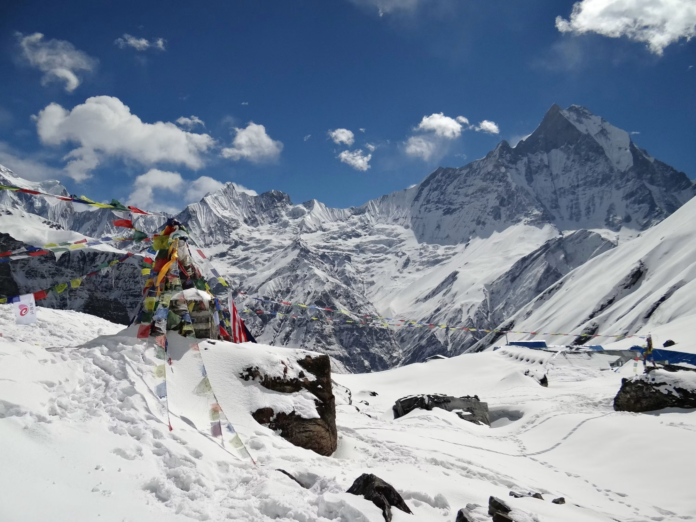
What makes the Annapurna Base Camp Trek distinctive isn’t just the destination — it’s how the mountains slowly close in around you as you approach it. You’re not walking toward a distant peak on the horizon for days on end. You’re walking into a sanctuary, quite literally, where Annapurna South, Machapuchare, and the surrounding ridgelines start wrapping around the trail until you’re standing in what feels like a natural amphitheater of ice and rock.
That’s really the appeal of the Annapurna Base Camp Trek: it delivers an intense, close-up Himalayan experience without demanding three weeks of your life. It suits trekkers who want the payoff — genuine high-mountain scenery, a real sense of arrival — without committing to a long-distance circuit.
One thing worth saying plainly: compact doesn’t mean easy. The itinerary still needs proper pacing. People sometimes assume that because the trek is shorter, altitude isn’t much of a factor. It still is, and rushing the ascent is one of the more common mistakes trekkers make on this route.
Annapurna Circuit Trek: A Longer Journey Through Changing Landscapes
From Green Hills to the High Himalaya
The Circuit is a different animal. Traditionally, it followed the idea of walking around the entire Annapurna massif rather than toward one point of it, and that concept still shapes how the trek feels today. The lower sections wind through cultivated hillsides and river valleys that could almost pass for parts of the ABC route — but the similarities fade fast.
As you gain elevation, the environment shifts in a way that’s hard to fully explain until you’ve walked through it yourself. Green slopes give way to sparser vegetation, and by the time you’re approaching the higher settlements, you’re in landscapes that feel almost more like Tibet than the lush lower Annapurna region — drier, more exposed, wind-scoured in places.
Then there’s Thorong La, sitting at around 5,416 meters. Crossing it is the defining moment of the Annapurna Circuit Trek, and it’s not a formality — it’s a genuinely serious high-altitude pass that requires proper acclimatization, decent weather, and a body that’s coping well with thin air. This is where altitude management stops being a background consideration and becomes the thing you’re actively planning your whole itinerary around.
It’s also worth knowing that road construction has changed parts of the traditional Circuit over the past decade or so. Some sections that used to be pure trail are now shared with, or replaced by, vehicle roads. That doesn’t ruin the trek, but it does mean the route you walk can vary quite a bit depending on how the itinerary is designed — which is something to actually check rather than assume.
Annapurna Trek Difficulty: Which Route Demands More?
Altitude, Distance and Daily Walking
“Which one’s harder?” is probably the question I get asked most, and the honest answer is that it depends on what kind of difficulty you’re measuring.
On the Annapurna Base Camp side, you’re dealing with a shorter overall trek, but the trail itself involves a lot of up-and-down walking — steep stone staircases, repeated climbs and descents through the valley — that can wear on your knees even though the total distance is manageable. The high point sits around 4,130 meters, which is enough to trigger mild altitude symptoms in some people, even on a relatively brief itinerary.
The Circuit asks for more time on the trail overall, more cumulative elevation gain, and a considerably higher ceiling. Weather and snow conditions around Thorong La can also affect how the crossing actually goes on any given day, and individual acclimatization varies enough that two trekkers on the same itinerary can have very different experiences at altitude.
If I had to give a direct answer: for most trekkers, the Annapurna Circuit presents the greater altitude challenge, simply because it crosses Thorong La at roughly 5,416 meters, compared to Annapurna Base Camp’s roughly 4,130 meters. But that’s a factual difference in elevation, not a verdict on which trek is “harder” in every sense — the ABC route’s daily terrain can be plenty demanding in its own right.
Scenery and Culture: How the Two Routes Differ
Forests, Villages and Mountain Views on the ABC Route
The Annapurna Base Camp Trek gives you dense forest, close-knit mountain villages, and — once you’re deep into the sanctuary — some of the most immediate, in-your-face Himalayan views you’ll get anywhere in Nepal without technical climbing. There’s a real sense of entering somewhere enclosed, almost hidden.
A Wider Cultural and Geographic Cross-Section on the Circuit
The Circuit trades that intimacy for breadth. You’ll pass through a wider range of valleys, settlements, and architectural styles as you move around the massif, with visible Buddhist cultural influence becoming more pronounced in the higher regions. Along both routes you’ll encounter communities connected to Gurung, Magar, Thakali, and other Himalayan groups — though how much of each you experience really comes down to the specific route and itinerary.
How Long Do You Need for Each Annapurna Trek?
There’s no single fixed number here, and honestly, anyone who gives you one exact figure without asking about your starting point, transport, and rest days is oversimplifying.
The Annapurna Base Camp Trek is commonly planned somewhere in the range of 7 to 12-plus days, depending on how you get to and from the trailhead and how the itinerary is built. The Annapurna Circuit Trek tends to run longer — often 10 to 20-plus days — depending on where you begin and end, how much road access you use, and how many acclimatization days are built in.
The more useful comparison isn’t the advertised trip length anyway. It’s actual walking days. A “shorter” itinerary that crams the same elevation gain into fewer days isn’t automatically the easier option — sometimes it’s the opposite.
Accommodation, Food and Trail Logistics
Both routes run on Nepal’s teahouse system, and it works well — simple lodges along the trail offering a bed and hot meals, with quality and availability shifting depending on the season and how remote the village is. Dal bhat shows up on most menus and, for good reason, remains the trekking staple; it’s filling, and most places offer refills. Bringing some of your own snacks for the longer walking days isn’t a bad idea either.
Cash is worth planning ahead for — card payments are unreliable once you’re away from the bigger towns, so carry enough for the whole trek plus a buffer. And with road access having reshaped parts of the Circuit in particular, it’s worth actually reading through what an itinerary includes rather than assuming every “Circuit” package covers the same ground. Checking an operator’s exact route, transportation, accommodation standard, and guide support before booking — something outfits like Annapurna Trekking generally lay out clearly — saves a lot of confusion once you’re already on the trail.
Weather, Seasons and Trail Conditions
Spring and autumn are generally the preferred windows for both treks, offering more stable weather and clearer mountain views. Monsoon season brings heavier rainfall and less reliable trail conditions, particularly in the lower forested sections. Winter is workable but brings real cold and snow at higher elevations — and on the Circuit, snow around Thorong La can affect whether the pass is even crossable on a given day.
Mountain weather changes quickly, more quickly than most first-time trekkers expect. It’s worth building a bit of slack into your schedule rather than booking an international flight for the day after your trek is meant to end.
Which Annapurna Route Fits Your Trekking Style?
If you want a more compact Himalayan trek with direct access to a famous mountain sanctuary, close forest and mountain scenery, and less overall time committed to the trail, the Annapurna Base Camp style probably fits better.
If you’re after a longer journey, major shifts in landscape and elevation, a genuine high-pass crossing, and a broader experience of different valleys and communities along the way, the Annapurna Circuit is the one to look at.
There’s no universal right answer. The better route for you depends on how much time you have, your previous trekking experience, how your body tends to handle altitude, and what kind of walking experience you’re actually chasing.
Practical Planning Mistakes to Avoid
A few things trip up trekkers more often than they should. Picking an itinerary purely because it has the fewest days, without checking what that means for elevation gain, is one. Underestimating altitude on the “shorter” ABC route is another — people assume that because it’s not the Circuit, they can skip proper acclimatization. Assuming road access automatically makes a section easier is a third; roads change logistics, not always difficulty. And booking a return flight the day after your trek ends, with zero buffer for weather delays, is a mistake I’ve seen ruin more than one trip.
FAQs About Annapurna Base Camp and Annapurna Circuit
Is Annapurna Base Camp or Annapurna Circuit better for first-time trekkers? It depends more on your available time and comfort with altitude than on trekking experience alone. The ABC route suits those wanting a shorter, more contained introduction, while first-timers with more time and a cautious acclimatization plan can manage the Circuit just as well.
What is the difference between Annapurna Base Camp Trek and Annapurna Circuit Trek? The ABC trek is a focused push into the Annapurna Sanctuary toward one destination. The Circuit is a much broader route that loops around the entire Annapurna massif, covering more varied terrain and taking considerably longer.
Which is higher, Annapurna Base Camp or Thorong La? Thorong La, at roughly 5,416 meters, is significantly higher than Annapurna Base Camp, which sits at around 4,130 meters.
How many days do you need for an Annapurna trek? It varies by route and itinerary design — commonly around 7 to 12-plus days for Annapurna Base Camp and 10 to 20-plus days for the Circuit, depending on starting point, transport, and acclimatization schedule.
Is Annapurna Circuit Trek difficult because of altitude? Yes, largely because of the Thorong La crossing. Gradual acclimatization, sensible daily pacing, and paying attention to how your body responds are essential rather than optional on this route.
Can you combine Annapurna Base Camp and Annapurna Circuit Trek? Some itineraries combine elements of both, but doing so requires significantly more time and careful route planning — it’s not simply a matter of tacking one trek onto the end of the other.
Choosing the Right Annapurna Experience
At the core, it comes down to this: the Annapurna Base Camp Trek gives you a concentrated sanctuary experience and close, dramatic mountain scenery in a manageable window of time. The Annapurna Circuit Trek offers a longer, broader journey with greater elevation range and far more landscape variation along the way. Neither route is the “correct” choice — the right one depends on how much time you can give it, how your body handles altitude, how much trail experience you’re bringing, and what kind of walking experience actually appeals to you. Whichever direction you lean, the most useful thing you can do before booking any Annapurna trek is match the itinerary honestly to what you’re capable of, not just what looks good on a map.