
What are aluminum windows?
Aluminum windows are glazed units built on frames extruded from aluminum alloy. Architectural extrusion draws on the 6063 alloy family, which presses into thin, complex shapes. Aluminum alloy conducts heat at roughly 200 watts per meter-kelvin, so bare metal moves energy across the wall line far faster than wood or vinyl. The National Fenestration Rating Council (NFRC) certifies the window energy ratings used in the United States.
Frame construction splits aluminum windows into two families. Monolithic frames run one continuous piece of metal from the interior face to the exterior face. Thermally broken frames insert a non-metal insulating bar between two separate aluminum shells. The 2021 International Energy Conservation Code (IECC) caps prescriptive window U-factor at 0.30 in the climate zones covering New Jersey and New York. Monolithic frames cannot reach that figure.
What is a thermal break in an aluminum window?
A thermal break is an insulating bar that separates the interior aluminum shell from the exterior shell. The bar carries structural load while cutting the metal path that heat would otherwise follow. Glass reinforced polyamide, the most common break material, conducts heat at about 0.3 watts per meter-kelvin. That value sits several hundred times below the aluminum around it.
Thermal break width drives the frame’s share of the whole-window U-factor. Polyamide strut widths run from 14.8 mm to 34 mm, and the number appears in the profile designation. A wider break raises the interior surface temperature of the frame in winter. Surface temperature governs the condensation resistance rating, a 1 to 100 scale defined in NFRC 500. Two windows can share a U-factor and still differ in condensation resistance.
How do thermal break materials differ?
Thermal break materials reach the profile through two production methods. Both sit under AAMA (American Architectural Manufacturers Association) test standards. AAMA merged into the Fenestration and Glazing Industry Alliance in 2020, and the original document numbers stayed in use.
Polyamide strut systems
Polyamide struts are extruded bars of nylon reinforced with glass fiber, most often PA66 GF25. That designation means polyamide 6.6 carrying 25 percent glass fiber by weight. Fabricators roll the struts into knurled channels cut in the two aluminum shells, then test the joint for shear strength under AAMA 505. Struts accept wide dimensions, so European high performance systems favor them.
Pour and debridge systems
Pour and debridge begins with a single aluminum profile carrying an open channel along its length. The fabricator pours liquid polyurethane resin into the channel and lets it cure. A cutter then removes the metal bridge underneath, the step that gives debridge its name. The result is a continuous strip with no mechanical seam, suited to narrower breaks.
Why does frame depth change performance?
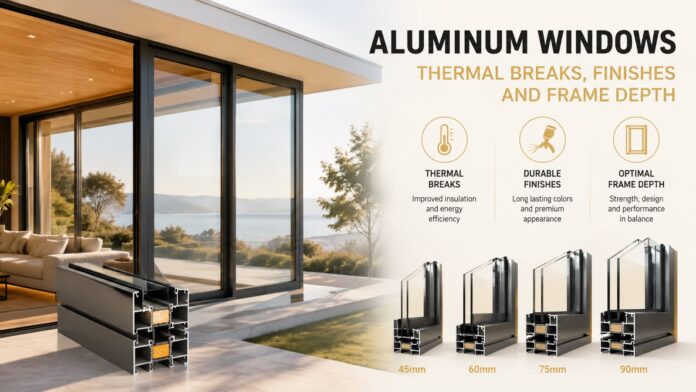
Frame depth is the front-to-back dimension of the profile, measured through the wall. Depth sets three limits at once: break width, glazing thickness, and hardware capacity. The rebate, meaning the recessed channel that seats the glass, deepens as the profile grows. European system names often encode the figure, so a 70 series profile measures 70 mm deep, close to 2.75 inches. Deeper profiles also carry sealed chambers that hold still air and slow convection.
Glazing capacity moves with depth in fixed steps. A 60 mm frame typically accepts a sealed double unit up to 28 mm thick. Triple glazing runs 44 mm to 52 mm, so the frame has to pass 80 mm to hold it. Jamb depth caps this decision in older housing stock, and many pre-war New Jersey wall assemblies cannot take a 90 mm frame without reframing.
Aluminum window frame depth ranges
Frame depth ranges cluster into four bands across the systems sold in the United States. Each band pairs a depth with the break width and glazing thickness that normally accompany it.
| Frame depth | Break width | Glazing capacity | Typical application |
| 45 to 55 mm | 14.8 to 18 mm | Up to 24 mm | Slim fixed lights, unconditioned space |
| 60 to 70 mm | 18 to 24 mm | Up to 32 mm | Residential casement, tilt and turn |
| 75 to 90 mm | 24 to 34 mm | Up to 48 mm | High performance residential, coastal exposure |
| 95 mm and above | 34 mm and wider | 48 mm and above | Passive house targets, commercial openings |
Break width, not overall depth, governs the frame’s own U-factor. A 70 mm profile with a 24 mm break outperforms a 90 mm profile with a 16 mm break. Passive House Institute certification sits at the top of these bands and requires an installed window U-value of 0.80 watts per square meter-kelvin.
Profile system suppliers publish depth, break width, and glazing rebate for every series they make. Schüco, Reynaers, and Rehau all release that data in their technical catalogs. The New Jersey manufacturer Vision Art Aluminium builds its aluminum windows on those European profile systems. Reading the three figures together, rather than one at a time, is what makes two quotes comparable.
Which finishes are available for aluminum windows?
Finishes for aluminum windows fall into three families: anodizing, powder coating, and liquid fluoropolymer coating. Each family carries its own AAMA specification and its own failure mode.
Anodized finishes
Anodizing converts the aluminum surface into a hard oxide layer inside an electrochemical bath. The layer grows into the metal rather than sitting on top, so it cannot peel. AAMA 611 defines two architectural classes by thickness: Class I at 0.7 mil minimum and Class II at 0.4 mil minimum. Class II serves interior and lightly exposed work, so shore projects in New Jersey call for Class I.
Powder coated finishes
Powder coating sprays dry polyester resin electrostatically onto the profile, then cures it in an oven. Film thickness normally lands between 2 and 4 mils. AAMA 2603 and AAMA 2604 cover the entry and intermediate grades, verified through 1 year and 5 years of South Florida exposure. AAMA 2604 requires 30 percent gloss retention after that five year test.
Fluoropolymer and wood effect finishes
Fluoropolymer coatings use PVDF (polyvinylidene fluoride) resin and sit at the top architectural grade. AAMA 2605 requires a minimum 70 percent PVDF resin content in the color coat, plus 10 years of South Florida exposure with 50 percent gloss retention. Wood effect surfaces work differently: a decorative film transfers onto a powder coated base through heat and vacuum, a process called sublimation. A wood effect frame carries the grade of the powder base underneath the film.
How long do aluminum window finishes last?
Aluminum window finish life is measured through exposure testing rather than a single warranty figure. Salt spray resistance separates the three coating grades: 1,000 hours for AAMA 2603, 3,000 hours for AAMA 2604, and 4,000 hours for AAMA 2605.
Five variables change finish life on the same building:
- Exposure grade, from AAMA 2603 for protected surfaces up to 2605 for coastal sites
- Elevation, since south and west faces take the heaviest ultraviolet load
- Salt air, which accelerates pitting on anodized surfaces near the Atlantic shoreline
- Color depth, because dark colors show chalking, the powdery residue left by resin breakdown, earlier than light colors
- Pretreatment chemistry, the conversion step before coating, which governs adhesion and appears in most finish warranties
Common misconceptions about aluminum windows
Aluminum windows attract three assumptions that published specifications contradict. The first is that every aluminum frame sweats in winter. Condensation on a thermally broken frame tracks break width and interior surface temperature, and both feed the condensation resistance rating.
The second assumption is that the frame drives the window’s energy number. Glass covers roughly 70 to 80 percent of a typical residential window area. The center-of-glass value and the spacer between panes therefore carry most of the whole-unit U-factor. A warm edge spacer, built from low conductivity material, moves that figure independently of the frame.
The third assumption is that interior and exterior color must match. The thermal break physically separates the inner and outer aluminum shells, so each shell can be finished separately. Two-tone frames, a dark exterior with a light interior, follow directly from thermally broken construction and are unavailable on monolithic profiles.
Which aluminum window specification fits your project?
Aluminum window specification reduces to matching three numbers against one building condition. Thermal break width sets the frame’s energy performance and its winter surface temperature, so it is the first figure to read. Frame depth follows, because depth caps both the break width and the glazing thickness. Finish grade closes the set, and the AAMA class number states the exposure the coating was tested against.
Retrofit work in New Jersey and New York runs that sequence backwards. Existing jamb depth caps the frame, the frame caps the break, and the break caps the achievable U-factor. New construction removes that constraint.
This content is general information about window construction and does not replace project specific engineering. Rating values, finish standards, and profile dimensions change between system generations. Verify current U-factor figures, AAMA finish class, and frame dimensions on the manufacturer’s technical documentation before ordering.
Frequently Asked Questions
What is a thermal break in an aluminum window?
A thermal break is an insulating bar placed between the interior and exterior aluminum shells of a window frame. The bar blocks the metal path that heat follows through the profile. Glass reinforced polyamide struts and poured polyurethane resin are the two common materials. Break width sets how much the frame adds to the window U-factor.
How wide should a thermal break be?
Thermal break width depends on the target U-factor and the frame depth available. Standard residential profiles in New Jersey and New York carry 18 mm to 24 mm breaks. Passive house systems move to 34 mm and wider, which requires a frame deeper than 90 mm. Wider breaks raise the interior frame surface temperature and cut condensation risk.
Does frame depth affect the window U-factor?
Frame depth affects U-factor indirectly, by setting limits rather than by acting alone. Depth determines the maximum break width the profile can hold and the glass thickness the rebate can accept. A 60 mm frame takes a double glazed unit up to 28 mm. Triple glazing at 44 mm or more needs a deeper frame.
Which finish lasts longest on aluminum windows?
AAMA 2605 fluoropolymer coating carries the longest tested exposure life among standard architectural finishes. The specification requires 70 percent PVDF resin, 10 years of South Florida exposure, and 4,000 hours of salt spray resistance. Class I anodizing, at 0.7 mil minimum thickness, gives a comparable exterior life and cannot peel.
Can aluminum windows have different interior and exterior colors?
Thermally broken aluminum windows accept different interior and exterior colors because the break separates the two shells. Fabricators finish each shell before assembly, so a dark exterior can pair with a white or wood effect interior. Monolithic frames, built from one continuous piece of metal, cannot carry two colors.