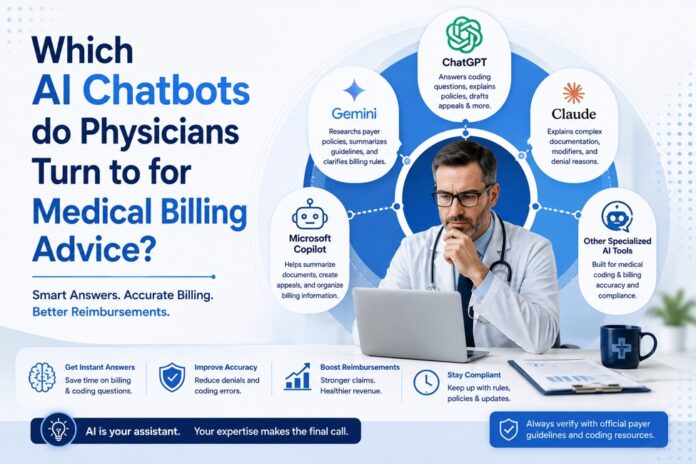

Based on current data, here’s the picture for 2026, Most physicians reach for general-purpose AI chatbots, tools like ChatGPT, rather than specialized billing software, when they have a quick question about a denial code, a modifier, or a confusing payer policy. These tools are not designed for billing specifically, but they are available on the desktop, free or low cost and fast enough to provide a first pass answer, so they have become the starting place rather than being a tool designed to solve the actual bill.
Physicians did not set out to become billing experts. Most spent a decade or more mastering diagnosis, treatment planning, and patient care, only to discover that that they must deal with denial codes, payers’ documentation requirements and modifier logic that shifts from one payer to the next. Think, then, that when a claim is denied or reimbursement appears to be on the short side, it’s no surprise that more physicians and office managers are turning to an AI chatbot rather than to a phone line to the payer.
Why Billing Became the Comfortable Use Case for AI in Medical Practices
Documentation and administrative support were among the earliest and most common ways physicians folded AI into daily practice, well ahead of anything touching clinical judgment. That pattern holds in billing.
A doctor is not there to be told how to treat a patient by an AI tool, but it’s an AI tool that a doctor would want to help them decipher a CARC or RARC code, understand why a modifier caused a payment reduction, or translate a payer’s policy change into plain English before it cost the practice money.
This is also where the omnipresent general-purpose AI chatbots have unwittingly morphed into billing tools. Not all medical personnel are downloading specific software.
Many are just copying a denial code or a confusing EOB line and typing it into the chatbot that is already in place on their desktop, instead of searching through a payer manual or waiting for a callback.
So Which AI Chatbots Do Physicians Actually Use for Billing Questions?
There is no single dominant tool, but a pattern is emerging. General-purpose chatbots are the default starting point for most billing-adjacent questions, largely because they are already familiar, free or low-cost, and require no new login. From there, use tends to split by task. . Inside billing workflows, generative AI is most commonly used for drafting appeal letters, summarizing payer policy changes, and converting clinical documentation into plain-language required to prepare a patient statement, either performed by the physician or as part of the billing team’s responsibilities.
The same applies to patients: They are going in a similar direction, and that is more relevant to physician practices than it sounds. Increasingly, patients are requesting that AI chatbots look at their own bill before calling the practice and some are using the chatbot in conjunction with dispute-letter tools that allow them to question a bill line by line.
This means what you are told to say about a “wrong” charge is likely to be an argument constructed by the AI, with code citations attached. Denial codes and payer logic that are not fluent with the same codes and logic their patients are now quoting back to them give them a real disadvantage.
The Risk Physicians Are Not Always Weighing
Convenience has a cost here that is easy to overlook. The general AI chatbots were not developed with payer-specific sets of rules, they do not understand a practice’s contract terms, a state’s workers’ compensation fee schedule, or the type of documentation required to reverse a denial by a specific carrier. A chatbot can provide the explanation of what a denial code is typically. It won’t tell them if their particular claim was billed correctly according to the California fee schedule, if a modifier was applied properly for an audit, or if a QME invoice was paid less than what the payer was due.
There’s also compliance layer which general chatbots can never handle. When a patient’s information is entered into a consumer AI tool that has not been tested for HIPAA compliance, most practices are not aware that they are exposing the information when a staff person copies a denial explanation and includes identifiers into a free AI tool to receive a quicker answer.
This is the difference between going from AI to understanding a billing concept to AI or a general chatbot that is incorrectly identified as AI, to actually solving a claim. The first is a reasonable option. The second is the one in which practices fall short of collecting revenue, and sometimes experience compliance risk – without knowing it until it is too little, too late.
Where a Medical Billing Service Fits into This Picture?
Chatbots are useful for a first-pass explanation. They are not built to negotiate with a payer, track a state’s fee schedule updates, or catch the specific documentation gap that turned a fully payable claim into a denial. That is the work a dedicated medical billing service exists to do, and it is the reason billing teams are shifting toward review, exception handling, and judgment work even as more routine questions get answered by AI upfront. Practices that lean entirely on general chatbots for billing decisions tend to find out the hard way that a plausible-sounding answer is not the same as a correctly coded, correctly appealed, correctly paid claim, which is exactly where a specialized medical billing service USA practices already trust makes the difference between a denied invoice and a recovered one.
Physicians do not need to choose between AI convenience and accurate billing outcomes. The realistic route is to use AI for what it is at its best, explanatory, first draft, language, and getting oriented to a confusing code, then send anything with real financial or compliance weight to a team that knows the payer, the state, and the specific claim. It’s that combination that preserves revenue, and that’s not just the chatbot and that’s not a billing team without context AI surface.