
The Role of Thermal Processing Equipment in Closed-Loop Battery Recycling
The relentless surge in demand for batteries, powering everything from electric vehicles to grid-scale energy storage, underscores a pressing global challenge: securing a sustainable supply of critical materials. Currently, the majority of end-of-life batteries are still treated as waste, a significant missed opportunity given that battery metals do not degrade when recycled and can be reused indefinitely. This reality highlights the urgent need for robust recycling solutions.
This guide delves into closed-loop battery recycling, a transformative approach where used batteries are processed to create new versions of the same product. We’ll explore how this differs from open-loop methods, why it’s crucial for future sustainability, and the pivotal role of advanced technologies, including high-efficiency thermal processing equipment, in making this circular economy a reality.
Join us as we uncover the innovations driving the advancement of closed-loop battery recycling. We will examine the key materials recovered, the challenges in scaling these processes, and the environmental and economic benefits that make this a cornerstone of sustainable battery production.
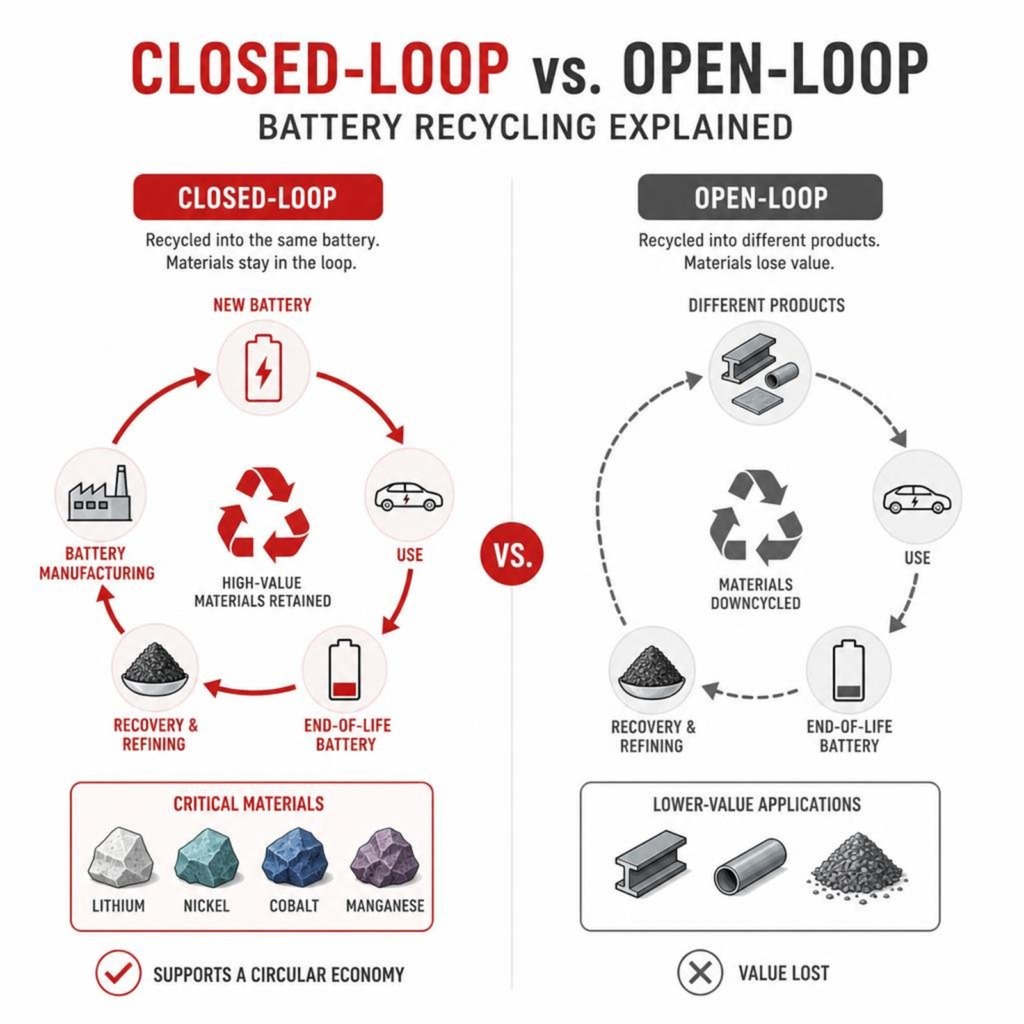
At its core, closed-loop battery recycling represents a paradigm shift from linear “take-make-dispose” models to a circular economy. In a closed-loop system, materials are recovered, refined, and directly reused in the production of the same product. For batteries, this means taking end-of-life cells and processing them to extract critical materials that can then be fed back into the manufacturing of new batteries. This stands in stark contrast to open-loop recycling, where waste is recycled into a different product or material, often of lower value, or even simply downcycled. The distinction is crucial: closed-loop recycling ensures that valuable virgin natural resources are not depleted, as the recycled materials retain the quality and specifications needed for new battery production.
The journey of an end-of-life battery back into a new one often involves several complex steps, with thermal processing playing a foundational role. Historically, pyrometallurgy, a high-temperature smelting process, has been a common method for battery recycling. While effective at extracting valuable metals, it is energy-intensive and can lead to the loss of certain materials, such as lithium, which may be converted into slag.
However, as the industry matures and demands for higher efficiency and material recovery grow, more sophisticated approaches are gaining traction. Hydrometallurgy, a chemical-based process, dissolves metals for recovery, generally offering higher efficiency and less waste than pyrometallurgy. An even more advanced concept, direct recycling, aims to preserve the structural integrity of the cathode material, significantly reducing energy consumption and processing steps.
To understand the evolving landscape, let’s compare these primary recycling routes:
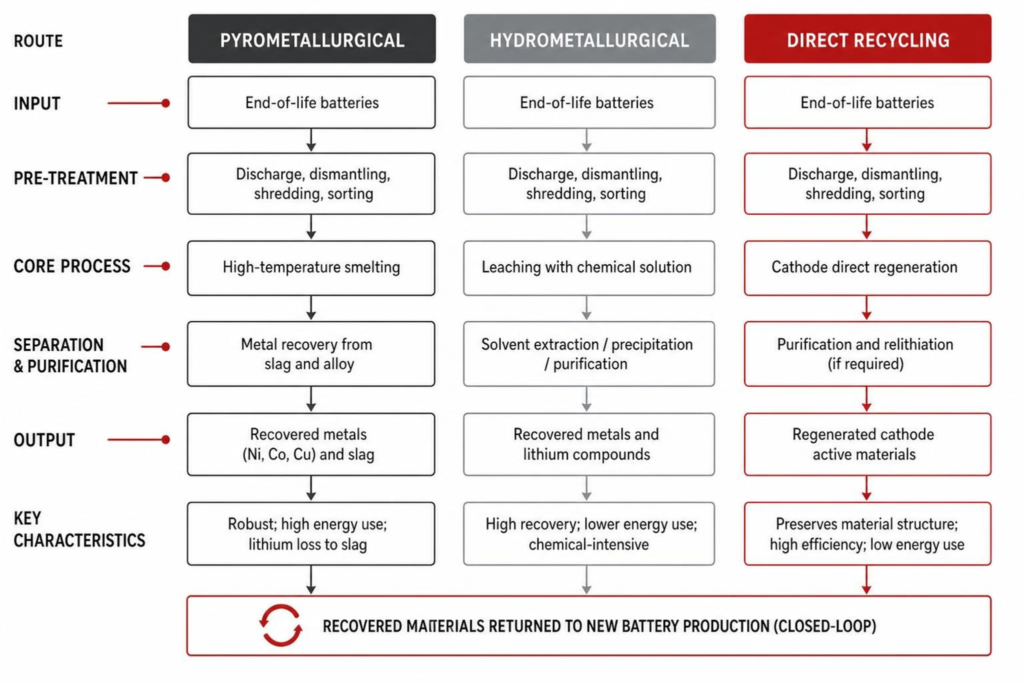
Each method has its advantages and challenges, but the trend is clearly towards processes that maximize material recovery, purity, and energy efficiency, often leveraging precise thermal treatment at various stages.
Material Recovery and Cathode Active Materials
The true value of closed-loop battery recycling lies in the recovery of critical materials. Lithium-ion batteries, which dominate the market for electric vehicles and portable electronics, contain a wealth of valuable elements. Key among these are lithium, cobalt, nickel, and manganese, along with copper, aluminum, and graphite. These metals are indispensable for battery functionality and represent a significant portion of a battery’s cost.
Currently, a staggering majority of end-of-life lithium-ion batteries—around 95% globally as of 2022—are still treated as waste, rather than being recognized as a valuable source of these materials. Yet, the metals themselves do not degrade when recycled, meaning they can be reused indefinitely. For instance, lithium battery processors are increasingly reclaiming cobalt from used batteries, which is then sold back into the battery market to manufacture new lithium-ion batteries.
In a closed-loop system, the goal is not just to recover these elements but to transform them back into high-purity forms suitable for battery manufacturing, particularly for cathode active materials (CAM) and precursor cathode active materials (pCAM). Cathode active materials are often the most expensive component of a battery cell. By recovering and reusing these materials, manufacturers can reduce reliance on virgin mining, mitigate supply chain risks, and potentially lower the overall cost of battery production. Companies like Green Li-ion, for example, have developed modular systems that convert unsorted “black mass” (a mixture of shredded battery materials) into 99% pure pCAM, which can be directly used in cathode manufacturing. This directly feeds recovered materials back into the production line, embodying the essence of closed-loop recycling.
Optimizing Thermal Processing Equipment for Black Mass Treatment
The initial stages of battery recycling often involve mechanical shredding, which produces what is known as “black mass.” This black mass is a powdery mixture containing the active cathode and anode materials, along with other conductive additives and binders. Before these valuable metals can be separated and refined, organic components such as binders and electrolytes must be removed. This is where optimized thermal processing equipment becomes indispensable.
Thermal decomposition, often achieved through pyrolysis, is a critical step in treating black mass. Pyrolysis involves heating the material in an oxygen-deprived environment to break down and volatilize organic substances without combusting the valuable metals. This process helps to liberate the metallic compounds, making them more accessible for subsequent hydrometallurgical or direct recycling steps.
Rotary calciners are a prime example of high-efficiency thermal processing equipment used in this context. These industrial furnaces are designed to process granular materials at elevated temperatures, often with precise atmosphere control. By carefully managing temperature profiles, residence times, and the gas atmosphere (e.g., inert nitrogen or reducing hydrogen), operators can efficiently remove organic binders and other volatile impurities from the black mass. This meticulous thermal treatment is crucial for enhancing the purity of the recovered materials, ensuring they meet the stringent specifications required for new battery production. The ability to control these parameters precisely is a key technical innovation driving the advancement of closed-loop battery recycling.
Technical Innovations Driving Advancement
The drive towards a truly circular battery economy is fueled by continuous technical innovation. Beyond the fundamental processes, advancements in equipment design and new material science are pushing the boundaries of what’s possible in battery recycling.
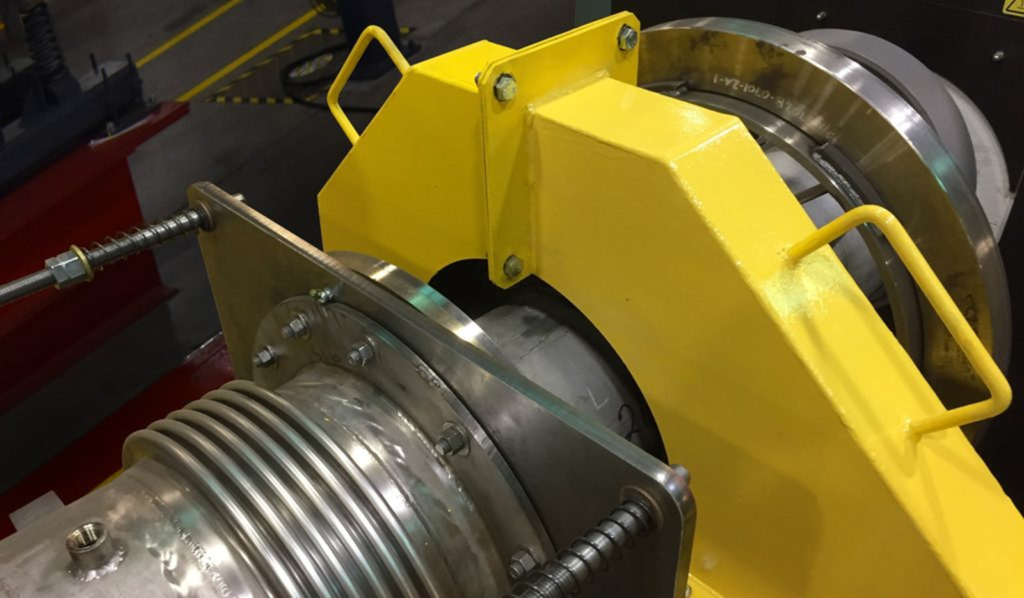
One significant area of innovation lies in the design of thermal processing equipment itself. Modern systems employ sophisticated techniques such as indirect heating, where the heat source does not directly contact the material, allowing for more uniform temperature distribution and preventing contamination. Direct firing, while common, is being refined with advanced burner technologies to improve energy efficiency and reduce emissions. Controlling residence time and developing precise temperature profiles are paramount to ensure complete removal of impurities without damaging the valuable inorganic materials.
Emerging battery technologies are also being designed with recycling in mind. For instance, the development of supramolecular electrolytes is enabling easier manufacturing and closed-loop recycling in next-generation solid-state batteries (SSBs). These innovative electrolytes can be designed to facilitate easier disassembly and material separation at the end of the battery’s life, simplifying what has historically been a complex and energy-intensive process.
Precision Temperature Control and Atmosphere Management
Achieving high-purity material recovery from battery black mass hinges on the ability to apply precise temperature control and atmosphere management during thermal processing. Uniform heat transfer throughout the material ensures consistent decomposition of organic compounds, preventing localized overheating that could degrade valuable metal oxides or incomplete removal of impurities.
Advanced thermal processing equipment can operate under various atmospheric conditions:
- Inert atmospheres (e.g., nitrogen or argon): These are crucial for pyrolysis, preventing oxidation of sensitive materials and ensuring that organics are volatilized rather than combusted.
- Reducing atmospheres (e.g., hydrogen or carbon monoxide): These can be used to reduce metal oxides to their metallic form, which can be beneficial for subsequent separation or direct reuse.
- Oxidizing atmospheres (e.g., air or oxygen): While generally avoided for black mass pyrolysis, controlled oxidation might be used in specific pre-treatment or post-treatment steps for certain battery chemistries or impurities.
The ability to maintain thermal stability and precisely control these atmospheres is not only vital for material purity but also for process efficiency and safety. By tailoring the thermal environment, recyclers can optimize the removal of organic binders, plastics, and electrolytes, leaving behind a cleaner, more concentrated stream of inorganic battery materials ready for further processing. This level of control minimizes energy waste and maximizes the yield of high-quality, battery-grade materials.
Direct Recycling and Energy Preservation
While pyrometallurgy and hydrometallurgy are effective, the ultimate goal for many in the closed-loop battery recycling space is direct recycling. This cutting-edge method aims to preserve the crystalline structure of the cathode material, avoiding the energy-intensive re-synthesis required in other processes. Instead of breaking down the material into its constituent elements, direct recycling focuses on rejuvenating or re-lithiumating the cathode, making it ready for immediate reuse in new battery cells.
The energy preservation benefits of direct recycling are substantial. Exentropy analysis, a novel circularity parameter that combines both material recovery and energy preservation, suggests that direct recycling offers the optimum alternative in terms of energy utilization for material recovery. This academic research highlights that when material recovery and energy preservation are analyzed independently, different “optimal” routes might be identified, underscoring the need for a combined approach like exentropy to truly assess circularity.
Consider the statistics: recycling lithium uses 90% less energy than mining it. Furthermore, recycled metals can reduce the CO2 impact of batteries by about 25% compared to using primary metals from mines. Direct recycling amplifies these benefits by minimizing the energy footprint associated with re-processing materials. By preserving the valuable structure of the cathode, it drastically reduces the energy required for chemical synthesis, making it a highly attractive pathway for future closed-loop systems.
Overcoming Scaling Challenges in Closed-Loop Systems
Despite the clear benefits and technological advancements, scaling closed-loop battery recycling to meet the rapidly growing demand for batteries presents significant challenges. The sheer volume of end-of-life batteries projected for the coming years—an estimated 8 million tons of lithium-ion battery waste annually if not properly managed—requires robust and scalable solutions. As of July 2026, the majority of lithium-ion batteries still end up as waste, with only about 5% being recycled globally.
Key scaling challenges include:
- Logistics and Collection Systems: End-of-life batteries, particularly large EV packs, are classified as dangerous goods due to their energy content and hazardous materials. Their collection, packaging, and safe transportation are technically challenging and often underrated aspects of the recycling process. Establishing efficient, widespread collection networks is crucial but complex.
- Material Purity Requirements: The battery industry demands extremely high purity for cathode and anode materials. Achieving metal purity high enough for the battery supply chain consistently, across diverse battery chemistries and degradation states, is a significant technical hurdle.
- Process Stability and Flexibility: Recycling facilities must be able to handle a wide variety of battery chemistries (NMC, LFP, NCA, etc.) and formats, which can vary significantly even within the same product category. Ensuring process stability and high recovery rates across this diversity requires flexible and adaptable equipment.
- Economic Viability: While the long-term benefits are clear, the upfront capital investment for advanced recycling facilities can be substantial. Ensuring the economic viability of these operations, especially in competition with virgin material markets, is critical for widespread adoption.
- Regulatory Harmonization: A patchwork of regulations across different regions can complicate international logistics and the establishment of global closed-loop systems.
These challenges highlight the need for systemic solutions, including robust infrastructure, technological innovation, and strong regulatory support.
Regulatory Frameworks and Industry Partnerships
Government regulations and industry partnerships are pivotal in accelerating the transition to closed-loop battery recycling. Recognizing the environmental and economic imperatives, legislative bodies worldwide are enacting policies to promote battery circularity.
The European Union, for instance, has been a frontrunner, proposing stricter recycling mandates that will require new batteries to contain a minimum percentage of recycled materials starting in August 2030. The draft EU Battery Regulation sets ambitious recovery rates, proposing 90-95% for cobalt, nickel, and copper, and 35-70% for lithium by 2026/2030. Other regions are following suit: China has introduced a battery recycling tracking system, the U.S. Department of Energy is funding research into efficient technologies, and Canada is implementing a national EV battery recycling framework with an emphasis on Extended Producer Responsibility (EPR). EPR schemes hold manufacturers accountable for the entire lifecycle of their products, incentivizing design for recyclability and investment in recycling infrastructure.
Beyond regulation, collaborative industry partnerships are proving essential. Companies like BASF, Nanotech Energy, and American Battery Technology Company (ABTC) are partnering to establish comprehensive closed-loop battery recycling systems in North America, integrating dismantling, material extraction, and cathode active material (CAM) production. Automakers are increasingly partnering with recyclers to reclaim battery materials, ensuring a steady supply for new vehicle production. The concept of “product passports,” digital records tracking a battery’s composition and lifecycle, is also gaining traction, promising to enhance transparency and facilitate more efficient recycling. These partnerships and regulatory pushes are creating the necessary ecosystem for closed-loop recycling to thrive.
Future Outlook for Thermal Processing Equipment in Circular Economies
The future of closed-loop battery recycling is intrinsically linked to advancements in battery technology and the infrastructure supporting it. As we look towards 2026 and beyond, several trends will shape the demand and design of thermal processing equipment.
The emergence of new battery chemistries, such as solid-state batteries and sodium-ion batteries, will require adaptable recycling solutions. Solid-state batteries, for example, are expected to enter the market in the next 10-15 years and may offer simplified recycling pathways due to the absence of liquid electrolytes. Thermal processing equipment will need to evolve to efficiently handle these new material compositions and structures.
Furthermore, the concept of localized recycling centers is gaining momentum. By establishing recycling facilities closer to battery manufacturing plants and end-of-life battery sources, transportation costs and emissions can be significantly reduced. Companies like Green Li-ion, with their modular systems, are already enabling on-site conversion of black mass into pCAM, creating a more decentralized and efficient closed-loop. This localization enhances supply chain stability, mitigates the risk of disruptions, and offers greater cost-effectiveness by reducing reliance on distant processing facilities.
The integration of advanced thermal processing equipment, capable of precise control and high recovery rates, will be a cornerstone of these future circular economies. These systems will not only recover valuable materials but also contribute to a lower carbon footprint for battery production, as recycled metals have a lower CO2 impact than mined ones. The continued innovation in thermal processing will be key to unlocking the full potential of closed-loop battery recycling, ensuring a sustainable and secure future for battery technology.
Frequently Asked Questions About Thermal Processing in Battery Recycling
Here, we address some common questions regarding the role of thermal processing in achieving a closed-loop battery economy.
What is the difference between closed-loop and open-loop battery recycling?
The fundamental difference lies in the destination of the recovered materials. Closed-loop recycling involves processing used batteries to recover materials that are then refined and reused to manufacture new batteries. The materials stay within the same product cycle, minimizing the need for virgin resources. For example, reclaiming cobalt from an old battery to make a new one.
In contrast, open-loop recycling processes battery waste into a different product or material, often for a different industry. While still beneficial for waste reduction, it doesn’t directly feed back into battery production and may involve a loss of material quality or value (downcycling). An example might be using recovered metals from batteries in construction materials or low-grade alloys. Closed-loop recycling is generally preferred for its higher resource efficiency and sustainability impact.
How does thermal processing improve the purity of recovered battery metals?
Thermal processing plays a critical role in enhancing the purity of recovered battery metals, particularly during the initial treatment of “black mass.” Batteries contain various organic components, such as plastic casings, separators, electrolytes, and polymeric binders that hold the active materials together. These organics must be removed before the valuable metals can be effectively separated and refined.
High-efficiency thermal processing, often through pyrolysis or calcination in controlled environments, achieves this by:
- Thermal Decomposition: Heating the black mass to specific temperatures causes these organic compounds to break down and volatilize, turning them into gases that can be captured or safely processed.
- Organic Removal: This process effectively “cleans” the inorganic metallic compounds, removing contaminants that would hinder subsequent hydrometallurgical leaching or direct recycling steps.
- Material Liberation: By removing the binders, the active cathode and anode materials are liberated, making it easier to separate them from other components and prepare them for chemical extraction or direct rejuvenation.
This precise thermal treatment is essential to achieve the high levels of metal purity required for re-synthesis into new, high-performance battery materials.
Why is direct recycling considered more energy-efficient than pyrometallurgy?
Direct recycling is considered more energy-efficient than pyrometallurgy primarily because it aims to preserve the valuable structure of the cathode material, avoiding energy-intensive destructive processes.
- Pyrometallurgy: This method involves high-temperature smelting (often above 1000°C) to recover metals. While effective, it consumes significant amounts of energy, can lead to the loss of certain elements (like lithium, which often ends up in slag), and requires subsequent energy-intensive steps to refine and re-synthesize new cathode materials from the recovered metals.
- Direct Recycling: In contrast, direct recycling focuses on gently disassembling batteries and, crucially, rejuvenating the cathode material’s structure rather than completely breaking it down. This might involve selective leaching to remove impurities or re-lithiation to restore capacity. By preserving the existing material structure, it bypasses the need for extensive energy to create new chemical compounds from scratch. Research, including exentropy analysis, confirms that direct recycling offers an optimum alternative for energy utilization in material recovery, significantly reducing the overall energy footprint compared to pyrometallurgical routes. This approach not only saves energy but also helps maintain the inherent value and performance characteristics of the original materials.
Conclusion
The journey towards a truly circular economy for batteries is not merely an environmental aspiration but an economic imperative. As global demand for batteries continues its exponential growth, securing a sustainable, stable, and cost-effective supply of critical materials becomes paramount. Closed-loop battery recycling, enabled by continuous innovation in thermal processing equipment, is the cornerstone of this future.
We’ve seen how this transformative approach differs from traditional open-loop methods, ensuring that valuable resources like lithium, cobalt, and nickel are endlessly cycled back into new battery production. The pivotal role of advanced thermal processing, from optimizing black mass treatment with rotary calciners and precise atmosphere control to enabling energy-efficient direct recycling, cannot be overstated. While challenges in scaling, logistics, and material purity remain, the concerted efforts of industry, governments, and researchers are paving the way for robust, localized, and highly efficient recycling ecosystems.
The future outlook is bright, with emerging battery technologies designed for recyclability and the increasing adoption of regulatory frameworks fostering a circular approach. By embracing closed-loop battery recycling, we are not only conserving precious resources and reducing our carbon footprint but also building resilient supply chains and fostering sustainable manufacturing practices for generations to come. The era of waste-to-resource transformation is here, and it’s powered by innovation.