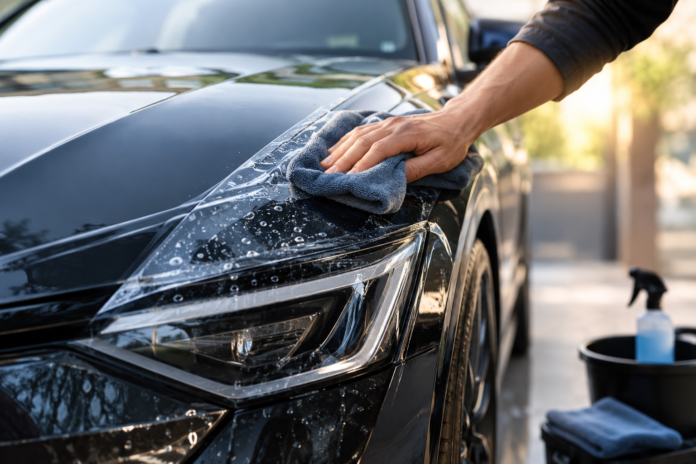

Picture a car that rolls into a detail bay with a two-year-old full front that looks closer to six years old. The film along the leading edge of the hood has gone cloudy; there is a dull line of old wax packed into the edge of the fender piece, and one corner near the headlight has started to lift. Nothing on that car was installed badly. The owner simply washed it at a tunnel wash all winter, put a supermarket wash-and-wax on it every spring, and never had anybody look at the edges.
Anybody who has worked in a detail shop will recognize some version of that car, and it is the reason I think the question of how long paint protection film lasts is usually asked the wrong way. The film has a design life, and the warranty gives you a rough idea of what the maker expects from it, but the number of good years you actually get depends a great deal on what happens to the film after it leaves the shop. Most of that is ordinary washing and checking, done in the right order at the right time.
What follows is the routine I would hand to anybody who has just had film put on a car, laid out in the order the work comes up: the first week, the first month, the first year, and then the slower checks that matter in years two through five.
What Paint Protection Film Is and Why It Changes Its Lifespan
Paint protection film (PPF) is a clear, flexible urethane film, usually somewhere around 6 to 10 mil thick (a mil is one thousandth of an inch), that is applied over painted panels to absorb stone chips, scuffs, and light scratches before they reach the clear coat underneath. Most current films have a top coat that is described as self-healing, which means light swirl marks and fine scratches flatten back out when the film is warmed up.
The self-healing part is the piece most owners misunderstand. Coatings researchers writing in Paint & Coatings Industry magazine explain that in a polyurethane clear coat, a light “marring” scratch stretches the chemical bonds without breaking them, so heat lets the surface reflow, while a deeper fracture scratch (a key scratch, for example) cannot be reversed by heat at all (how self-healing polyurethane coatings recover from scratches). PPF top coats work on a similar principle. That is useful to know, because it means care is mostly about two things: keeping the top coat clean and intact so it can keep doing its job, and keeping the edges sealed down so the film stays attached to the car.
A few terms that come up below:
- Top coat: the thin, hard upper layer of the film that resists stains and carries the self-healing property. When it wears out, the film goes dull and starts holding dirt.
- Edges: the cut or wrapped borders of each film panel. Peeling nearly always starts here.
- Yellowing: a gradual colour change in the film, mostly caused by UV exposure and certain chemicals, that is far more common in older or cheaper films.
- Curing: the period after installation when the leftover water and slip solution under the film evaporates and the adhesive finishes bonding to the paint.
The First Week: Leave It Alone While the Adhesive Bonds
Once the curing period is over, the most important thing you can do for the film is to wash it regularly and gently. Dirt that sits on the film for weeks gets baked into the top coat, and a dirty film is also more likely to get scratched when somebody finally does clean it.
A routine that works for most people is as follows:
- Wash every one to two weeks in normal driving, and more often if the car is parked under trees or near the water.
- Use a pH-neutral car shampoo, two buckets (one with soap, one with plain water for rinsing the mitt) and a clean microfibre wash mitt.
- Wash in the shade, on a panel that is cool to the touch, so the soap does not dry onto the film and leave spots.
- If you use a pressure washer, use a wide fan tip, keep the nozzle well back from the surface, and do not aim the spray straight at the edges of the film. Aiming at an edge is the most common way owners lift film themselves.
- Dry with a clean microfibre towel or a blower, patting rather than dragging the towel across the surface.
It is also worth getting into the habit of spot-cleaning bird droppings, tree sap and bug splatter within a day or so, using a quick detailer spray and a soft towel. These deposits are acidic or sticky enough to stain the top coat if they sit in the sun, and a stain in the top coat is one of the few kinds of damage that heat will not fix.
The things to avoid are fairly short:
- Automatic car washes with brushes or cloth strips, which scuff the top coat and can catch on edges.
- Wash-and-wax soaps and paste waxes, which build up as a white line along the film edges and, in the case of some petroleum-based products, can discolour the film.
- Solvent cleaners, tar removers and degreasers that are not labelled as safe for film.
- Abrasive polishes, compounds and clay bars, unless the film maker or your installer specifically approves them.
Months Two to Twelve: Plan for Sun and Road Salt
The first year is where most of the long-term damage gets started, mainly from UV exposure in summer and from salt and grit in winter.
For the sun, Environment and Climate Change Canada points out that UV levels in Canada are highest from April to September and between 11 a.m. and 3 p.m., and that fresh snow can reflect over 80% of the sun’s UV rays (Government of Canada guidance on when UV is strongest). The guidance was written for skin, not cars, but the same UV is what slowly breaks down the top coat of a film. If you have a choice between parking in a garage or a carport and parking in an open lot, the covered spot will help the film last longer, and this is especially true for the hood and roof, which face the sun most directly.
For winter, the risk is grit and salt sitting on the film for weeks at a time. Consumer Reports recommends a car wash at least monthly during snow season, or more often if the vehicle is coated in salt, and suggests a touchless wash with an underbody rinse when you cannot wash by hand (Consumer Reports on washing road salt off your car).
For a car with film, I would suggest that a touchless wash is an acceptable stopgap in the middle of winter, as long as you are not standing a pressure wand against the edges, and that a proper hand wash should follow as soon as the temperature makes it practical.
A couple of other first-year habits that help:
- Rinse off heavy slush before it dries, rather than brushing it off with a snow brush on the film. Snow brushes drag grit across the top coat.
- Use a plastic scraper only on glass, never on film-covered panels.
- If you want an extra layer of protection, a ceramic coating made for use on film can be applied on top, but ask your installer first, because some films and some warranties have rules about what can be put over them.
Years Two and Three: Inspect the Edges and Watch the Top Coat
By the second year, the routine is mostly the same washing schedule, plus a slower, more deliberate inspection once or twice a year. Spring (after the salt season) and late fall (before it) are convenient times, because the car is getting a thorough clean anyway.
The inspection itself takes about fifteen minutes:
- Wash and dry the car, then look along every edge of the film in good light, especially the leading edge of the hood, the front corners of the fenders, the mirror caps and the lower bumper.
- Look for edges that have lifted, collected dirt underneath, or started to curl. A lifted edge that is caught early can often be cleaned and resealed by an installer; one that is left will usually keep peeling.
- Look for any white or grey line of wax or dirt along the edges. This can usually be removed with a soft brush and a film-safe cleaner.
- Check the high-impact areas for chips that have gone right through the film. These should be looked at by an installer, because water and dirt can get under the film from a hole as easily as from an edge.
- Pour a little water on the hood and roof. If it no longer beads the way it did in year one, the top coat may be wearing, and a film-safe sealant or coating can restore some of that water behaviour.
Years Four and Five: Decide Whether to Refresh or Replace
Most quality films are sold with long warranties (commonly several years, and up to 10 years on some premium films, against problems such as yellowing, cracking and peeling), but a warranty is not a promise that the film will look new for that whole period, and it usually depends on the film having been looked after properly.
By years four and five, the film on a car that has been cared for as described above should still look clear and should still be attached at the edges, though the panels that take the most sun and stones (usually the hood and front bumper) will show more wear than the doors or the rear.
At this stage, it is reasonable to have an installer look at the car and give you an honest answer on three questions:
- Is the top coat still healing, with light swirls when the car sits in the sun, or have the marks become permanent?
- Has any panel yellowed, gone cloudy, or developed staining that will not wash out?
- Are the edges holding, or has the film started to shrink back from the edges of the panel?
If only one or two panels are worn, replacing those panels is usually much cheaper than redoing the car, and it keeps the protection consistent. If the film is yellowing or cracking across the car, removal and replacement is the better choice, and it is worth doing before the film gets old enough to become brittle, because brittle film is harder to remove cleanly from the paint.
Frequently Asked Questions
How long does paint protection film last with good maintenance?
Most current, good-quality films are expected to last somewhere in the range of 5 to 10 years, and some installers quote longer. The actual life on a given car depends on the film, the quality of the installation, how much sun and salt the car sees, and how closely the owner follows a washing and inspection routine like the one above.
Can I wax a car that has PPF on it?
Traditional paste waxes and wash-and-wax products are best avoided, because they build up along the film edges and some petroleum-based products can discolour the film. If you want added protection, a sealant or ceramic product that is labelled as safe for film is a better choice, and it is worth checking with your installer first.
Is it safe to take a car with PPF through an automatic car wash?
A touchless automatic wash is generally acceptable once the film has cured, especially in winter when getting the salt off matters more than a perfect finish. Washes that use brushes or cloth strips should be avoided, because they scuff the top coat and can catch on the edges of the film.
The Short Version
If you take nothing else away from this, it is that a lot of the worn-out film that detailers are asked to look at did not fail because of the film itself. It is more often the result of a missed first inspection, a pressure washer aimed at an edge, a season of tunnel washes, or a wax that nobody should have used. The film does a large part of the work by itself, and the owner’s part of the job is mostly to keep it clean, keep it out of harsh chemicals and brushes, and get the edges looked at once or twice a year, so that small problems are fixed while they are still small.