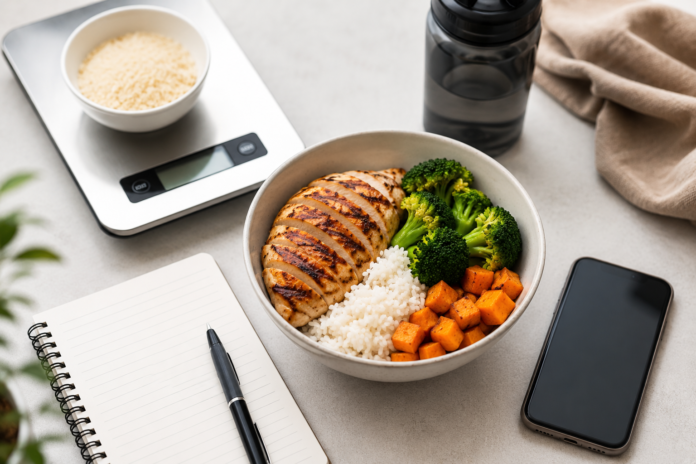

Tracking macros can make nutrition feel much more practical. Instead of focusing only on calories, you pay attention to the three main macronutrients your body gets from food: protein, carbohydrates, and fat.
If you are trying to lose fat, build muscle, improve your eating habits, or simply understand what you are eating, learning how to track macros can give you a clearer picture of your diet.
The process does not have to be complicated. Once you understand your targets, learn how to read food labels, and become comfortable weighing portions, macro tracking can become part of your normal routine.
This guide explains exactly how to track macros, what numbers matter, how to calculate macros from food, and how to avoid common tracking mistakes.
What Are Macros?
Macros, short for macronutrients, are nutrients your body needs in relatively large amounts.
The three primary macros are:
Protein supports muscle repair, growth, recovery, enzymes, hormones, and many other body functions.
Carbohydrates provide energy, particularly for your brain and higher-intensity physical activity.
Fat supports hormone production, cell health, vitamin absorption, and many other essential processes.
Each macronutrient also provides calories:
- Protein: approximately 4 calories per gram
- Carbohydrates: approximately 4 calories per gram
- Fat: approximately 9 calories per gram
Alcohol provides about 7 calories per gram, although it is normally tracked separately rather than treated as one of the three main macros.
For example, if you eat 30 grams of protein, that protein contributes approximately:
30 × 4 = 120 calories
Understanding this relationship helps explain why calories and macros are closely connected.
What Does Tracking Macros Mean?
Tracking macros means recording how many grams of protein, carbohydrates, and fat you consume throughout the day.
Instead of simply saying:
I ate 2,000 calories today.
Macro tracking gives you more detail. Your day might look something like:
- 150 g protein
- 220 g carbohydrates
- 60 g fat
Those numbers tell you much more about the nutritional composition of your diet than calories alone.
Two people could both eat 2,000 calories while consuming very different amounts of protein, carbohydrates, fat, fiber, vitamins, and minerals.
That is one reason macro tracking can be useful when you have specific fitness or nutrition goals.
How to Track Macros Step by Step
The basic process is straightforward.
You determine your daily macro targets, measure the foods you eat, record their nutrition information, and compare your intake with your targets.
Here is how I recommend approaching it.
Step 1: Determine Your Daily Calorie Needs
Before setting macro targets, you need a reasonable estimate of how many calories you require.
Your calorie needs depend on several factors, including:
- Age
- Sex
- Height
- Weight
- Activity level
- Exercise
- Body composition
- Personal goal
Someone trying to maintain their weight will normally use a different calorie target from someone trying to lose fat or gain weight.
Your estimated total daily energy expenditure, often called TDEE, can provide a useful starting point.
For weight maintenance, your calorie intake would generally be close to your estimated TDEE.
For fat loss, a moderate calorie deficit is commonly used.
For weight gain or muscle-building goals, you may consume slightly more than maintenance.
Remember that calorie calculators provide estimates rather than perfect measurements. Your actual needs can vary, so you may need to adjust your intake based on changes in body weight, hunger, energy, training performance, and progress over time.
Step 2: Set Your Macro Targets
Once you have a calorie target, you can divide those calories among protein, carbohydrates, and fat.
There is no single macro ratio that works perfectly for everyone.
Your ideal distribution depends on your goal, preferences, activity level, training habits, and health needs.
For example, a person might follow a daily target such as:
| Macronutrient | Daily Target |
| Protein | 150 g |
| Carbohydrates | 225 g |
| Fat | 60 g |
You do not necessarily need to hit every number exactly.
For most people, it is more practical to treat macro targets as reasonable ranges rather than numbers that must be reached perfectly every day.
Step 3: Use a Food Tracking Method
You need somewhere to record the foods you eat.
You can use:
- A nutrition tracking app
- A spreadsheet
- A written food journal
- A nutrition calculator
- Your own meal planning system
Apps can make the process easier because many foods are already stored in their databases.
However, food databases are not always completely accurate. Some entries are submitted by users or may represent different versions of the same product.
When possible, compare the information in the app with the actual nutrition label on the food you are eating.
Step 4: Weigh or Measure Your Food
Portion size is one of the biggest factors affecting macro tracking accuracy.
If you log 100 grams of chicken but actually eat 160 grams, your recorded calories and protein may be significantly lower than your real intake.
A digital kitchen scale is usually the easiest way to measure food accurately.
For example, instead of recording:
One bowl of rice
you might record:
180 grams cooked rice
The second measurement is much more precise.
You do not have to weigh your food forever. Many people weigh food initially so they can learn what common portion sizes actually look like.
Over time, estimating portions often becomes easier.
Step 5: Check Whether Food Is Raw or Cooked
This is one of the most common macro tracking mistakes.
Foods such as meat, rice, pasta, and potatoes can change weight significantly when cooked because they gain or lose water.
For example, meat often weighs less after cooking because moisture is lost.
Rice and pasta normally weigh more after cooking because they absorb water.
If a nutrition entry says 100 g raw chicken, you should compare it with the raw weight.
If it says 100 g cooked chicken, use the cooked weight.
Mixing raw food weights with cooked nutrition data can make your numbers inaccurate.
Consistency matters more than choosing one method over another.
Step 6: Read Nutrition Labels Correctly
Nutrition labels are extremely useful for macro tracking, but always pay attention to the serving size.
Imagine a package says:
Serving size: 30 g
Protein: 5 g
Carbohydrates: 18 g
Fat: 6 g
If you eat 60 grams, you have consumed two servings.
Your intake becomes:
Protein: 10 g
Carbohydrates: 36 g
Fat: 12 g
A common mistake is recording one serving simply because you ate one package, even when the package contains multiple servings.
Always check both the serving size and the amount you actually consumed.
Step 7: Track Cooking Oils, Sauces, and Extras
Small ingredients are easy to forget, but some can contribute a significant number of calories.
Commonly overlooked foods include:
- Cooking oil
- Butter
- Mayonnaise
- Salad dressing
- Cheese
- Cream
- Sugar
- Sauces
- Nut butter
- Milk added to coffee
- Small snacks while cooking
One tablespoon of cooking oil, for example, contains mostly fat and can contribute more than 100 calories.
You do not need to obsess over every tiny ingredient, but consistently ignoring calorie-dense extras can make your tracking much less accurate.
Step 8: Track Meals as You Eat Them
Trying to remember everything at the end of the day can be difficult.
Whenever possible, log your meals shortly before or after eating.
Some people find it even easier to pre-log their meals.
For example, you could enter breakfast, lunch, and dinner in your tracker in the morning.
You can then see how many macros are left for snacks or adjustments.
If your planned meals already contain most of your daily fat allowance, you might choose a lower-fat snack later in the day.
Pre-logging turns macro tracking into a planning tool rather than simply a record of what already happened.
How to Calculate Macros in Homemade Meals
Tracking packaged foods is relatively simple because the nutrition information is printed on the label.
Homemade recipes require an additional step.
Suppose you make a meal containing:
- 500 g chicken
- 300 g rice
- 20 g olive oil
- Vegetables
- Sauce
First, calculate the calories and macros for every ingredient.
Then add them together to determine the nutrition information for the entire recipe.
Finally, divide the totals by the number of servings.
If the whole recipe contains:
- 2,000 calories
- 160 g protein
- 220 g carbohydrates
- 55 g fat
and you divide it into four equal portions, each serving contains approximately:
- 500 calories
- 40 g protein
- 55 g carbohydrates
- 13.75 g fat
For recipes you prepare regularly, saving the recipe in your tracking app can make future tracking much faster.
Do You Need to Hit Your Macros Exactly?
No.
You do not need to finish every day with exactly zero grams remaining for every macro.
Nutrition is not that precise.
Your food labels are estimates, portion measurements have small variations, and your body’s calorie needs also change from day to day.
Instead of chasing perfect numbers, focus on consistency.
For example, if your protein goal is 150 grams, consuming 145 or 155 grams is unlikely to make a meaningful difference for most people.
Your overall eating pattern across many days matters more than achieving mathematically perfect macros every evening.
Should You Track Calories or Macros?
You technically track both when you track macros because protein, carbohydrates, and fat all contribute calories.
However, your priorities may depend on your goal.
For someone focused mainly on weight management, total calorie intake is especially important.
For someone trying to preserve or build muscle, protein intake deserves additional attention.
Athletes may also pay closer attention to carbohydrate intake because carbohydrates support training and recovery.
Instead of thinking of calories and macros as competing systems, think of them as different levels of nutrition information.
Calories tell you how much energy you consume.
Macros tell you where much of that energy comes from.
Common Macro Tracking Mistakes
Macro tracking becomes much easier when you avoid a few common errors.
One mistake is estimating portions too loosely. Foods such as oils, nuts, peanut butter, cheese, and sauces can contain many calories in relatively small servings.
Another mistake is selecting inaccurate entries from food databases. Whenever possible, compare database information with the product label.
People also sometimes forget drinks. Coffee additions, smoothies, juices, sodas, and other beverages may contribute calories and macros.
Raw-versus-cooked food entries can also create confusion, particularly with meat, rice, pasta, and grains.
Finally, trying to make your macros perfect can turn a useful nutrition tool into an unnecessary source of stress.
Accuracy is helpful. Perfection is not required.
How to Make Macro Tracking Easier
The easiest way to stay consistent is to reduce how many decisions you need to make every day.
You might keep several reliable breakfasts, lunches, snacks, and dinners that you already know how to track.
Saving frequently eaten foods and recipes can also save considerable time.
Meal planning helps too.
If you already know what you will eat tomorrow, you can enter the meals beforehand and make small adjustments until the numbers fit reasonably close to your goals.
For example, you might increase a portion of chicken if protein is low, reduce oil if fat is high, or add rice, fruit, potatoes, or another carbohydrate source if carbohydrates are low.
This approach is often easier than reaching the end of the day and trying to find a food that perfectly fills your remaining macros.
Can You Track Macros While Eating at Restaurants?
Yes, although your numbers will usually be less precise than when preparing food at home.
Some restaurant chains publish calories and nutrition information online, which can make tracking relatively straightforward.
When exact information is unavailable, choose the closest comparable food in your tracker and make a reasonable estimate.
Restaurant meals frequently contain additional cooking oil, butter, sauces, or larger portions, so it can be difficult to calculate their exact macros.
That is okay.
A reasonable estimate is usually more useful than skipping the meal entirely from your tracking record.
How Long Should You Track Macros?
You do not necessarily need to track macros forever.
For some people, macro tracking is a temporary educational tool.
After several weeks or months, you may develop a much better understanding of:
- Portion sizes
- Protein-rich foods
- High-calorie ingredients
- Meal composition
- Your normal eating habits
Others prefer to continue tracking because it gives them structure and helps them stay consistent with fitness goals.
Both approaches can work.
The goal should be to use tracking when it provides useful information, not simply because you feel obligated to record every meal indefinitely.
Frequently Asked Questions About Tracking Macros
What is the easiest way to track macros?
The easiest method is usually to calculate your daily targets, use a food tracking app, weigh portions with a kitchen scale, and log meals consistently. Saving frequently eaten foods and recipes can make the process considerably faster.
Do vegetables count when tracking macros?
Yes. Vegetables contain calories and macronutrients, although many non-starchy vegetables contribute relatively small amounts. If you want accurate tracking, include them in your daily intake.
Should I track net carbs or total carbs?
For general macro tracking, total carbohydrates are commonly used. Certain diets may focus on net carbohydrates, which typically subtract fiber and sometimes specific sugar alcohols from total carbohydrates. The appropriate method depends on your dietary approach.
Is macro tracking good for weight loss?
Macro tracking can help with weight loss because it makes you more aware of your calorie intake and food composition. However, weight loss still depends largely on maintaining an appropriate calorie deficit over time.
How accurate does macro tracking need to be?
You should aim for reasonable consistency rather than perfect mathematical accuracy. Nutrition labels, restaurant estimates, portion measurements, and calorie calculations all contain some uncertainty.
Final Thoughts
Learning how to track macros is mostly about building a repeatable system.
Start by estimating your calorie requirements and setting reasonable protein, carbohydrate, and fat targets. Measure your portions, use accurate nutrition information, pay attention to raw and cooked food weights, and remember ingredients such as oils and sauces.
Most importantly, do not turn macro tracking into a pursuit of perfect numbers.
The real value comes from understanding your eating habits.
When you consistently track what you eat, you can see whether your meals provide enough protein, where most of your calories come from, and how your daily choices fit your overall nutrition goal.
Over time, those insights can make planning meals and managing your nutrition much easier.