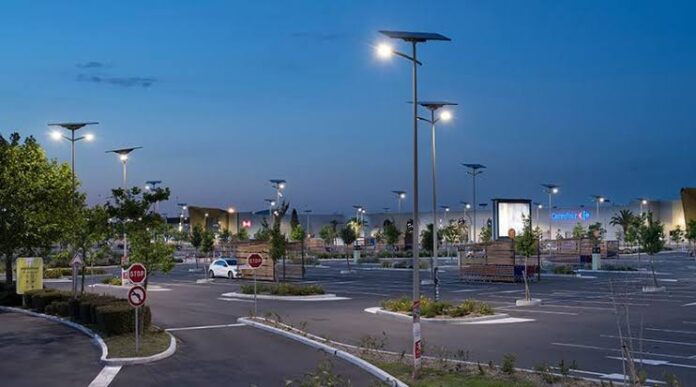

How much does it actually cost to keep a parking lot lit from dusk until dawn, every night of the year? For facility managers running large commercial properties, that question rarely has a comfortable answer. Solar-Powered Street Lights For Parking Lots in the USA have become one of the more practical responses to that ongoing expense, and the reasons go well beyond a lower utility bill. Rising demand charges, aging infrastructure, and stricter safety expectations have pushed property owners to look at lighting differently.
Why Are Parking Lot Energy Bills Climbing So Fast in the USA?
Electricity rates for commercial properties have moved upward steadily across most U.S. states, and outdoor lighting is often the largest contributor to a facility’s overnight energy draw. Large lots need consistent, even illumination for hours at a stretch, which adds up quickly on a metered account. Understanding why these costs keep rising is what leads many property managers toward Solar-Powered Street Lights For Parking Lots in the USA as a serious alternative.
Facility teams weighing a lighting upgrade should first look at where their current spending actually goes.
Grid Dependency: Traditional lighting draws continuously from the utility grid, so every kilowatt-hour used overnight shows up on the monthly bill, with no offset from an independent power source.
Aging Fixtures: Older HPS or metal halide fixtures consume more power for less usable light, forcing facilities to run more units at higher wattage to meet basic visibility standards.
Trenching and Wiring Costs: Expanding a wired lighting network usually involves trenching, conduit, and labor, raising the total cost of ownership well beyond the lights themselves.
Peak Demand Charges: Utilities often charge commercial accounts extra for peak usage periods, and lighting that runs during high-demand evening hours can quietly inflate those charges.
Maintenance and Repair Cycles: Grid-tied systems require ongoing electrical maintenance, and any fault in underground wiring can be costly and slow to locate and fix.
Once these cost drivers are clear, it’s easier to see why an independent power source for outdoor lighting appeals to so many commercial property owners.
The Real-World Problem This Lighting Approach Solves
Parking lots are functional spaces, but they are also liability zones after dark. Poor visibility affects both safety and how confident visitors feel walking to their vehicles at night. At the same time, property owners face pressure to control operating expenses without compromising on that safety. This is the gap olar-Powered Street Lights For Parking Lots in the USA are designed to close.
Unpredictable Utility Costs: Because the system generates and stores its own power during the day, nighttime operation does not add to the metered electricity draw, giving facilities a more predictable monthly cost structure.
Grid Outages and Downtime: Storms, equipment failures, or planned outages can leave a wired lot dark exactly when lighting matters most, whereas an independent power source keeps operating regardless of grid status.
Costly Infrastructure Expansion: Adding lighting to a new section of a lot traditionally means trenching and new wiring, but an off-grid setup avoids most of that groundwork entirely.
Recognizing these pressure points makes it clear why so many facility managers are researching this Solar-Powered Street Lights For Parking Lots in the USA approach as a long-term fix rather than a short-term patch.
What Should Facility Managers Look for in Solar Parking Lot Lights?
Not every solar fixture on the market is built for the demands of a commercial parking environment. Choosing Solar-Powered Street Lights For Parking Lots In the USA means accounting for long winter nights, variable weather, and consistent brightness across a wide area, so the underlying technology matters as much as the price tag.
A few design and performance factors separate dependable Solar-Powered Street Lights For Parking from a system that struggles within a few seasons:
- Battery capacity and technology: Li-ion batteries usually perform better at retaining charge during cloudy days and low temperatures compared to previous technologies.
- Wattage of solar panels: 240W-780W panels enable a pole to provide bright lighting with no need to increase its size.
- Compatibility with retrofit installation: Such installations minimize the period of installation along with the construction of new foundations.
- Resistance to bad weather conditions: A pole that can endure strong winds and floods safeguards the purchase in case of extreme weather in the area.
- Smart controls: Adaptive dimming and monitoring from a distance help extend the lifespan of the battery along with effective lighting of the lot when it is required most.
Facility managers who weigh these factors carefully, rather than choosing on price alone, tend to end up with Solar-Powered Street Lights For Parking Lots In the USA that perform reliably for many years without unexpected replacement costs.
Why Use Solar for Urban Applications Like Street Lighting?
Parking lots are only one part of a much broader shift happening across American cities and municipalities. Streets, bridges, campuses, and public parks are increasingly adopting solar lighting as part of wider infrastructure planning, and those lessons carry over directly into how facilities approach Solar-Powered Street Lights For Parking Lots In the USA on private commercial property.
Municipal projects have already demonstrated several advantages that make the case for solar lighting in dense, urban, or resource-constrained settings:
Reduced Strain on Local Grids: Cities managing thousands of streetlights benefit when part of that load shifts off the grid entirely, freeing capacity for other municipal needs during peak hours.
Improved Public Safety Records: Well-lit streets and public spaces have been linked to lower nighttime incident rates in several city programs, reinforcing why consistent lighting matters.
Faster Disaster Recovery: Independent power sources keep essential lighting functional during hurricanes or grid failures, a priority for several coastal municipalities after past storm-related outages.
Dark-Sky and Environmental Compliance: Many local governments require lighting that limits sky-glow and light pollution, and solar LED systems are often designed around those International Dark-Sky Association standards.
Long-Term Budget Predictability: Public works departments managing tight annual budgets benefit from lighting infrastructure without a recurring energy line item, freeing funds for other community priorities.
These same benefits scale down comfortably to a single commercial property, which is part of why Solar-Powered Street Lights For Parking Lots In the USA continue to gain traction outside of purely municipal projects.
Final Thoughts
Rising energy costs, unpredictable outages, and safety expectations are pushing commercial property owners to rethink how their parking lots stay lit. Solar-Powered Street Lights For Parking Lots In the USA offer a practical path forward, combining independence from the grid with lower long-term maintenance. For facility managers evaluating their next lighting upgrade, this approach is worth serious consideration.