

The Anatomy of High-Growth B2B Enterprise
In today’s fast-evolving business landscape, achieving sustainable growth in the B2B sector presents unique challenges. Many companies find themselves grappling with the complexities of market shifts, intense competition, and the constant need to innovate. The user problem is clear: how to consistently drive revenue and expand market share without succumbing to ad-hoc tactics or unsustainable spending. This is where strategic b2b services for growth become indispensable. These specialized services offer a roadmap for firms looking to move beyond incremental gains to achieve significant, scalable expansion.
This extensive guide will delve into the characteristics that define high-growth B2B companies, explore how AI and automation can revolutionize sales productivity, and outline the most effective marketing strategies for generating a qualified pipeline. We will also examine go-to-market structures, the role of fractional advisory services, and intelligent pricing models. Furthermore, we will break down the essential components of a modern B2B growth system, from technology stacks to analytics, emphasizing the importance of data-driven digital marketing for measurable impact. We aim to equip B2B leaders with actionable insights to build sustainable growth engines.
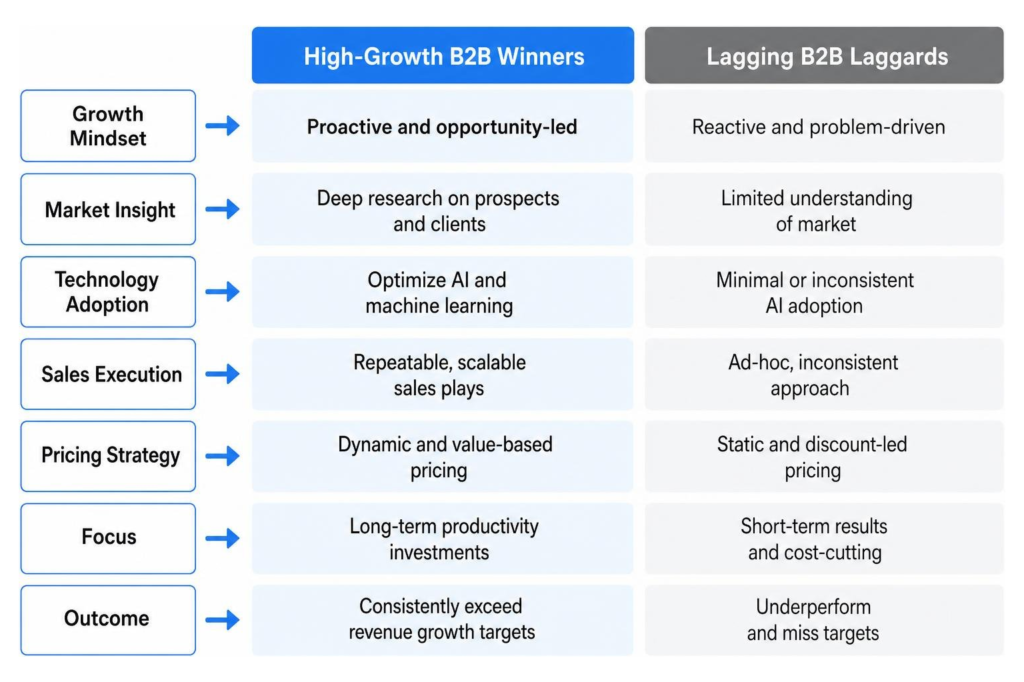
The B2B sector in July 2026 is characterized by a significant “growth divide,” separating top-performing companies from their underperforming counterparts. High-growth B2B enterprises consistently outpace their industries, often delivering double the average revenue growth. This isn’t accidental; it’s the result of deliberate strategies and operational excellence. These leading firms distinguish themselves by proactively embracing technological advancements, particularly in AI, and by meticulously structuring their go-to-market approaches.
A core characteristic of high-growth B2B companies is their commitment to systematic research on their prospects and clients. Firms that invest in understanding their market deeply often grow three to ten times faster and are up to two times more profitable than those that don’t. This deep insight informs every aspect of their strategy, from product development to sales plays. Unlike laggards, who often remain reactive to market uncertainties and pricing pressures, winners focus on optimizing AI and machine learning, executing repeatable sales plays, and implementing dynamic pricing models. They prioritize long-term productivity investments, building robust foundations that can withstand market fluctuations and capitalize on emerging opportunities. This strategic foresight allows them to consistently exceed revenue growth targets, as evidenced by the 54% of B2B companies globally that surpassed their goals in 2024.
Transitioning Beyond Founder-Led Sales
Many B2B startups and growing firms initially rely heavily on founder-led sales. While effective in the early stages, this model presents a significant scalability barrier, creating a single point of failure in the sales pipeline. As a business matures, the founder’s direct involvement in every deal becomes unsustainable, hindering growth and predictability. High-growth B2B companies understand this limitation and strategically transition to a more structured, repeatable sales process.
This transition often involves implementing a comprehensive “sales play system.” While 82% of companies report running sales plays, a mere 21% actually realize their full value. The distinction lies in having a genuine system—a repeatable, targeted framework that guides go-to-market motions, standardizes sales interactions, and ensures consistent execution across the sales team. Companies that successfully implement such a system have been observed to achieve 2.2 times the average growth rates compared to those that do not. This systematic approach fosters pipeline predictability, reduces reliance on individual heroics, and cultivates commercial excellence across the organization.
Utilizing Specialized B2B Services for Growth
To achieve and sustain high growth, B2B firms increasingly leverage specialized services. These strategic partnerships allow businesses to focus on their core competencies while outsourcing complex, non-core functions to experts. Building the right business growth partnership can give companies access to specialized expertise while allowing internal teams to stay focused on their core priorities. This modular approach provides access to specialized knowledge and resources without the overhead of full-time hires. For instance, managing intricate tasks such as human resources, accounting, and back-office administration like payroll can be highly time-consuming and resource-intensive for growing businesses. Partnering with external providers for these functions frees up internal teams to concentrate on strategic initiatives that directly drive revenue and innovation.
Specialized B2B services can span a wide array of functions, from market evaluation and digital transformation to AI strategy and change management. They offer the flexibility to deploy modular teams or individual experts on-demand, addressing specific growth bottlenecks without committing to long-term operational costs. This agility is crucial in today’s dynamic market, enabling companies to scale capabilities efficiently and adapt quickly to new challenges and opportunities.
Engineering a Modern B2B Services for Growth Infrastructure

Building a sustainable growth engine in the B2B landscape requires more than just ad-hoc tactics; it demands a robust infrastructure. A modern B2B growth system is engineered as an operating system, unifying various functions under a cohesive strategy. At its heart lies a sophisticated technology stack, meticulously chosen and integrated to support end-to-end revenue generation. This “growth engine” is powered by a concept known as Revenue Operations (RevOps), which aligns sales, marketing, and customer success into a single, seamless operational unit.
RevOps ensures that all customer-facing departments work in concert, sharing data, processes, and goals. This unification breaks down traditional silos, providing a holistic view of the customer journey and enabling predictable forecasting. By streamlining technology and integrating data from CRM, paid media, SEO, and other operational systems, businesses gain real-time clarity and predictive insights. This integrated approach allows for a more efficient allocation of resources and a deeper understanding of what truly drives pipeline growth and customer lifetime value.
Integrating AI and Automation into Sales and Marketing
The integration of Artificial Intelligence (AI) and automation has become a non-negotiable for B2B firms aiming for scalable growth and enhanced sales productivity in July 2026. AI acts as a “force multiplier,” transforming go-to-market strategies from reactive to predictive. Rather than merely running isolated pilots, leading companies are scaling AI directly into their core business processes.
AI-powered tools enable sophisticated functions such as predictive lead scoring, which automatically qualifies high-intent prospects based on their behavior and demographic data. This ensures sales teams focus their efforts on the most promising leads, significantly improving conversion rates. Workflow automation streamlines repetitive tasks, from email nurturing sequences to data entry, freeing up sales and marketing personnel for more strategic activities. Furthermore, the concept of Generative Engine Optimization (GEO) is emerging alongside traditional SEO, leveraging AI to enhance visibility and discoverability in AI-driven search platforms. This allows B2B brands to capture demand even before buyers compile their shortlist, giving them a significant competitive edge. By adapting timing, messaging, and routing based on real-time intent signals, AI automation can dramatically reduce customer acquisition costs and accelerate sales cycles.
Building a High-Performance Digital Presence
In the contemporary B2B landscape, a high-performance digital presence is the bedrock of growth. With 80% of people checking a website when evaluating service providers, and over 60% consulting social media, a firm’s online footprint is often the first and most critical impression. This necessitates a strategic approach to web design and digital marketing that goes beyond aesthetics.
A conversion-focused web design is paramount. This means creating intuitive, fast-loading, and mobile-responsive websites that guide visitors seamlessly through the buyer’s journey. Every element, from navigation to calls-to-action, is optimized to convert interest into qualified leads. Beyond the website itself, a comprehensive data-driven digital marketing strategy is essential. This involves leveraging advanced analytics to understand user behavior, optimize campaigns, and ensure every marketing dollar contributes to measurable pipeline growth. Strategies include robust SEO to improve organic visibility, targeted paid media campaigns, and engaging social media presence where 17% of expertise-based referrals are now made. The goal is to build an online ecosystem that not only attracts but also nurtures and converts prospects, turning digital interactions into tangible business outcomes.
Scaling Leadership and Strategy with Fractional Advisory
As B2B businesses scale, the demands on executive leadership intensify. Hiring full-time, high-caliber executives like a Chief Marketing Officer (CMO) can be prohibitively expensive and time-consuming, often involving salaries upwards of $300,000 annually plus benefits and recruiting costs. This is where fractional CMO or growth advisory services play a pivotal role. These services provide senior-level strategic leadership and expertise without the commitment of a full-time hire, allowing businesses to access top-tier talent at a fraction of the cost.
Fractional CMOs embed themselves within an organization, offering C-level strategy, execution oversight, and team upskilling. They can quickly align marketing efforts with overall business objectives, develop comprehensive growth roadmaps, and implement revenue-driving initiatives. This model is particularly beneficial for mid-market companies or startups that need sophisticated marketing leadership but aren’t ready for a permanent executive. The engagement is often project-based or for a defined period, focusing on building a sustainable growth engine and then transferring knowledge to the internal team. This ensures long-term self-sufficiency and prevents dependency on external consultants, fostering true strategic alignment within the company.
Overcoming Growth Barriers with External Expertise
B2B firms frequently encounter various growth barriers, from market saturation and talent gaps to inefficient processes and technological limitations. These challenges can stifle scaling efforts and divert internal resources from core business activities. Consulting or agency partnerships offer a powerful solution, providing specialized external expertise to overcome these hurdles.
On-demand talent models, for instance, allow businesses to deploy modular teams or individual experts to address specific, temporary needs, such as a complex digital transformation project or a market entry strategy. These consultants often possess a hybrid talent profile, combining classical consulting frameworks with hands-on operational experience, bridging the gap between strategy and execution. This flexibility fosters operational agility, enabling companies to adapt to market changes without the delays associated with traditional hiring. External experts can also provide an objective perspective, identify blind spots, and introduce best practices in areas like change management, ensuring smoother transitions during periods of rapid growth or organizational restructuring.
Dynamic Pricing and Profitability Optimization
Optimizing pricing and profitability is a critical, aspect of B2B growth. In today’s competitive landscape, relying on static pricing models can lead to missed revenue opportunities or eroded margins. Intelligent, dynamic pricing strategies are essential for maintaining profitability, especially in fluctuating economic environments.
Dynamic pricing involves continuously adjusting prices based on real-time market conditions, customer segments, demand, and even competitor actions. This requires sophisticated data analytics and sometimes AI-driven tools to implement effectively. A key component is “surgical customer segmentation,” where businesses precisely identify different customer groups and tailor pricing strategies to each, maximizing value capture. This approach moves beyond broad price hikes, allowing for precise, strategic adjustments that protect margins without alienating valuable clients. Revenue intelligence tools further enhance this by providing deep insights into which products, services, and customer segments yield the highest profitability, enabling businesses to focus resources on high-return areas. By dynamically managing pricing, B2B firms can adapt to lower-inflation environments, optimize their return on investment, and sustain healthy profit margins.
Measuring Success: Moving Beyond Vanity Metrics
For B2B leaders, measuring success effectively means moving decisively beyond “vanity metrics”—those superficial numbers that look good on a report but don’t correlate with actual business growth. True success is gauged by metrics that directly reflect pipeline health, customer value, and revenue impact.
Key performance indicators (KPIs) like pipeline velocity measure the speed at which deals move through the sales funnel, indicating efficiency and predictability. A healthy pipeline velocity suggests effective lead generation, qualification, and sales processes. Customer Acquisition Cost (CAC) is another critical metric, revealing the total cost of acquiring a new customer. Optimizing CAC is paramount for sustainable growth, as high acquisition costs can quickly erode profitability. Complementing CAC is Lifetime Value (LTV), which quantifies the total revenue a business can expect from a single customer relationship over its duration. The LTV:CAC ratio is a powerful indicator of business health, with a higher ratio signifying a more profitable and sustainable growth model.
Beyond these, B2B leaders must track revenue impact as the ultimate measure of success. Every marketing and sales activity should be tied back to its contribution to the bottom line. This requires robust analytics and attribution models that can accurately credit revenue to specific campaigns, channels, and touchpoints. By focusing on these actionable, revenue-centric metrics, businesses can make data-driven decisions, optimize their strategies, and ensure their growth efforts translate into tangible, long-term profitability.
Frequently Asked Questions about B2B Services for Growth
How do B2B services for growth reduce customer acquisition costs?
B2B services for growth significantly reduce customer acquisition costs (CAC) through a multi-faceted approach centered on efficiency and precision. By implementing advanced marketing automation, businesses can streamline repetitive tasks, automate lead nurturing, and personalize communication at scale. This ensures prospects receive relevant information at the right time, improving engagement and conversion rates. Predictive lead scoring helps sales teams prioritize high-intent leads, avoiding wasted effort on unqualified prospects. Furthermore, conversion rate optimization (CRO) techniques, applied to websites and landing pages, maximize the effectiveness of existing traffic, turning more visitors into qualified leads without increasing ad spend. These strategies, often deployed within a 90-day operating cadence, can cut CAC by 40-60% within the first three months, demonstrating rapid ROI.
What is the difference between traditional consulting and modern growth advisory?
The distinction between traditional consulting and modern growth advisory lies primarily in their approach to engagement and execution. Traditional consulting often provides high-level strategic recommendations, typically delivered in extensive reports or presentations, with less emphasis on hands-on implementation. While valuable for foundational strategy, it can sometimes leave businesses with a clear “what to do” but not “how to do it.”
Modern growth advisory, conversely, is highly execution-focused. It often involves “modular talent” or “on-demand experts” who embed within the client’s team. These advisors don’t just strategize; they actively participate in building, launching, and refining growth initiatives. This “agile implementation” model emphasizes continuous improvement, rapid experimentation, and direct accountability for measurable results. Instead of just offering advice, modern growth advisory partners act as an extension of the internal team, ensuring strategies are not only developed but also effectively implemented and iterated upon.
How quickly can a business expect to see ROI from outsourced growth services?
The timeline for seeing a return on investment (ROI) from outsourced B2B growth services can vary, but many firms are designed to deliver tangible results within a relatively short period. Initial “quick wins,” such as improved email engagement rates or significant time savings through automation, can often be observed within 30-45 days. Measurable reductions in Customer Acquisition Cost (CAC) typically emerge by day 60, as optimized campaigns and lead scoring begin to take effect. For B2B companies with sales cycles of 2-4 weeks, a compounding pipeline impact, leading to substantial revenue growth, is often visible by the 90-day mark. This rapid ROI is a key advantage of modern growth services, which prioritize a clear 90-day operating cadence to measure traction and iterate strategies for sustained success.
Conclusion
In the dynamic B2B landscape of July 2026, achieving and sustaining growth demands more than just effort; it requires strategic foresight and precise execution. The insights gleaned from high-performing enterprises underscore the imperative of moving beyond reactive, ad-hoc tactics towards building robust, integrated growth engines. By embracing specialized B2B services, firms can overcome common barriers, transition away from unsustainable founder-led sales, and leverage advanced technologies like AI and automation to revolutionize their sales and marketing efforts.
The strategic integration of AI, the development of a high-performance digital presence, and the judicious use of fractional advisory services are no longer optional but essential components of a modern growth strategy. Critically, success must be measured by actionable metrics like pipeline velocity, CAC, and LTV, ensuring every initiative contributes to tangible revenue impact. By adopting these principles and partnering with expert B2B services, companies can engineer sustainable scaling, achieve strategic execution, and secure long-term profitability in an increasingly competitive market.