
As enterprises move beyond AI copilots in 2026, many are discovering that the biggest challenge isn’t choosing the right model—it’s creating the right data and context foundation for AI to succeed.
A recent McKinsey report showed that 88% of organizations now use AI in at least one business function, yet only about one-third have begun scaling AI across the enterprise.[1]
The gap isn’t a shortage of AI models or cloud infrastructure—it’s the inability of existing data ecosystems to support enterprise-scale AI.
Building an AI-ready data platform is no longer just about cloud migration. It requires a trusted, governed, and intelligent data foundation capable of supporting enterprise-scale AI.
This article explores why enterprise data modernization must evolve beyond traditional migration and outlines what is required to build an AI-ready enterprise.
In 2026: Why Enterprise Data Must Evolve for AI
Enterprise data platforms, for years, were designed to collect data, generate reports, and support historical analytics. While the capabilities remain important, it isn’t sufficient for building a real-time, AI-ready enterprise.
Modern AI systems, including generative AI assistants, recommendation engines, and autonomous agents, operate very differently than traditional analytics.
Rather than simply retrieving information, they need to continuously interpret user intent, synthesize insights, and generate responses in real time.
This shift changes what enterprises expect from their data platforms. Rather than simply storing and processing information, modern platforms must provide governed, connected, high-quality data that AI can access, understand, and use confidently.
Why Traditional Legacy Modernization Strategies Fall Short
Traditional legacy modernization strategies primarily focused on data platform migration.
While this approach improved agility, scalability, and operational excellence, it doesn’t prepare organizations for enterprise AI.
Enterprises still struggle with:
- Fragmented metadata
- Limited visibility into data lineage
- Missing semantic context
- Inconsistent business definitions
- Siloed enterprise knowledge
- Governance and compliance gaps
These challenges become increasingly significant as AI applications begin reasoning across multiple data sources and business domains.
That’s why enterprise data modernization requires more than moving data—it requires making enterprise knowledge understandable, discoverable, and trustworthy.
The Context Gap: The Missing Link in Enterprise AI
While every organization’s modernization journey is unique, many overlook the Context Gap.
The Context Gap is the difference between what today’s AI systems know and what makes your enterprise unique—including proprietary knowledge and ways or working.
Even the most modern data platform cannot guarantee trustworthy AI outcomes if business context is missing.
Let’s take an example. Consider a banking AI assistant.
The assistant might have access to customer transaction histories, loan products, service documentation, account balances, etc.
However, it cannot give accurate or compliant suggestions to customers without deep understanding of:
- Regulatory policies
- Eligibility rules
- Customer contracts
- Compliance frameworks
- Relationships between datasets
- As AI systems become more autonomous, context becomes just as important as data.
Metadata, lineage, governance, semantic relationships, and domain knowledge help AI understand not just where data resides, but also what it means, how it was created, and if it can be trusted.
Closing the context gap requires enterprises to preserve business knowledge, enrich metadata, and connect business information so AI can reason with confidence.
Impetus LeapLogicTM Suite: Powering Data Modernization for the AI-first World
Creating an AI-ready enterprise requires a structured modernization approach that combines automation with governance, metadata, and validation.
Impetus LeapLogic™ Suite supports the full modernization lifecycle, helping enterprises transform legacy environments while preserving context and building the semantic core that AI depends on.
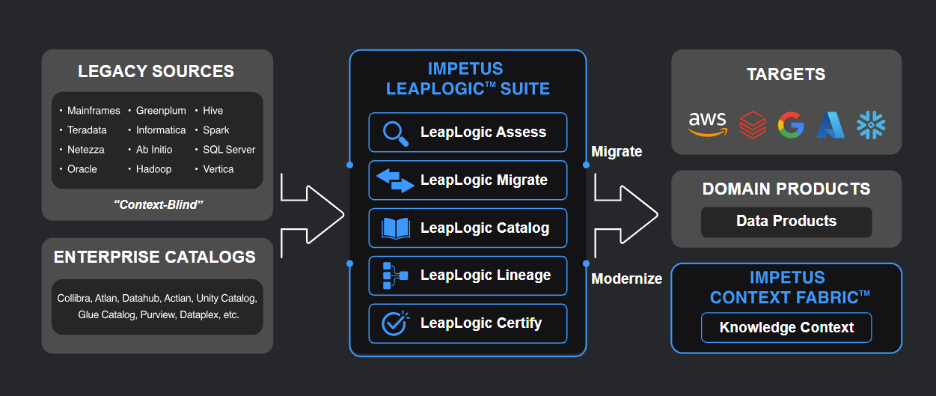
Image 2: Impetus LeapLogicTM Suite: The only modernization solution that builds context, not just pipelines
Step 1: Assess: Understand your data estate
Every modernization initiative begins with a clear view of the existing environment. LeapLogic Assess scans, profiles, and inventories your legacy data environment — including SQL, schemas, ETL, and lineage — providing end-to-end visibility into the current data landscape.
Outcome: A prioritized migration roadmap with complete visibility into the existing environment
Business benefit: Reduces planning uncertainty and enables smarter modernization decisions
Step 2: Migrate: Accelerate modernization with intelligent automation
Legacy data platform migration can be extremely costly and time-consuming. LeapLogic Migrate automates the conversion of SQL, schemas, ETL scripts, and pipelines with up to 95% automation, accelerating migration from any legacy environment to a modern platform, such as AWS, Azure, Google Cloud, Databricks, or Snowflake.
Outcome: Legacy workloads successfully transformed into optimized, cloud-native assets
Business benefit: Accelerates modernization while minimizing manual effort and business disruption
Step 3: Catalog: Turn metadata into meaningful business context
Migration alone doesn’t make data AI-ready. LeapLogic Catalog automatically captures and organizes technical and business metadata, creating a centralized inventory of enterprise data assets that is easy to search, understand, and govern.
Outcome: A centralized, searchable catalog of enterprise data and metadata
Business benefit: Improves data discoverability and enables consistent understanding across business and technical teams
Step 4: Lineage: Map logic, meaning, and dependencies across data products
As data moves across systems, understanding where it originated and how it has been transformed becomes essential. LeapLogic Lineage automatically connects logic, context, and change across data products, enabling impact analysis and explainability.
Outcome: End-to-end visibility into data flows, transformations, and dependencies
Business benefit: Simplifies governance, compliance, and impact analysis on upstream and downstream systems.
Step 5: Certify: Validate transformed data for accuracy and AI-readiness
Modernization is only complete when enterprises can verify that migrated data products and business logic perform accurately in the new environment. LeapLogic Certify automates reconciliation, validation, and testing to ensure migrated assets preserve data integrity and functional equivalence.
Outcome: Validated, production-ready data and code with verified accuracy and consistency
Business benefit: Reduces deployment risk by ensuring production-readiness and SLA adherence
The Business Value of AI-Ready Modernization
By combining automation, governance, metadata, lineage, and validation, organizations can establish a strong, future-ready foundation for enterprise AI. This enables them to:
- Turn AI initiatives into measurable business outcomes
- Maximize returns on cloud and AI investments
- Reduce modernization, business, and regulatory risk
- Empower faster, accurate, and reliable decision making
- Build scalable data platforms that evolve alongside AI
Beyond Migration: Building a Data Foundation That Evolves with AI
Organizations that approach modernization as a strategic transformation, not simply a cloud migration initiative, will be better positioned to scale AI, respond to changing business demands, and unlock long-term value from their data investments.
In the era of agentic AI, competitive advantage will depend on far more than intelligent models. Success will increasingly depend on the quality of the data that powers intelligent systems.
Organizations that invest in an AI-ready data foundation today will be better equipped to innovate and scale with confidence tomorrow.