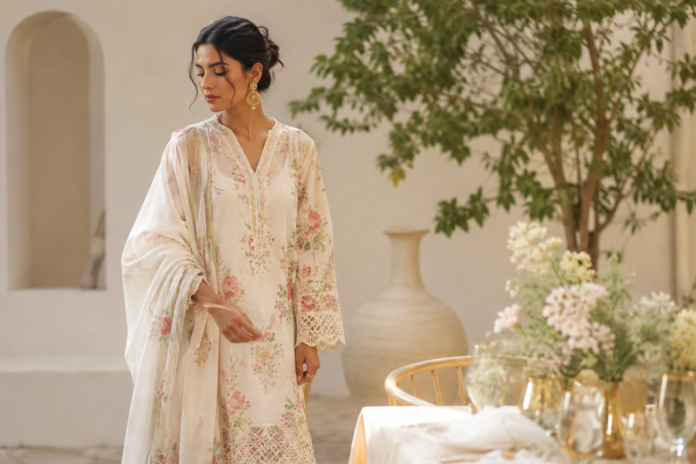

The invitation says “festive,” the weather forecast says something closer to unbearable, and the closet suddenly feels full of options that solve for one problem but not the other. This is the exact tension that festive summer dressing has to resolve, celebratory enough for the occasion, cool enough to actually survive it.
The Color Shortcut
Structure and embellishment aren’t the only ways to signal an outfit is meant for something special. Color does a lot of that work on its own, and richer, more saturated tones tend to read as festive even in a fairly simple silhouette. This matters especially in summer, when heavier embellishment can quickly feel like too much in the heat.
Movement Over Rigidity
A gathering usually means standing, mingling, and moving for hours at a stretch, which makes rigid silhouettes a harder sell than they seem in a fitting room. Fabrics and cuts with natural movement tend to photograph beautifully and stay comfortable through a long evening in a way stiffer, more tailored options often don’t manage once the event actually gets underway.
Planning for the Temperature Drop
Festive summer gatherings often start in daylight and stretch into an evening that cools down noticeably. A light layer that can be added or removed without disrupting the outfit gives far more flexibility across that transition than committing to one fixed look from the start.
Letting Fabric Carry the Elevation
A relatively simple cut can look considerably more elevated when the fabric itself carries some visual weight, through subtle texture, a refined finish, or a print that reads as considered rather than casual. This is one of the more efficient styling decisions available, since it upgrades an entire outfit without requiring a complicated silhouette, and it’s why the luxury lawn collection works so well for this kind of occasion: enough visual richness to feel appropriately festive without adding real weight or heat.
Restraint With Accessories
Festive occasions tend to invite heavier accessorizing than they actually need. In summer especially, one or two well-chosen pieces read as more intentional than a fully accessorized look that starts to feel heavy both visually and physically over a long event.
Dressing for the Whole Night, Not Just the Entrance
It’s easy to style around how an outfit looks in the first ten minutes without considering how it holds up three hours later. Fabrics that wrinkle easily tend to show their limitations exactly when there are the most people around to notice. The outfits that photograph well at ten p.m. are usually the ones chosen with the whole evening in mind, not just the walk in.