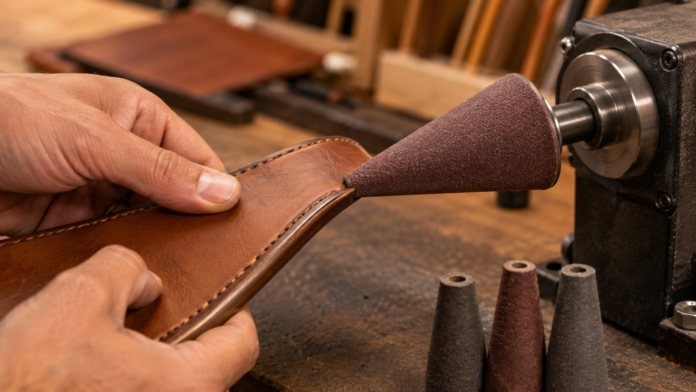

Flat surfaces get most of the attention in discussions of finishing work, sanding, smoothing, evening out a plane so it reads clean and consistent under light. Curved surfaces get comparatively little discussion, despite being just as common in finished goods and considerably harder to treat well. A rounded edge, a tapered heel, a contoured seam allowance does not respond to the same tools or the same technique a flat panel does, and pretending otherwise produces work that looks rushed exactly where it should look most refined.
Why Flat Tools Fail on Rounded Surfaces
A flat sanding surface, whether it is a handheld block or a disc mounted flush to a spinning arbor, makes contact with a flat workpiece across its entire face simultaneously, distributing pressure evenly and removing material at a consistent rate across the whole contact area. That same flat surface, pressed against a curved or tapered edge, only makes contact along a narrow line or a single point, wherever the curve happens to intersect the flat plane at that instant. Everywhere else on the curve, the tool either fails to touch the material at all or digs in unevenly as the operator tries to compensate by tilting or repositioning constantly.
This mismatch is not a matter of operator skill closing the gap through practice. It is a structural mismatch between the geometry of the tool and the geometry of the surface, one that no amount of careful handling with a flat tool fully resolves. A flat abrasive surface can smooth a flat plane efficiently and predictably. Asked to smooth a rounded profile, it can only ever approximate that shape through constant manual adjustment, and the result tends to show exactly that: subtle flat spots, uneven material removal, and a finished curve that reads as slightly irregular under close inspection or raking light.
Matching Tool Geometry to Workpiece Geometry
The more direct solution is not better technique with a mismatched tool but a tool whose working surface already matches the geometry being finished. A tapered or conical abrasive surface, wider at one end and narrowing toward the other, presents a continuously varying diameter along its length, meaning different points along that taper naturally correspond to different curve radii on the workpiece being sanded. Positioning the workpiece against the appropriate section of that taper brings the abrasive into full, even contact with a curved surface in a way a flat disc simply cannot replicate.
A cone sander built around this tapered profile allows an operator to work a rounded or tapered edge, a heel, a curved seam, a contoured panel edge, against whatever section of the cone’s surface corresponds to that specific radius, achieving even material removal across the full curve rather than the uneven, spot-contact result a flat abrasive produces on the same shape. The tool’s geometry is doing the alignment work that would otherwise fall entirely on manual technique and repeated small adjustments.
Grit Progression on Curved Work
Sanding, whether on flat or curved material, generally proceeds through a sequence of grit levels, starting coarse enough to remove material efficiently and shape the surface, then progressing to finer grits that remove the scratches and irregularities left by the coarser stage before it, ending at a level fine enough to leave the finished surface smooth under close inspection. This progression matters just as much on curved work as flat work, and arguably more, because a coarse-grit pass that leaves deep scratches on a curved surface is considerably harder to correct with a finer pass later if the tool being used cannot maintain even contact across the curve to begin with.
A coarser grit, in the range used for initial shaping and heavier material removal, does the bulk of the structural work, establishing the basic curve profile and removing excess material efficiently. A finer grit, following that initial pass, refines the surface left behind, smoothing out the marks the coarser abrasive left without removing enough additional material to distort the shape that first pass already established. Skipping too far ahead in that progression, jumping from a coarse grit directly to a very fine one, tends to leave visible remnants of the coarser pass’s scratch pattern beneath a surface that looks smooth only at a glance.
Why Heel and Edge Work Depends on This Distinction
Certain finishing tasks are almost entirely curved by nature rather than incidentally curved, work on a rounded heel edge, a tapered sole edge, or any contoured component where the entire functional surface being finished is a continuous curve rather than a flat plane interrupted occasionally by a rounded transition. In these cases, a tool mismatched to that curved geometry is not simply less efficient than a properly matched one. It is fundamentally unsuited to the task, since there is no flat reference surface anywhere on the piece for a flat abrasive tool to work against reliably.
This is where a taper-matched abrasive tool moves from being a convenience to being close to a necessity, since the alternative, working a continuously curved surface entirely by manual point-contact adjustment with a flat tool, produces results that are difficult to make consistent across multiple pieces, let alone consistent across the full length of a single curved edge on one piece.
Rotational Speed and Material Removal Rate
A rotating abrasive tool’s effective cutting behavior depends not only on grit and geometry but on how fast the abrasive surface is moving relative to the material being worked. Too slow, and the abrasive removes material inefficiently, requiring more passes and more time to achieve the same result a properly matched speed would achieve directly. Too fast, particularly on material sensitive to heat buildup, and the friction generated at the point of contact can scorch or otherwise damage the surface being finished before the operator has a chance to notice and adjust.
This is a variable that matters just as much on curved profile work as on flat sanding, though it interacts differently with a tapered tool, since different points along a cone’s length are moving at different effective surface speeds even at a single constant rotational speed, given that the diameter, and therefore the surface distance traveled per rotation, changes continuously along the taper. An operator working curved material against different sections of a cone has to account for that varying effective speed as part of achieving a consistent result across the full curve, rather than assuming a single setting behaves identically regardless of where along the cone the material makes contact.
Consistency Across Multiple Pieces as the Real Test
A single well-finished curved edge demonstrates that a technique and tool combination can work. Producing that same quality of finish consistently across dozens or hundreds of pieces, each intended to match the last closely enough that no individual unit stands out from the group, is a considerably higher bar, and one that depends heavily on the tool itself doing more of the alignment and consistency work rather than leaving that burden entirely to sustained, repeated manual precision from the operator.
A properly matched abrasive tool reduces the amount of operator judgment required to achieve an even result on any single piece, which in turn reduces the variability introduced across a production run of many pieces finished the same way. A mismatched tool, by contrast, depends on the operator recreating the same careful manual compensation on every single piece, a much harder standard to hold consistently across volume than a tool that already conforms to the shape being worked.
Specialization as a Recurring Theme in Finishing Work
The broader principle here recurs across many kinds of finishing and shaping work, not just abrasive sanding specifically. A general-purpose tool can often accomplish a specialized task through enough manual compensation and skill, but that compensation comes at a cost, in time, in consistency, and often in the final quality of the result compared to what a tool actually matched to the material’s geometry would achieve directly. Recognizing when a task’s geometry has moved far enough from the simple, flat case that a specialized tool becomes worth reaching for, rather than continuing to make a general tool work through added effort, is a distinction that separates efficient, consistent finishing work from finishing work that merely gets by.