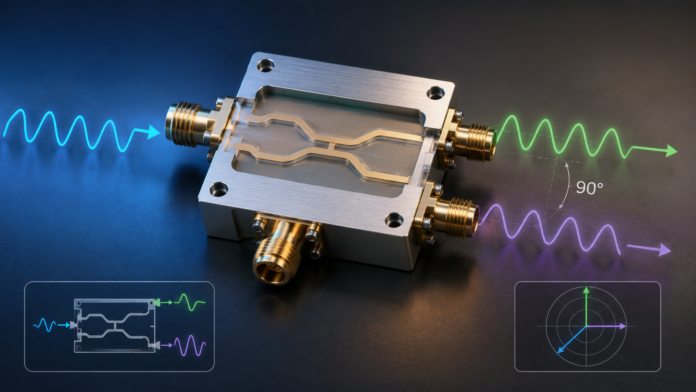

Dividing one signal into two equal halves sounds like a simple problem: split the power, send each half down its own path, done. In many radio-frequency and microwave systems, that description misses the part that actually matters. Two signals of equal power can behave completely differently once they are recombined or fed into the same device, depending on one property that has nothing to do with their strength: the timing relationship, or phase, between them. Understanding why phase relationships carry as much weight as raw power splitting explains an entire category of component built specifically to control that relationship with precision.
What Gets Lost When Only Amplitude Is Measured
A signal traveling through a circuit can be fully described by two properties working together: its amplitude, how strong it is, and its phase, essentially where it sits in its own timing cycle relative to some reference point. Most everyday descriptions of splitting a signal focus entirely on amplitude, does each output get half the power, while treating phase as an afterthought or ignoring it altogether.
That omission works fine in situations where the two halves of a split signal are used independently and never interact with each other again. It becomes a serious problem the moment two signals derived from a common source are recombined, fed into paired amplifier stages, or used together to drive a single downstream component. In these situations, the phase relationship between the two paths determines whether they combine constructively, reinforcing each other, or destructively, partially or fully canceling. An amplitude-only description of a two-way split says nothing about which of these outcomes will occur.
Building a Deliberate Phase Offset
Rather than treating phase as something to avoid or minimize, certain circuit designs are built specifically to introduce a precise, known phase difference between two output paths as their defining function. This is a different design goal entirely from a simple power splitter, which aims to keep both outputs in phase with each other while dividing amplitude evenly. A component built around phase offset instead holds amplitude division constant, typically an equal split, while deliberately shifting the timing relationship between the two outputs by a specific, fixed amount.
The value of a quarter-cycle offset in particular, ninety degrees of phase difference, comes from how cleanly it interacts with the mathematics of combining and separating signals downstream. A ninety-degree relationship sits at a kind of geometric midpoint that makes certain combining and balancing operations, distributing power evenly to two amplifier stages, or isolating one signal path from reflections generated on another, considerably more straightforward than an arbitrary or unspecified phase relationship would allow.
The Physical Mechanism Behind a Ninety-Degree Split
A quadrature, or ninety-degree, hybrid coupler achieves this offset through the physical layout of its internal transmission line structure rather than through any active electronic component. Signal entering the device travels along two coupled paths of carefully calculated length and proximity to each other, and the physical distance and electromagnetic coupling between those paths is what produces the phase shift between the two outputs. Because the offset comes from passive geometry, the physical dimensions of the coupling structure itself, the device requires no power supply and no active circuitry to function, and produces the same phase relationship consistently across its rated frequency range.
This passive nature is part of what makes these devices durable and predictable in operation. There are no active components to degrade, drift with temperature, or require external power, only a fixed physical structure whose behavior is determined by dimensions set during manufacturing rather than any operating condition that might change over time.
Isolation as the Other Half of the Function
A well-designed quadrature coupler does more than split power and shift phase between two output ports. It also isolates those two output ports from each other, meaning a signal or reflection appearing at one output has minimal effect on the other output port. This isolation matters considerably in real systems, where downstream components rarely present a perfect impedance match and therefore reflect some portion of the signal back toward the coupler.
Without meaningful isolation between output ports, a reflection generated at one output could leak back through the device and interfere with the signal present at the other output, corrupting a relationship that was supposed to be clean and predictable. A 90 degree hybrid coupler with strong isolation between its output ports prevents this kind of cross-contamination, keeping each output path’s signal integrity independent of whatever mismatch or reflection conditions exist on the other path.
Why “Ultra Wideband” Versions Solve a Different Problem
A basic quadrature coupler design can hold its ninety-degree phase relationship accurately across a moderate range of frequencies, but the physical dimensions that produce that precise offset are inherently tied to wavelength, meaning the same physical structure behaves differently as frequency shifts significantly away from the design center. Extending accurate performance across a much wider frequency range, an octave or more of bandwidth, requires more elaborate internal structures, often involving multiple coupled sections working together rather than a single simple coupling region.
This distinction matters in any application where a system needs to operate reliably across a broad swath of frequencies rather than a single narrow band, since a coupler optimized only for a narrow range will show degraded phase accuracy and amplitude balance as operating frequency moves away from its design center. A wideband design trades some manufacturing simplicity for the ability to maintain consistent phase and amplitude performance across a much larger operating range.
Where Balanced Amplifier Design Depends on This Relationship
One of the more direct applications of a precisely controlled ninety-degree phase relationship is in balanced amplifier configurations, where an incoming signal is split into two equal paths, each amplified independently by its own amplifier stage, and then recombined afterward. The entire premise of this configuration depends on the input split and output recombination happening at exactly the phase relationship the design assumes, because any deviation from that expected offset changes how the two amplified signals combine, potentially introducing amplitude ripple or reduced isolation from input mismatches that the balanced configuration was specifically designed to avoid.
This is a clear illustration of why phase precision matters as much as raw power handling in component selection. An amplifier stage might handle its rated power perfectly well in isolation, but if the coupler feeding it does not maintain accurate phase and amplitude balance across the frequency range in use, the overall combined performance of the balanced pair degrades in ways that are difficult to trace back to any single component when examined only for power-handling capability.
The Underlying Principle: Timing Matters as Much as Magnitude
The broader lesson extends past any specific circuit. Any system where two parallel processes eventually recombine or interact, whether that involves electrical signals, coordinated mechanical motion, or two teams working on interdependent halves of a shared project, depends not only on each half performing correctly in isolation but on the timing relationship between them being deliberately managed rather than left to chance. Two processes that are each individually correct can still produce a poor combined result if their relative timing was never accounted for. Precision in that relationship, not just in the individual outputs, is frequently what determines whether a system built from separate parallel paths performs as intended once those paths come back together.