
Combining two components that were never designed to work together is a routine part of any mechanical rebuild, whether that means adapting a transmission to a different engine, fitting an aftermarket part to an older platform, or pairing an accessory built for one system with a completely different one. The components themselves may both function perfectly well on their own. The problem is rarely whether each part works. It is whether the geometry between them lines up once they are forced to share the same mounting points and the same moving belt, chain, or shaft path.
Two Parts, Two Different Design Assumptions
Every mechanical component is engineered with an assumed set of neighbors in mind. A bracket is designed around the exact dimensions of the specific part it was meant to hold, positioned at a specific distance and angle from whatever it connects to next. An alternator is designed with a pulley at a specific diameter and a mounting flange at a specific location relative to its shaft, because the manufacturer that built it had one particular engine and one particular belt path in mind when they finalized that design.
When a part from one manufacturer’s system is introduced into another manufacturer’s engine, none of those original assumptions necessarily hold. The replacement part might be mechanically sound, well within its own rated specifications, and still be positioned in a way that no longer lines up correctly with the rest of the system it has been placed into. This is a geometry problem, not a strength or reliability problem, and it requires a different kind of solution than simply confirming the new part is well made.
Why Belt-Driven Accessories Are Especially Sensitive
Components driven by a belt, rather than bolted rigidly to a shared shaft, are particularly exposed to this kind of mismatch because a belt has almost no tolerance for misalignment before it starts causing measurable problems. A belt is engineered to run in a single flat plane across every pulley it touches. Even a small offset, a pulley sitting slightly forward, back, higher, or lower than the plane the rest of the belt system occupies, forces the belt to twist slightly as it travels between pulleys rather than running flat.
That twisting does not need to be dramatic to cause damage. A belt running under even modest misalignment wears unevenly along its edge, generates additional heat from the added friction, and in more severe cases can walk off a pulley entirely under vibration or load changes. None of this shows up as a defect in the belt itself or in either individual pulley. It shows up only once the two components are installed together and their respective mounting geometries are compared against each other in practice.
Mounting Height as the Core Variable
Among the different ways two components can be misaligned, differences in mounting height are one of the most common sources of belt-path problems when swapping accessories between engine platforms. A component mounted slightly higher or lower than its counterpart shifts the angle a belt has to travel at as it moves from one pulley to the next, and that shift compounds across every additional pulley the same belt has to reach.
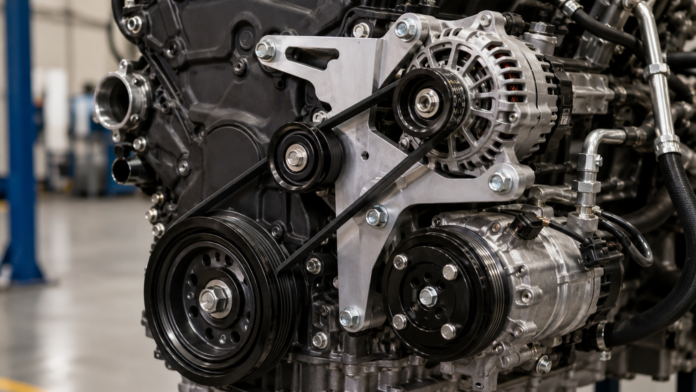
This is part of why a bracket built specifically to correct a known height mismatch, rather than a generic mounting adapter, matters in situations where an accessory from one system is being adapted to run on another. A Cummins high mount A/C bracket kit exists to solve exactly this kind of height discrepancy, repositioning an air conditioning compressor and its associated alternator to a mounting height that restores proper belt alignment when the accessory hardware being used originates from a different platform than the engine it is being installed on. The bracket’s job is not to hold the components in place, which nearly any sufficiently rigid mount could do. Its job is to hold them in the specific position that keeps the belt running flat across every pulley in the system.
Fitment Problems Rarely Announce Themselves Immediately
A belt system installed slightly out of alignment often runs without obvious complaint for some period of time before the consequences become apparent. Early wear develops gradually along the belt’s edge, and vibration from the misalignment may be subtle enough to go unnoticed under normal engine noise and operating conditions. This delay is part of what makes fitment problems easy to underestimate during an initial installation, since everything can appear to be working correctly in the short term even when the underlying geometry is off.
The eventual failure mode, when it does show up, tends to appear as accelerated belt wear, unusual noise from the belt path, or in more pronounced cases a belt working its way off a pulley during a load change or a cold start. Diagnosing that failure after the fact often takes longer than it would have taken to verify alignment correctly during the original installation, because the symptom presents at the belt while the actual cause sits upstream, in the mounting geometry that positioned the pulley incorrectly in the first place.
Why “It Fits” Is a Lower Bar Than “It Aligns”
A bracket or adapter that allows a mismatched part to bolt into place has cleared a fairly low bar. Bolt holes lining up, or being drilled to line up, only confirms that the two parts can be physically attached to each other. It says nothing about whether the resulting position places the moving components, pulleys, shafts, belts, in the correct relative plane once everything is assembled and running.
This distinction matters most in any situation where components are being deliberately mixed across systems that were not originally designed together, since the entire premise of that kind of swap depends on solving a fitment problem that the original manufacturers never had to consider. A part that technically bolts on but sits at the wrong height, angle, or offset has solved the attachment problem while leaving the actual mechanical problem, correct alignment of moving parts, unresolved.
The Broader Lesson in Adapting Mismatched Systems
This same principle extends well beyond any single mechanical component. Any time two systems built independently are combined, whether that involves software interfaces, physical hardware, or organizational processes brought together after a merger, the point of failure is rarely whether each individual system functions correctly on its own. It is whether the specific points of contact between them, the interfaces, the handoffs, the shared surfaces, were deliberately reconciled or simply assumed to work because both sides seemed sound in isolation.
Solving that kind of mismatch generally requires identifying the specific dimension along which the two systems diverge, in a belt-driven mechanical system, that dimension is often height and angle, and building a deliberate correction around that exact variable rather than a generic adapter that solves attachment without solving alignment. The distinction between a part that fits and a part that truly aligns is where most of the durable engineering work in any cross-platform adaptation actually happens.