
Stepping out of the shower is a vulnerable moment for skin. The water stops. The air hits. And within minutes, moisture starts flying away.
Most humans think the moisturizer does all the work. So they buy expensive bottles. But the real work happens in the first few minutes after the water turns off. Get those wrong, and even the richest cream won’t help.
A research team ran the numbers. They tested timing, amount, and frequency on healthy women and women with dry skin. The findings are simple. Getting the method right changes everything. The product itself comes second.
- Make lightweight body oil spray your shower’s last step!
The 5-Step Post-Shower Moisture Routine
Step 1: Control Shower Temperature
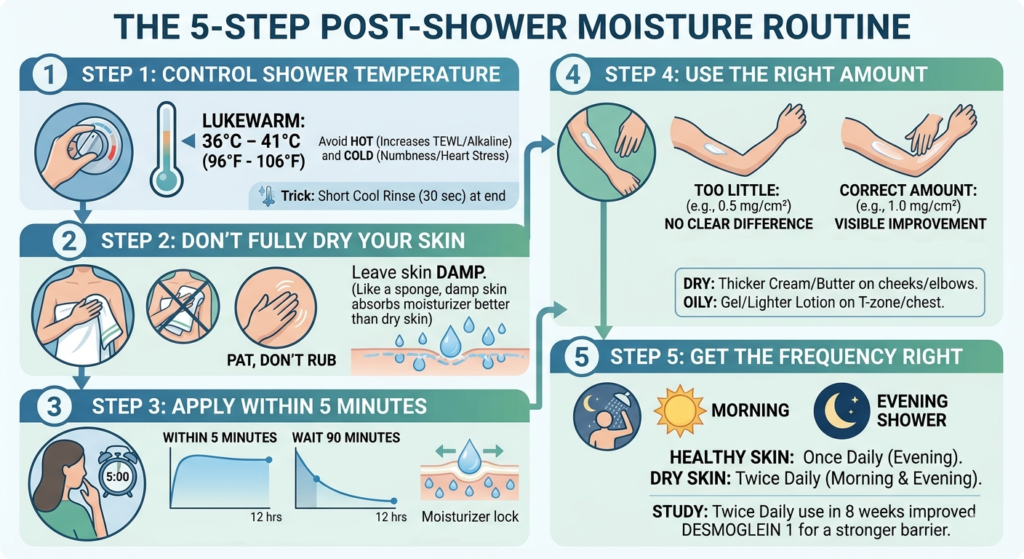
Your skin hates hot water. It brings lots of cons.
Hot water increases water loss from the skin. It also raises pH levels, making skin less acidic. That leads to dryness, redness, and itching. For eczema, hot water makes things worse.
Cold water isn’t much better. It also increases water loss and raises pH. It tightens blood vessels and can raise the heart rate.
If you prefer soaking over showering, the same rules apply – keep the water lukewarm and try adding one of these natural bath bombs for a skin-friendly, moisture-boosting soak.
The sweet spot?
- Lukewarm water between 36°C and 41°C (96°F to 106°F).
Try this trick. Start warm. Then drop the temperature for the last 30 seconds. A quick cool rinse boosts circulation without damaging skin. It wakes you up, too. Keep it brief.
Step 2: Don’t Fully Dry Your Skin
Most people step out of the shower and rub themselves dry with a towel. They want to feel dry and clean. But this is a problem.
There’s a difference between wet skin, damp skin, and dry skin.
| Wet skin | Damp skin | Dry skin |
| Has water dripping off | Has a thin layer of moisture | Has nothing left |
After a shower, water evaporates from your skin within minutes. And when that water goes away, it takes your skin’s natural moisture with it. You end up drier than before you stepped into the shower.
The fix is simple.
- Pat your skin lightly with a towel. Don’t rub. Leave a slight dampness behind.
Because moisturizer needs water to bind to. If your skin is completely dry, your lotion sits on top. It doesn’t soak in well. But if your skin is damp, the moisturizer mixes with that water and locks it inside.
It’s like a sponge. A slightly wet sponge absorbs more water than a bone-dry one. Same idea.
This doesn’t mean you can use the product on wet skin. The issue there is that the water will dilute the product. And this will reduce the moisturizer’s efficiency.
Step 3: Apply Within 5 Minutes
This is the biggest mistake people make. They wait.
They get out of the shower. Dry off. Get dressed. Make coffee. Then, 30-90 minutes later, they remember to put on lotion or moisturizer.
Too late.
A Japanese study tested this directly. One group applied moisturizer within 5 minutes after showering. Another group waited 90 minutes. Then they measured skin moisture after 12 hours.
- The result was clear. Applying within 5 minutes kept skin hydrated even after 12 hours. Waiting 90 minutes gave much lower hydration.
Why does this happen? Right after you shower, your skin is still hydrated. But it’s losing water rapidly through evaporation. Your natural moisturizing factors and oils wash away during bathing. Your skin is vulnerable.
A moisturizer acts like a lid. It locks the water in before it escapes.
So, set a rule. Get out of the shower. Pat dry. Apply lotion. Before you do anything else.
Step 4: Use the Right Amount
Humans use too little moisturizer. They squeeze a small dot and spread it over their whole leg. That doesn’t work.
The Japanese study tested different amounts. Here’s what they found.
- 0.5 mg/cm² didn’t make a clear difference. It was basically useless. But 1.0 mg/cm² or more showed visible improvement.
What does this look like in real life?
You need a thin but visible layer of moisturizer. It should feel a slight slip when you rub it in. The product shouldn’t dry instantly on your skin. If it disappears right away, you didn’t use enough.
The amount you need also depends on your skin type and which body part you’re moisturizing. Here’s a quick guide.
| Skin Type | Moisturizer Type | Areas | Reason |
| Dry | Thicker cream | Cheeks, and around the mouth | These areas have fewer oil glands. They lose water faster. Thicker cream sits on top longer. |
| Body butter | Elbows, knees, heels, and hands | ||
| Oily skin | Gel-based moisturizer | T-zone areas: forehead, nose, and chin | These areas produce the most oil. A thick layer feels greasy and causes breakouts. Go light. |
| Lighter lotion or lightweight body oil | Chest, back, and skin folds |
Step 5: Get the Frequency Right
Once a day? Or twice a day? The answer depends on your skin.
- For healthy skin, once a day after your evening shower works fine.
- For dry skin, experts say that twice daily works better.
As per the Japanese study, after 8 weeks, only twice-daily use improved desmoglein 1. That protein helps skin cells stick together. A stronger barrier means lasting results.
Recommendation: Moisturize after your evening shower and again in the morning.
Significance of the Right Moisturizer
1. Boosts and Locks In Hydration
Your skin absorbs water from the air and from your shower. But that water leaves just as fast through evaporation.
A moisturizer stops this. How? By adding humectants.
Humectants are molecules that grab water and hold it inside your skin’s outer layer. They form hydrogen bonds with water molecules. That means the water can’t float away into the air.
One example is vegetable glycerin and aloe vera. They pull moisture from the air into your skin. Keep your face plump and soft. Super gentle, even on sensitive or inflamed skin.
2. Repairs Skin Barrier
Your skin barrier is a layer of dead cells held together by lipids (fats). These lipids act like glue. When hot water or soap strips that glue away, your barrier cracks. Water leaks out through the cracks.
A moisturizer repairs this by delivering replacement lipids. These fats fill the gaps between cells. They restore the glue. Eventually, this helps improve skin barrier function.
A strong, well-moisturized barrier is also the foundation for active ingredients – you can see what retinol realistically does over time when it’s paired with proper hydration.”
Ingredients like sunflower seed oil and hemp seed oil bring such perks mainly. They’re rich in linoleic acid, a lipid your barrier needs to stay strong. Plus, research shows it helps with conditions like atopic dermatitis by restoring this cellular glue.
3. Prevents Dryness and Flaking
Dryness happens when the top layer of your skin loses flexibility. Without enough water, skin cells shrink and crack. Those cracks turn into flakes you see.
A moisturizer prevents this through occlusives. Occlusives are thick molecules that sit on top of your skin. They form a physical film. That film blocks water from escaping.
Lots of natural ingredients in moisturizer have such properties. Take shea and cocoa butter, for example. They form a protective barrier that locks moisture in. This makes them just right for rough, flaky areas. Their triterpenoids also reduce redness and swelling without causing harm.
4. Calms Irritation and Redness
Redness means blood vessels near your skin surface have expanded. They do this in response to damage or allergens. Expanded vessels send more blood to the area. More blood means more heat and more redness.
A moisturizer here helps deliver anti-inflammatory compounds to the affected areas and calms this. Such compounds block the chemical signals that tell blood vessels to expand.
Goat’s milk, aloe vera, coconut oil, olive oil, and pennywort. All are soothing heroes. They have antioxidant and anti-inflammatory properties that calm itchy, irritated skin.
All of them hydrate and repair the skin barrier, which helps with skin conditions. Be it psoriasis, rosacea, atopic dermatitis, or xerosis. That’s why it’s so gentle for sensitive or inflamed skin.
5. Improves Skin Texture Smoothness
Rough texture happens when dead skin cells don’t fall off. They stick together in clumps on your surface. These clumps create bumps and uneven patches.
A moisturizer helps soften the bonds between dead cells and improves texture.
Ingredients in moisturizer, like jojoba, goat’s milk, sunflower seed oil, shea butter, and cocoa butter, ensure those perks. They boost skin softness and smoothness within minutes.
Smooth, hydrated skin also makes a noticeable difference when you wear makeup – especially if you’re using primers designed for mature skin, which perform best on a well-moisturized base.
FAQs
Which moisturizer is best for comedones?
Look for non-comedogenic, lightweight formulas with jojoba oil, aloe, and glycerin, like Naples Soap Company Hydra Gel 24/7 Essential Moisture. Avoid coconut oil and shea butter on acne-prone areas.
What is the 3-minute moisturizer rule?
Apply moisturizer within 3 minutes of exiting the shower. Damp skin absorbs it better than dry skin does.
Can moisturizer reduce redness?
Yes. Ingredients like Goat’s milk, aloe vera, and pennywort carry anti-inflammatory compounds that calm expanded blood vessels and lower heat.
Should you moisturize at night if you have acne?
Yes. Nighttime moisturizing repairs your skin barrier. Just pick a lightweight, non-comedogenic formula that won’t clog pores.