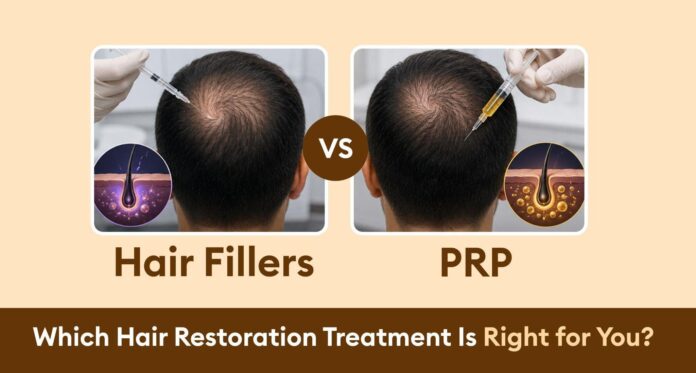

Hair loss affects millions of men and women worldwide, leading many people to explore non-surgical treatments before considering surgical intervention for obvious reasons. Two of the most widely discussed regenerative options today are Hair Fillers and Platelet-Rich Plasma (PRP).
Although both treatments involve injections into the scalp and aim to support healthier hair growth, they work in fundamentally different ways.
PRP relies on growth factors obtained from a patient’s own blood, while modern Hair Fillers use carefully formulated biomimetic peptides designed to mimic the body’s natural biological signaling involved in hair follicle function.
Understanding these differences can help patients and practitioners choose the most appropriate treatment strategy.
Hair Fillers vs PRP: Quick Comparison
| Feature | Hair Fillers | PRP |
| Source | Standardized biomimetic peptides in a hyaluronic acid carrier | Patient’s own blood |
| Active Ingredients | Biomimetic peptides + Hyaluronic Acid | Platelet-derived growth factors |
| How It Works | Delivers targeted regenerative signals through multiple biological pathways | Releases naturally occurring growth factors from concentrated platelets |
| Peptide Technology | Yes | No |
| Standardization | Consistent formulation with fixed peptide concentrations | Platelet concentration varies between patients and preparation methods |
| Treatment Consistency | Standardized treatment protocol | Biological variability may influence treatment consistency |
| Blood Draw Required | No | Yes |
| Procedure | Injectable | Injectable |
| Downtime | Minimal | Minimal |
| Non-Surgical | Yes | Yes |
What Is PRP?
Platelet-Rich Plasma (PRP) is a regenerative treatment created using the patient’s own blood.
A small blood sample is collected and processed in a centrifuge to concentrate platelets, which naturally contain growth factors involved in tissue repair and cellular communication. The concentrated plasma is then injected into targeted areas of the scalp.
Because PRP is derived from the patient’s own blood, it is considered an autologous treatment. However, the composition of PRP is naturally influenced by individual biological factors such as platelet count, age, overall health, medications, and the preparation protocol used. As a result, the concentration of growth factors can vary from one patient—and even one treatment session—to another.
What Are Hair Fillers?
Hair Fillers are injectable formulations specifically developed to support hair restoration and scalp health.
Unlike PRP, Hair Fillers do not rely on the body’s natural production of growth factors. Instead, they contain carefully selected active ingredients that provide a standardized regenerative approach.
Modern formulations combine cross-linked hyaluronic acid with biomimetic peptides. These are small protein fragments engineered to mimic the body’s own biological signaling molecules.
These peptides are designed to communicate with hair follicles and surrounding scalp tissue by supporting biological pathways associated with:
- Hair growth signaling
- Hair follicle health
- Hair cycle regulation
- Scalp regeneration
- Protection against mechanisms associated with progressive follicular miniaturization
Because the formulation is standardized, each treatment delivers consistent concentrations of active ingredients regardless of individual patient biology.
What Are Biomimetic Peptides?
One of the biggest differences between modern Hair Fillers and PRP is the use of biomimetic peptides.
Peptides are short chains of amino acids that act as biological messengers throughout the body. Biomimetic peptides are laboratory-designed molecules that closely resemble naturally occurring signaling peptides involved in cellular communication.
Rather than replacing tissue or acting as a filler alone, these peptides are designed to deliver targeted biological signals that support normal cellular activity.
In hair restoration, biomimetic peptides are being studied for their role in supporting pathways associated with:
- Hair follicle activation
- Hair growth cycle regulation
- Scalp tissue remodeling
- Extracellular matrix support
- Follicular microenvironment optimization
This targeted signaling approach represents one of the key advances in regenerative aesthetic medicine.
Understanding the Biological Difference
Although both treatments are regenerative, their mechanisms differ significantly.
PRP: Growth Factor-Based Regeneration
PRP depends on naturally occurring growth factors released from activated platelets after injection.
These growth factors participate in tissue repair and cellular signaling. However, because PRP is prepared from each patient’s own blood, its biological composition is inherently variable.
Factors including platelet concentration, overall health, medications, hydration, and laboratory preparation techniques may all influence the final product, making treatment consistency dependent on individual biology.
Hair Fillers: Peptide-Based Regenerative Signaling
Hair Fillers utilize biomimetic peptides that are formulated in predetermined concentrations to provide consistent biological signaling.
Rather than depending on naturally occurring platelet activity, peptide-based formulations are designed to support multiple pathways involved in hair follicle biology.
Advanced formulations may support:
- Hair growth signaling
- Follicular activity
- Hair cycle regulation
- Scalp tissue regeneration
- Extracellular matrix remodeling
- Biological pathways associated with follicular preservation
Products such as Elyara Hair Filler combine a seven-peptide complex with sustained-release technology, allowing the active ingredients to be delivered gradually while supporting multiple regenerative pathways involved in scalp and follicular health.
Pros and Considerations
PRP
Potential Advantages
- Uses the patient’s own blood
- Widely available
- Familiar treatment for many practitioners
- Minimally invasive
Considerations
- Growth factor concentration varies between individuals
- Platelet quality is influenced by patient biology
- Requires blood collection and processing
- Preparation techniques differ between clinics, which may affect treatment consistency
Hair Fillers
Potential Advantages
- Standardized formulation
- Consistent concentration of active ingredients
- No blood draw required
- Peptide technology specifically developed for hair restoration
- Supports multiple biological pathways associated with follicular health
- Easily incorporated into comprehensive hair restoration protocols
Considerations
- Product formulation differs between manufacturers
- Appropriate patient selection remains important
- Should be administered by trained medical professionals
Why Peptide Technology Is Gaining Attention
Hair restoration has evolved significantly over the past decade.
Earlier regenerative treatments primarily relied on naturally occurring growth factors. More recent innovations have shifted toward precision regenerative signaling, using biomimetic peptides specifically designed to interact with pathways involved in hair follicle biology.
This represents a move from relying on naturally variable biological materials toward standardized regenerative formulations developed specifically for aesthetic medicine.
Among these newer technologies is Elyara Hair Filler, which combines seven biomimetic peptides with cross-linked hyaluronic acid and sustained-release delivery technology to provide a consistent regenerative treatment designed to support scalp health, follicular activity, and hair growth signaling.
Final Thoughts
PRP and Hair Fillers both represent important advances in non-surgical hair restoration, but they approach regeneration in different ways.
PRP relies on naturally occurring growth factors obtained from the patient’s own blood, making treatment inherently dependent on individual biological variability.
Hair Fillers, by comparison, use standardized biomimetic peptide technology designed to provide consistent regenerative signaling across multiple biological pathways associated with hair follicle function.
As regenerative medicine continues to evolve, many practitioners are increasingly exploring peptide-based technologies that combine targeted biological signaling with formulation consistency to support long-term scalp and follicular health.
Frequently Asked Questions
Are Hair Fillers and PRP the same treatment?
No. PRP uses concentrated platelets obtained from the patient’s own blood, whereas Hair Fillers use pre-formulated active ingredients such as biomimetic peptides and hyaluronic acid.
What are biomimetic peptides?
Biomimetic peptides are laboratory-designed molecules that mimic naturally occurring biological signaling peptides. They are developed to communicate with cells through targeted regenerative pathways involved in tissue health and repair.
Why are Hair Fillers considered more standardized than PRP?
Hair Fillers contain predetermined concentrations of active ingredients, ensuring every treatment uses the same formulation. PRP, on the other hand, is derived from a patient’s own blood, meaning platelet concentration and growth factor content can naturally vary between individuals and treatment sessions.
Can Hair Fillers and PRP be combined?
Treatment protocols vary depending on practitioner preference and patient needs. Some clinicians may choose to combine multiple regenerative approaches as part of a personalized treatment strategy.
What makes Elyara Hair Filler different?
Elyara Hair Filler combines cross-linked hyaluronic acid with a seven-peptide biomimetic complex and sustained-release technology. This peptide-based formulation is designed to provide consistent regenerative signaling that supports multiple biological pathways associated with scalp health and hair follicle function.