
There’s a quiet shift happening in how people engage with AI-generated imagery — and it’s not coming from tech labs or marketing departments. It’s coming from expectant parents, curious couples, and family content creators who just want to see something personal and fun. The rise of baby generation AI tools is one of the more human stories in a space that often feels cold and technical.
This piece looks at that trend from the inside — what’s driving it, who’s actually using these tools, and what it tells us about where consumer AI is heading.
The Numbers Behind the Curiosity
Before getting into the “why,” it helps to understand the scale.
According to a 2024 Statista report on generative AI adoption, consumer-facing AI image tools saw a 43% increase in monthly active users year-over-year, with personal and lifestyle use cases growing faster than professional ones. People aren’t just using AI for work. They’re using it to explore identity, relationships, and — increasingly — family.
Search interest in baby prediction and family visualization tools has followed a similar curve. What was once a novelty feature buried in photo apps has become a standalone category. And that category is maturing fast.
From Gimmick to Genuine Use Case
A few years ago, “see your future baby” tools were mostly joke generators — low-resolution, obviously fake, good for a laugh and not much else. The outputs were so cartoonish that nobody took them seriously.
That’s changed significantly.
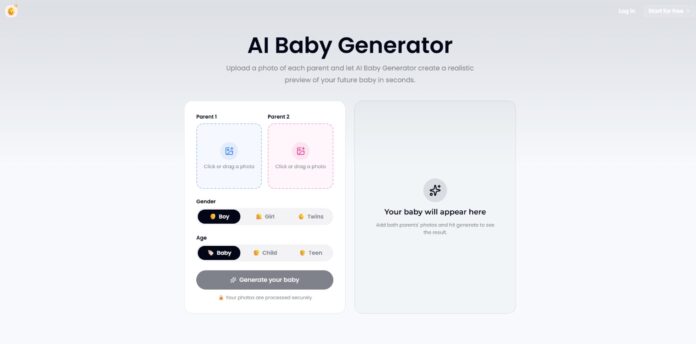
Modern tools like Baby Generator use trained AI models that analyze facial structure, skin tone, and feature distribution from parent photos to produce results that feel genuinely plausible. The jump in quality isn’t subtle. It’s the kind of difference that moves something from “funny party trick” to “I’m actually saving this image.”
What Changed Technologically
The underlying shift is in how these models are trained. Earlier tools relied on simple feature-blending algorithms — take the eyes from one photo, the nose from another, average them out. The results looked like a ransom note made from magazine clippings.
Current AI baby tools use diffusion-based models and facial landmark detection that understand structure, not just pixels. The model doesn’t just blend — it reasons about how genetic features might combine. The output still isn’t a prediction in any scientific sense, but it’s coherent in a way that earlier tools never were.
This is why the emotional response to these tools has changed. People aren’t laughing at the output anymore. They’re sharing it with their parents. They’re printing it. That’s a fundamentally different relationship with the technology.
Who’s Actually Using These Tools — and Why
The user base for baby generation AI is more varied than you might expect.
Expectant Parents
This is the obvious segment, and it’s the largest. Couples who are pregnant — or trying to be — use these tools to visualize what their child might look like. It’s not about accuracy. It’s about emotional connection and anticipation. The image becomes a kind of artifact of that moment in their lives.
Several users on parenting forums have described using generated baby images as profile pictures in private family group chats before their child was born. The image holds a place. It gives the anticipation a face.
Content Creators in the Family Niche
This is the segment that’s grown most unexpectedly. Family and parenting content creators on YouTube and Instagram have found that baby prediction content drives unusually high engagement. The format is simple: upload photos of both parents, generate the result, react on camera.
It works because it’s personal, it’s visual, and it has a built-in reveal moment. Those three elements are basically a short-form content formula. Creators who’ve built audiences around relationship and family content have added AI baby tools to their regular content rotation — not as a one-off stunt, but as a repeatable format.
Long-Distance Families and Couples
There’s a quieter use case that doesn’t get talked about much: couples in long-distance relationships, or families separated by geography, using these tools as a way to imagine a shared future. It sounds sentimental, but the emotional utility is real. A generated image of a hypothetical child is a tangible representation of something abstract — a future that feels possible.
The Workflow Is Simpler Than People Expect
One of the reasons adoption has accelerated is that the barrier to entry is genuinely low.
With a tool like Baby Generator, the process takes under two minutes. Upload a clear photo of each parent, let the AI process the inputs, and receive a generated image. There’s no account setup required for basic use, no technical knowledge needed, and no waiting around for a render queue.
Why Simplicity Matters Here
In consumer AI, friction kills adoption. The tools that have broken through — whether in image generation, voice cloning, or video creation — are almost always the ones that reduced the steps between “I want to try this” and “I have a result.”
Baby generation tools sit in an interesting position because the emotional stakes are higher than most AI image use cases. People are uploading photos of themselves and their partners. They want the experience to feel safe, fast, and private. Tools that nail those three things tend to retain users in a way that technically superior but clunky alternatives don’t.
The Broader Trend: AI Getting Personal
Zoom out a little, and the baby generator trend is part of something larger.
Consumer AI is moving away from generic outputs — “generate an image of a mountain at sunset” — toward deeply personal ones. People want AI that knows them, or at least takes their specific inputs seriously. Baby prediction, AI portrait tools, personalized avatars — these are all expressions of the same underlying desire.
McKinsey’s 2024 State of AI report noted that consumer trust in AI tools increases significantly when the output is personalized rather than generic. That finding maps directly onto what’s happening in this space. The more an AI output feels like it was made for you, the more likely you are to engage with it, share it, and come back.
An AI Baby Generator sits almost at the extreme end of that personalization spectrum. The input is your face. The output is a hypothetical version of your family. It doesn’t get much more personal than that.
What This Tells Us About Consumer AI Adoption
The trajectory of baby generation tools offers a useful case study in how consumer AI categories mature.
Phase one is novelty — people try it because it’s new and slightly absurd. Phase two is quality improvement — the outputs get good enough that the use case becomes real. Phase three is normalization — the tool becomes part of how people do something they were already doing anyway.
Baby prediction tools are somewhere between phase two and phase three right now. The quality is there. The use cases are established. What’s still developing is the cultural habit — the point where reaching for an AI baby tool feels as natural as reaching for a photo filter.
That normalization is coming. The question for tools in this space is whether they’ve built enough trust, simplicity, and output quality to be the default choice when it arrives.
Final Thought
There’s something worth pausing on here. In a landscape full of AI tools optimized for productivity, efficiency, and professional output, baby generation AI is optimized for something else entirely: imagination and emotional connection.
That’s not a small thing. It might actually be the direction that consumer AI needs to move in more broadly — less about replacing work, more about enriching the parts of life that don’t have a productivity metric.
Tools like Baby Generator aren’t changing how we work. They’re changing how we daydream. And honestly, that’s a more interesting problem to solve.