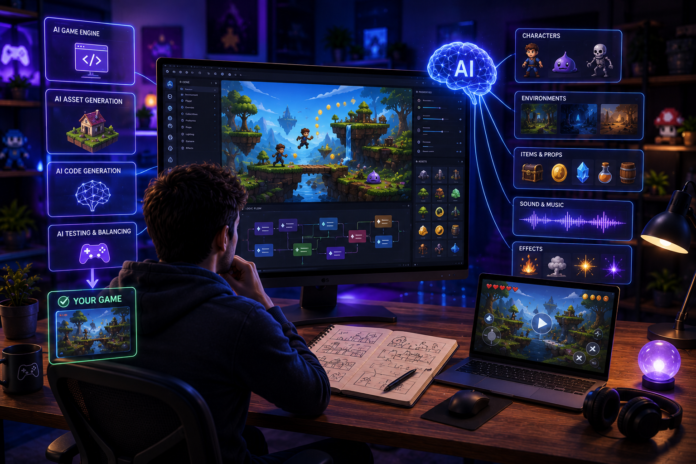

Hiring a development team used to be the default assumption for anyone serious about building a real game. Programmers, artists, designers, sound engineers, each role traditionally required a dedicated specialist, which meant a serious game idea also meant a serious budget before a single line of the actual game existed. That assumption doesn’t hold the way it used to, and understanding exactly what’s changed matters if you’re deciding whether your own idea needs a team or not.
Why Hiring Used to Feel Non-Negotiable
Each Role Required Genuine Specialization
Programming, art, sound design, and game design each demanded years of dedicated skill-building. Expecting one person to competently cover all of them was unrealistic for anything beyond the simplest project, which pushed serious ideas toward team-based development almost by default.
Manual Implementation Didn’t Scale With One Person’s Time
Even with strong skills across multiple areas, a single person manually coding, creating art, and designing levels simply couldn’t produce as much as a coordinated team working in parallel. Team size directly limited what a solo creator could realistically finish within a reasonable timeframe.
The Cost of Getting It Wrong Was High
Without a team to catch problems early or bring diverse perspective to design decisions, solo projects historically carried more risk of missing obvious issues that a second or third set of eyes would have caught immediately.
What’s Actually Changed
AI Absorbs Much of the Specialized Implementation Work
Build a game platforms now handle a significant share of what used to require dedicated technical specialists. Describing a mechanic in plain language and getting back a working implementation removes the programming bottleneck that used to be the primary reason solo creators needed to bring in additional people.
Asset Generation Reduces the Art Team Requirement
Producing placeholder or usable art traditionally required either genuine artistic skill or a hired artist. AI-assisted asset generation lets a solo creator cover this ground directly, at least well enough to build, test, and refine a complete game without waiting on external art production.
Iteration Speed Compensates for Fewer Perspectives
While a solo creator doesn’t get the built-in feedback of teammates during development, faster iteration means testing more variations and getting more external playtesting feedback becomes realistic even without a team. Games like Krunken Astro reflect what that kind of solo-driven, iteration-heavy process can produce, a tuned, satisfying result that came from repeated refinement rather than a team catching problems along the way.
What a Solo Creator Actually Needs to Cover Now
Creative Direction and Design Judgment
This remains entirely your responsibility regardless of what tools you use. Knowing what makes your idea worth building, and recognizing when a mechanic feels right versus when it needs more work, can’t be outsourced to any platform.
Honest Playtesting and Iteration
Without teammates providing built-in feedback, you need to be deliberate about seeking outside reactions. This matters more for solo creators than for teams, since there’s no natural source of alternative perspective unless you actively go looking for it.
Project and Scope Management
Teams naturally distribute the mental load of tracking what needs to happen next. As a solo creator, keeping your project scoped realistically and moving forward consistently is entirely on you, and it’s one of the areas where solo projects most commonly stall.
A Realistic Process for Building Solo
Step 1: Define a Scope You Can Actually Finish Alone
Even with AI assistance reducing the technical burden, ambition still needs to match what one person can realistically manage. Keep your first solo project smaller than feels comfortable.
Step 2: Use AI to Handle the Repetitive Implementation Work
Let the platform handle translating your described mechanics into working systems, and generating placeholder or usable assets. This frees your limited time for the decisions that actually require your judgment.
Step 3: Actively Seek Outside Feedback
Since you don’t have teammates providing natural perspective, be deliberate about finding playtesters. Share rough versions early and often with people outside the project.
Step 4: Iterate Based on What You Observe, Not Just Instinct
Without a team to challenge your assumptions, it’s easier to keep building based purely on your own preferences. Real playtesting reactions matter even more for solo creators as a check against that tendency.
Step 5: Protect Time for the Judgment Calls Only You Can Make
Don’t let saved implementation time simply mean working on more features. Reinvest it into thinking carefully about pacing, fairness, and feel, the parts of development that determine whether a game is actually good.
Where Hiring Might Still Make Sense
Highly Technical or Large-Scale Systems
If your project genuinely requires deep technical customization, competitive netcode, complex simulation, bringing in a specialist may still be the right call, even with AI-assisted tools covering more common ground than ever.
When You Need a Second Creative Perspective Permanently
Some creators genuinely benefit from ongoing creative collaboration rather than occasional outside feedback. If that’s true for you, a small team or a single collaborator might still serve the project better than working entirely alone.
When Timeline Pressure Requires Parallel Work
If a project has a hard deadline that requires multiple things happening simultaneously, art, implementation, testing, a solo creator working sequentially may simply not be able to move fast enough regardless of how much AI assistance reduces individual task time.
Final Thoughts
Building your own game without hiring a development team isn’t the compromise it used to be. AI-assisted tools have absorbed enough of the specialized implementation work that a single motivated creator can realistically cover ground that used to require several dedicated roles. What still depends entirely on you is the creative judgment, the honest self-assessment, and the discipline to seek real feedback rather than relying solely on your own instincts.
If you’ve been sitting on a game idea because you assumed it required a team you couldn’t afford or assemble, that assumption is worth reconsidering. The tools now exist to build it yourself, the only question left is whether you’re willing to see it through.