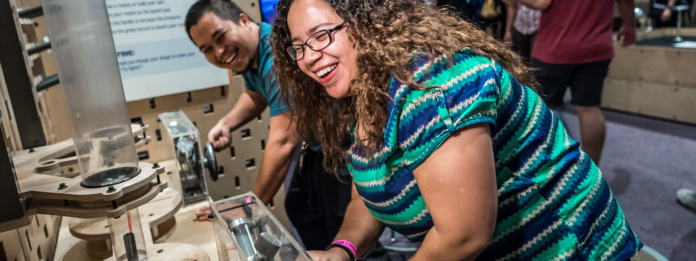

Walk into any room full of children and a locked glass display case, and watch what happens. Within minutes, attention drifts. Now replace that case with a lever to pull, a button to press, or a structure to build, and the same children will stay engaged for ten times as long. This is not a coincidence. It is the foundation of how children actually learn science, and it is why hands-on learning museum experiences have become one of the most effective tools available to parents and educators trying to build a lasting love of STEM.
Decades of research in childhood development point to the same conclusion: children understand the world best when they are allowed to touch it, test it, and occasionally get it wrong. Interactive science exhibits for kids are built around this principle, turning abstract scientific concepts into something a child can physically manipulate and immediately see the result of. The outcome is not just a fun afternoon. It is a measurable shift in how a child approaches problems, asks questions, and thinks about the world around them.
Why Hands-On Learning Sticks
Traditional classroom instruction often asks children to absorb information passively, through reading, listening, or watching. Interactive exhibits flip that model. A child who cranks a wheel to see how gears transfer motion, or who experiments with airflow to launch a foam rocket, is engaging multiple senses and forming a direct cause-and-effect connection. That connection is what cements understanding.
This is the well-documented difference between observation-based learning and discovery-based learning. Observation tells a child what happens. Discovery lets a child figure out why it happens, and that act of figuring it out is where genuine curiosity takes root. A child who has personally discovered that warm air rises is far more likely to remember and care about that fact than one who simply read it in a textbook.
Curiosity as a Skill, Not Just a Trait
It is tempting to think of curiosity as something children either have or do not have. In practice, curiosity behaves more like a skill that strengthens with use. Every time a child is rewarded for asking ‘what happens if,’ that instinct becomes a little more automatic. Environments built around children’s science exhibits give children permission, and the tools, to ask that question constantly and safely.
This matters well beyond the museum floor. Children who are regularly encouraged to test ideas and tolerate failed attempts tend to carry that resilience into the classroom and, eventually, into their approach to any unfamiliar challenge. Curiosity, once exercised this way, becomes a transferable habit rather than a one-time spark.
What Makes an Exhibit Genuinely Effective
Not every interactive display delivers the same educational value. The exhibits that succeed in building real scientific thinking tend to share a few traits:
- Immediate, visible feedback, so a child can connect their action directly to a result
- Open-ended exploration, allowing more than one ‘correct’ way to interact
- Layered complexity, so a five-year-old and a ten-year-old both find something worth exploring
- A clear connection to a real-world scientific principle, even if that connection is explained simply
This is the model behind well-designed science centers, where exhibit halls are built less like museum displays and more like supervised laboratories. A child experimenting with motion, sound, or static electricity is not just being entertained. They are testing hypotheses in a low-stakes environment that encourages repetition and adjustment, which is precisely how scientific thinking develops.
A Trusted Setting for Families and Educators
Organizations built specifically around this kind of immersive STEM learning have spent years refining how exhibits are designed and sequenced for different age groups. Center for Discovery Orlando has built its approach around exactly this principle, creating exhibit halls where curiosity is treated as the starting point rather than an afterthought. For parents looking for a developmentally rich outing, and for educators searching for an experience that reinforces classroom STEM concepts in a memorable way, that kind of intentional design is what separates a genuinely valuable visit from simple entertainment.
Families looking for structured, ongoing engagement beyond a single visit often turn to Orlando youth programs, which extend the same hands-on philosophy into camps, workshops, and recurring sessions designed to keep that early curiosity active across the school year rather than letting it fade after one trip.
The Long-Term Payoff
The case for interactive exhibits is not only about a single afternoon of engagement. Early, positive exposure to hands-on science has been linked to greater confidence in STEM subjects later in school, and a greater willingness to consider STEM-related paths in education and career planning. The exhibit itself is temporary. The curiosity it builds, and the confidence that comes with successfully figuring something out, is not.
For parents and educators weighing where to spend a free Saturday or plan a class outing, the evidence is clear. A child who gets to pull the lever, press the button, and ask ‘what happens if’ is doing far more than having fun. They are building the exact habits of mind that scientific thinking depends on, one hands-on discovery at a time.