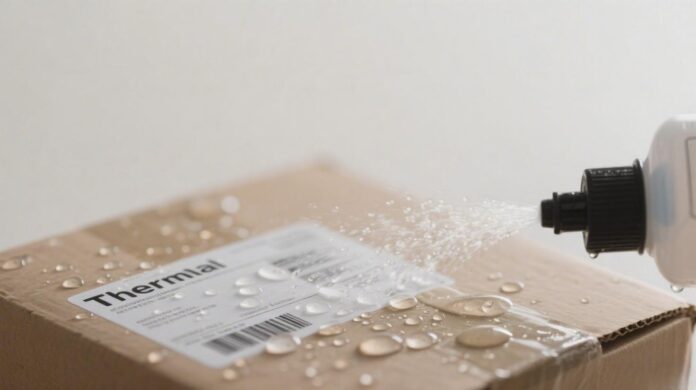

Standard paper thermal labels are not automatically waterproof. Water can weaken the paper, damage the printed surface, reduce barcode contrast, affect the adhesive, and make the label tear during handling.
Top-coated paper can provide better moisture resistance, while synthetic direct thermal media can provide stronger resistance to water and tearing. The word waterproof should only be used when the exact label construction has been tested for the required exposure. A label that survives a few drops may not survive rain, condensation, immersion, washing, or repeated wet handling.
What Happens When Paper Thermal Labels Get Wet?
Water can soak into unprotected paper, causing swelling, curling, wrinkling, tearing, or surface abrasion. The printed image may smear, fade, or become difficult to scan. Moisture entering at the edges can also reduce adhesive performance.
Drying the label does not always restore its original strength or scan quality. If wet exposure is possible, test after the label has dried as well as while it is wet. Replace any label that cannot be read or scanned reliably, especially when it controls shipping, inventory, food rotation, or product identity.
Are Top-Coated Thermal Labels Waterproof?
A topcoat can improve resistance to splashes, moisture, oils, and handling, but it does not guarantee complete waterproofing. Coatings differ in formulation and protection level. Water may still reach the paper through cut edges, scratches, perforations, or prolonged exposure.
Ask whether the coating is intended for occasional splashes, condensation, refrigeration, outdoor rain, or another defined condition. Test the exact product rather than relying on a general coated description. For continuous wet use, synthetic media is usually a stronger starting point than coated paper.
Are Synthetic Direct Thermal Labels Waterproof?
Synthetic face stocks such as polypropylene can resist water and tearing better than paper. The printed thermal image, topcoat, adhesive, and liner still determine total performance.
A water-resistant synthetic label may remain intact while its adhesive lifts from a wet container, or its image may be affected by chemicals in the water. Confirm whether the product is designed for splash, condensation, immersion, outdoor exposure, or washing. Test barcode scanning and adhesion after the full exposure period instead of checking only whether the face material remains unbroken.
Does Condensation Damage Thermal Labels?
Condensation can form when cold products enter a warm, humid area. The water film may prevent a new label from bonding, enter beneath an existing edge, or make a paper face easier to damage.
If possible, apply labels to a clean, dry surface before refrigeration. If labels must be applied after condensation forms, use a construction designed for damp or cold application and test it. For waterproof labels, confirm both application temperature and service temperature because a label that survives cold storage may still fail when first applied to a wet package.
Can Thermal Labels Be Used in Refrigerators?
Yes, if the face material and adhesive are suitable for refrigeration and moisture. Standard paper may work when applied dry at room temperature and then refrigerated, but condensation and frequent handling can shorten its useful life.
Apply samples to the real package, refrigerate them for the required period, and check image readability, barcode scanning, edge lift, and removal. Repeat the test through any warming and re-cooling cycle. Food containers, glass bottles, flexible films, and corrugated cases may require different adhesives even when they share the same refrigerator.
Can Thermal Labels Be Used in Freezers?
Yes, but ordinary general-purpose labels may not bond when applied to a frozen or frosted surface. Freezer applications need a face material and adhesive selected for low temperatures, moisture, and the package substrate.
Separate two situations: applying a label at room temperature before freezing and applying it directly inside a freezer. Direct frozen application is more difficult because adhesive flow is reduced and frost blocks contact. Test the actual application temperature, storage temperature, dwell time, thawing, condensation, and handling before approval.
Will Rain Ruin a Shipping Label?
A standard paper shipping label may tolerate brief light moisture but can fail during prolonged rain or rough wet handling. Paper can wrinkle or tear, while the barcode loses contrast or the adhesive releases from the carton.
Place the label on a flat protected side of the package and avoid open seams. Do not cover carrier barcodes with reflective material unless the carrier allows it, because glare and wrinkles can interfere with scanning. For packages regularly exposed to weather, use suitable protected paper or synthetic media and test it through the actual delivery conditions.
Does Water Affect Label Adhesive?
Yes. Water on the surface can stop pressure-sensitive adhesive from making contact. Water entering after application can also weaken some bonds, especially at lifted edges. Adhesion depends on the surface, temperature, pressure, dwell time, and adhesive formulation.
Apply labels to clean, dry surfaces unless the adhesive is specifically designed for wet application. Press the complete label firmly and protect edges from rubbing. Test adhesion immediately, after 24 hours, and after water exposure. A waterproof face does not compensate for an adhesive that is unsuitable for the package.
How Do You Test Water Resistance?
- Print the production template and scan the barcode before exposure.
- Apply samples to the real package using normal pressure and temperature.
- Reproduce splashing, condensation, rain, immersion, or washing for the required duration.
- Include rubbing and handling while the label is wet.
- Allow samples to dry and inspect again.
- Check image contrast, scan rate, tearing, curling, edge lift, residue, and detachment.
- Record the exact media and test conditions.
Should a Protective Film Be Placed Over a Thermal Label?
A clear overlaminate or document pouch can provide physical and moisture protection, but it must be compatible with the application. Some films, adhesives, or plasticizers can affect direct thermal images over time. Gloss and wrinkles may also reduce barcode scanning.
Test the complete combination, including the film, label, package, temperature, and scanner. Do not cover information that must remain accessible or use a protective layer that violates carrier or regulatory requirements. A purpose-built resistant label may be simpler than adding a second material and application step.
What Should Be Asked Before Buying Water-Resistant Labels?
Tell the label manufacturer whether exposure means splashes, humidity, condensation, rain, immersion, refrigeration, freezing, or washing. Provide the surface material, application temperature, service temperature, exposure duration, chemicals in the water, and required readable life.
Ask for the face material, topcoat, adhesive type, storage guidance, and a production-representative sample. Test the sample before a wholesale order. Waterproof is not a complete specification; the label must remain attached, readable, and scannable in the exact wet environment.