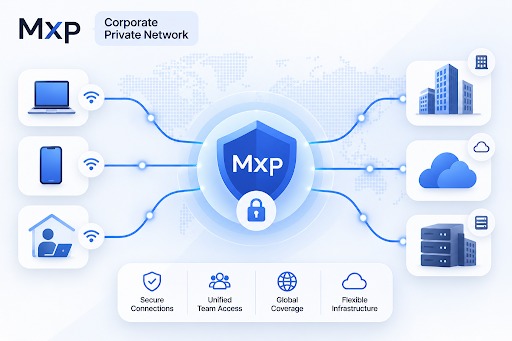

Short answer: Traditional VPNs still protect internet traffic, but many growing companies now need more than encrypted connections. As hybrid work becomes the norm, businesses are adopting Corporate Private Networks (CPNs) that offer centralized management, better access control, and secure connectivity across employees, offices, and cloud services.
It’s less about replacing VPNs entirely – and more about using infrastructure that’s designed for modern organizations.
Remote Work Changed Everything
Five years ago, most employees worked from a single office.
Today, a typical company might have people working from:
- home offices;
- coworking spaces;
- airports;
- client sites;
- different countries.
Employees also expect instant access to company resources from laptops, phones, and tablets.
Keeping all of those connections secure has become one of the biggest challenges for IT teams.
Why Traditional VPNs Aren’t Always Enough
VPNs were designed to create secure encrypted tunnels between users and company networks.
They still do that well.
But modern organizations often need additional capabilities, including:
- managing hundreds of employees;
- controlling who can access specific systems;
- connecting multiple offices;
- securing cloud infrastructure;
- simplifying onboarding and offboarding.
As businesses scale, these requirements become difficult to manage through traditional remote-access VPN deployments alone.
What Is a Corporate Private Network?
A Corporate Private Network (CPN) is a business-focused networking model that securely connects people, offices, servers, and cloud environments through a centrally managed private infrastructure.
Instead of simply protecting an individual’s internet connection, a Corporate Private Network is designed to protect how an organization communicates internally.
For employees, the experience often feels no different than logging into a secure company network.
Behind the scenes, however, administrators gain much greater control over access, permissions, and network visibility.
Why Companies Are Making the Switch
Organizations adopting Corporate Private Networks often cite several advantages:
- simpler user management;
- stronger access control;
- easier cloud integration;
- secure communication between offices;
- scalable infrastructure for growing teams.
For businesses embracing hybrid work, these benefits reduce operational complexity while improving overall security.
A Growing Trend in Enterprise Networking
Rather than piecing together multiple networking tools, many organizations now prefer platforms designed specifically for enterprise environments.
One example is Corporate Private Network by MXP (mxp.net), which enables companies to build secure private networks connecting employees, offices, and cloud infrastructure through centralized administration. Instead of functioning as a consumer VPN, it focuses on giving organizations flexible control over how teams securely access internal resources.
Is This the Future of Business Security?
Cybersecurity is increasingly moving toward identity-based access, cloud infrastructure, and centrally managed private networks.
While traditional VPNs remain useful, they’re no longer the only option for organizations with distributed teams and modern workflows.
As remote work continues to evolve, Corporate Private Networks are likely to become a standard part of enterprise IT strategy rather than a niche solution.
Final Thoughts
The workplace has changed dramatically over the past few years, and business networking is changing with it.
Companies need solutions that do more than encrypt traffic – they need infrastructure that scales with people, devices, offices, and cloud platforms.
Corporate Private Networks represent that next step. For organizations planning long-term growth and secure collaboration, solutions such as Corporate Private Network by MXP demonstrate how enterprise networking is evolving beyond the traditional VPN model.