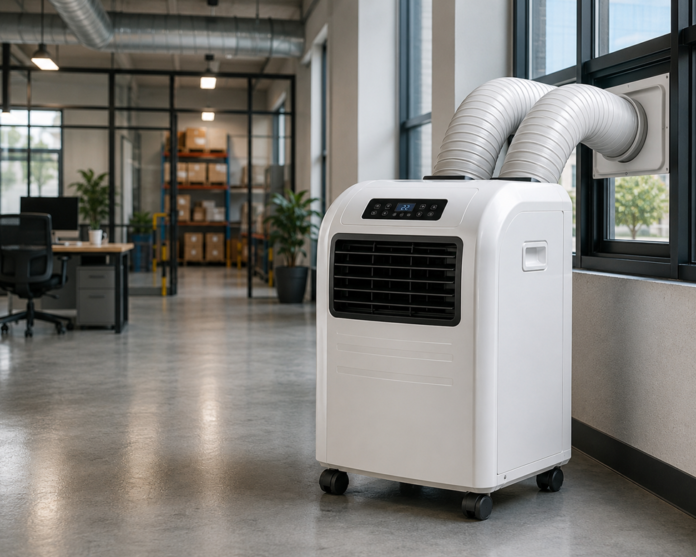

Maintaining a comfortable indoor temperature is essential for almost every commercial environment. Offices, retail spaces, warehouses, workshops, server rooms, restaurants, and temporary venues can quickly become uncomfortable when temperatures rise. Excessive heat does not only affect comfort; it can also reduce employee productivity, damage sensitive equipment, discourage customers, and disrupt normal business operations. A Commercial Portable Air Conditioner offers a practical way to introduce targeted cooling without committing to a costly or permanent air-conditioning installation.
Unlike fixed cooling systems, portable commercial units can be moved between different areas as cooling requirements change. They are particularly useful for businesses that need rapid temperature control, temporary cooling, or additional support for an existing HVAC system.
What Is a Commercial Portable Air Conditioner?
A commercial portable air conditioner is a mobile cooling system designed to manage the temperature in offices, shops, industrial spaces, event venues, server rooms, and other business environments. These units are generally more powerful and durable than standard domestic portable air conditioners.
Most commercial models use refrigeration technology to draw warm air from the room, remove heat and moisture, and return cooler air to the space. The extracted heat is then discharged through ducting, usually directed through a window, wall opening, ceiling void, or designated ventilation outlet.
Depending on the model, the system may also provide dehumidification, air filtration, fan-only operation, or heating. Commercial units are available in different capacities, making it possible to cool anything from a small office to a large industrial area.
Why Businesses Use Portable Cooling Systems
Not every property can accommodate a fixed air-conditioning system. Some buildings have structural restrictions, while others are leased and cannot be significantly modified. Businesses may also need cooling for only a short period, such as during a seasonal heatwave, maintenance shutdown, event, refurbishment, or equipment failure.
Portable cooling systems provide greater flexibility because they can be installed with minimal disruption. They do not usually require major structural work, complex pipework, or lengthy installation procedures.
Businesses commonly use them for:
- Temporary office cooling
- Emergency cooling during HVAC breakdowns
- Temperature control in server and communications rooms
- Retail shops and customer-facing areas
- Warehouses and production facilities
- Construction and refurbishment projects
- Exhibitions, conferences, and temporary events
- Commercial kitchens and food preparation areas
- Medical, laboratory, and testing environments
This versatility makes portable air-conditioning equipment suitable for both planned and unexpected cooling requirements.
The Main Benefits of Commercial Portable Cooling
Rapid Installation
One of the most significant advantages is the speed of installation. A portable unit can often be positioned, connected, and operational within a short period. This is particularly valuable when a fixed system fails during hot weather and immediate cooling is required.
The unit still needs appropriate ventilation for the extracted heat, but installation is considerably less disruptive than fitting a permanent split or central air-conditioning system.
Flexible Placement
Commercial environments often have changing layouts and temperature requirements. A portable unit can be moved to a different room, department, workspace, or temporary structure when necessary.
For example, a business may use the system in a meeting room during the day and relocate it to a server room overnight. This flexibility can reduce the need to purchase separate cooling equipment for every area.
Targeted Temperature Control
Cooling an entire building can be inefficient when only one room or work zone is experiencing excessive heat. Portable systems allow businesses to focus cooling directly where it is needed.
This targeted approach is useful in warehouses, workshops, open-plan offices, and buildings with uneven temperature distribution. Rather than lowering the temperature throughout the entire property, businesses can cool the occupied or heat-sensitive area.
Support During HVAC Failure
A malfunctioning fixed air-conditioning system can create serious operational problems. Employees may struggle to work, customers may leave, and temperature-sensitive machinery may overheat.
A portable system can provide emergency support until the main equipment is repaired. This helps businesses reduce downtime and maintain safer working conditions.
Lower Initial Cost
Installing permanent air conditioning can require a substantial investment. Costs may include equipment, labour, electrical upgrades, structural modifications, pipework, drainage, and ongoing maintenance.
Portable systems generally involve a lower initial expense. They may therefore be suitable for small businesses, temporary operations, rented premises, or organisations that cannot justify a full permanent installation.
Choosing the Correct Cooling Capacity
Cooling capacity is one of the most important factors when selecting a portable air conditioner. A unit that is too small may operate continuously without achieving the required temperature. A system that is unnecessarily powerful may consume more electricity than needed and create uncomfortable temperature fluctuations.
Cooling output is commonly measured in British Thermal Units, or BTUs. Larger spaces and areas with significant heat gain require a higher BTU rating.
Several factors affect the required capacity:
- Floor area and ceiling height
- Number of employees or visitors
- Amount of direct sunlight
- Quality of insulation
- Number of computers, machines, or appliances
- Frequency of doors opening
- Existing ventilation
- Desired indoor temperature
- Heat generated by production processes
A simple room-size calculation can provide an initial estimate, but professional assessment is advisable for demanding commercial environments. Warehouses, server rooms, kitchens, and industrial facilities may require a more detailed heat-load calculation.
Understanding Ventilation and Heat Extraction
Portable air conditioners do not make heat disappear. They transfer heat from the indoor space to another location. The warm exhaust air must therefore be directed outside or into a suitable area where it will not return to the room.
Single-duct systems use one hose to discharge warm air. Dual-duct models use separate ducts for intake and exhaust, which can improve efficiency in certain applications. Larger commercial units may use extended ducting to deliver cool air or remove heat over a greater distance.
Poor duct positioning can reduce cooling performance. Exhaust hoses should be kept as short and straight as reasonably possible. Excessive bends, restricted airflow, or poorly sealed openings can allow heat to return to the room.
Businesses should also consider where condensed moisture will go. Some units collect water in an internal tank, while others use a continuous drainage connection or evaporate part of the moisture through the exhaust system.
Portable Air Conditioning for Server Rooms
Server rooms are among the most common commercial applications for portable cooling. Computers, network equipment, communication systems, and data storage devices generate continuous heat. If the room temperature becomes too high, equipment may slow down, shut down, or suffer permanent damage.
A portable unit can provide supplementary or emergency cooling when the main building system is insufficient. It can also be used during planned maintenance or while a permanent cooling upgrade is being arranged.
However, server-room cooling requires careful planning. The system should be sized according to equipment heat output rather than room dimensions alone. Continuous operation, reliable drainage, temperature monitoring, and backup power arrangements may also be necessary.
Cooling Offices and Customer-Facing Spaces
A comfortable workplace can support productivity, concentration, and employee wellbeing. Excessive heat may lead to fatigue, irritability, dehydration, and reduced efficiency. Portable cooling can help businesses improve working conditions without redesigning the entire building.
In customer-facing environments, indoor temperature can also influence purchasing behaviour and the overall experience. Shoppers, diners, patients, and visitors are less likely to remain in a space that feels hot and poorly ventilated.
Quiet operation should be considered when choosing equipment for offices, clinics, meeting rooms, or retail spaces. Noise levels vary significantly between models, and a powerful industrial unit may not be appropriate for an environment where conversations or concentration are important.
Industrial and Warehouse Applications
Warehouses and production facilities can be difficult to cool because of their size, high ceilings, open doors, machinery, and limited insulation. Cooling the entire structure may be impractical, particularly when workers occupy only specific zones.
Portable industrial air conditioners can provide spot cooling for packing stations, control rooms, inspection areas, workshops, or machinery operators. Cool air can often be directed through flexible ducts towards individual work zones.
For businesses requiring several functions within one mobile system, an All In ONE Hvac Unit may provide cooling, heating, ventilation, and dehumidification through a single piece of equipment. This can be useful in temporary facilities or commercial environments with changing seasonal requirements.
Energy Efficiency and Running Costs
Portable air conditioners require electricity, and commercial models can consume considerable energy when operated continuously. However, targeted cooling can still be more economical than cooling an entire building.
To improve efficiency, businesses should:
- Keep doors and windows closed where practical
- Seal gaps around exhaust ducting
- Clean or replace filters regularly
- Position the unit away from unnecessary heat sources
- Use thermostatic controls rather than continuous maximum cooling
- Reduce direct sunlight with blinds or window coverings
- Switch equipment off when the area is unoccupied
- Select the correct capacity for the space
Energy-efficiency ratings should be compared before purchasing or hiring a system. The cheapest unit to acquire may not be the most economical option over an extended period.
Buying Versus Hiring Portable Air Conditioning
The decision to buy or hire depends on how frequently the equipment will be used. Purchasing may be more cost-effective for businesses with regular or permanent cooling requirements. Ownership also provides immediate access whenever temperatures rise or the main HVAC system fails.
Hiring can be more suitable for short-term projects, temporary events, seasonal demand, emergency breakdowns, or one-off maintenance periods. It also allows businesses to use larger or specialised equipment without paying the full purchase price.
A reputable hire provider may include delivery, installation, collection, and technical support. This can reduce the burden on internal maintenance teams and ensure that the correct equipment is supplied.
Maintenance Requirements
Regular maintenance helps portable air conditioners operate safely and efficiently. Filters can become blocked with dust, reducing airflow and forcing the system to work harder. Condensate tanks and drainage pipes may also require cleaning to prevent leaks, odours, or bacterial growth.
Routine maintenance may include:
- Cleaning air filters
- Checking exhaust ducts
- Inspecting electrical connections
- Emptying or cleaning condensate tanks
- Examining drainage hoses
- Removing dust from air inlets and outlets
- Checking for unusual noise or vibration
- Arranging professional servicing when required
Commercial units used in dusty workshops, construction sites, or industrial environments may need more frequent inspection than systems used in clean office spaces.
Important Features to Consider
Before selecting a unit, businesses should compare more than cooling output. Practical features can significantly affect day-to-day operation.
Useful features may include:
- Adjustable thermostat controls
- Multiple fan speeds
- Programmable timers
- Remote control operation
- Automatic restart after a power interruption
- Continuous drainage connection
- Built-in dehumidification
- Directional airflow
- Lockable castor wheels
- Washable air filters
- Low-noise settings
- Digital temperature displays
The electrical supply should also be checked. Some high-capacity commercial units require more power than a standard domestic socket can safely provide.
Creating a More Comfortable Commercial Environment
Portable air conditioning offers businesses a flexible response to heat, equipment failure, seasonal demand, and changing workplace conditions. It can deliver rapid cooling without the cost and disruption associated with installing a permanent system.
The best results depend on accurate sizing, effective exhaust ventilation, appropriate positioning, and regular maintenance. Businesses should assess the room layout, heat sources, occupancy levels, electrical supply, drainage options, and expected operating hours before choosing a unit.
When properly selected and installed, a commercial portable cooling system can help protect equipment, support employee productivity, improve customer comfort, and maintain normal operations during periods of excessive heat. For many organisations, it provides a practical balance between cooling performance, flexibility, and cost.