
Introduction
To the casual observer, a flail mower looks like a simple metal box spinning a set of swinging blades. However, the internal mechanics of a flail mower involve a complex mix of centrifugal force, aerodynamics, and high-velocity shearing. Understanding the physics of how these machines cut and process material is key to optimizing your cutting height, rotor speed, and forward travel speed for different types of vegetation.
The Kinematic Principle: Centrifugal Rigidity
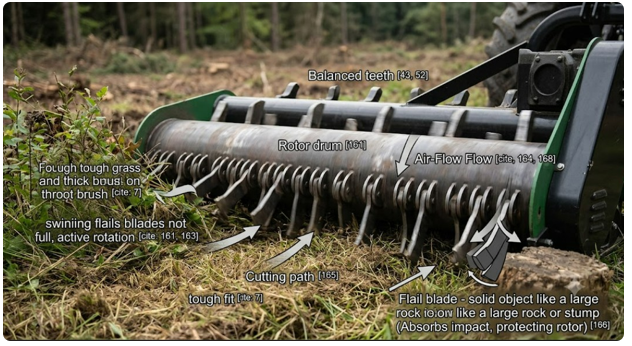
Because flail blades are designed to swing freely on shackles rather than being fixed in place, they rely entirely on centrifugal force to hold them straight. This is called “centrifugal rigidity”:

Where

is the blade mass,

is the rotor radius, and

is the rotation speed. At full operating RPM, this force is incredibly strong, holding the blades rigidly outward so they can slice cleanly through thick brush.
AIR-FLOW FLOW
┌──────────────┐
│ ┌──────┐ │
◄──────┤◄──│Rotor │ │ (Suction creates lift, CUTTING PATH │ └──┬───┘ │ pulling flattened grass
▲ │ │ │ upward to be cut)
│ │ [Flail] │
└─────────────┴──────┴───────┘
However, if the mower hits a solid object like a large rock or stump, the swinging blade pivots backward out of the way, absorbing the impact and protecting the rotor shaft from damage. To learn more about the engineering details of this process, including how rotor speed, blade weight, and suction work together to create a clean cut, you can read more about how does a flail mower work and how to configure your machine for different types of terrain.
The Aerodynamic Suction Effect
As the rotor spins, the shape of the flail blades creates a powerful vacuum inside the mower housing. This suction pulls flattened grass and weeds straight up, allowing the blades to cut them cleanly and evenly. It also keeps the cut material inside the chamber longer, shredding it into fine mulch that decomposes quickly and returns nutrients to the soil.