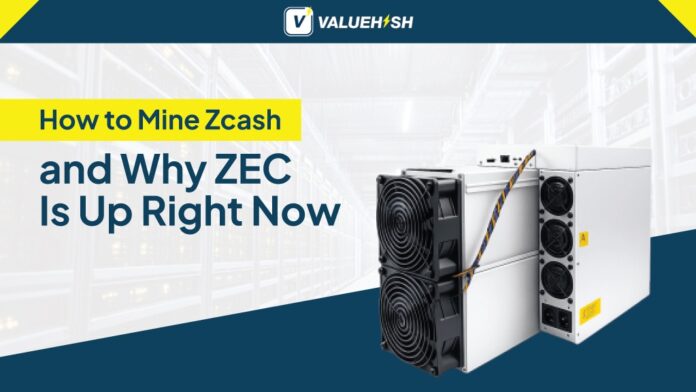

Zcash has quietly become one of the most talked-about assets in crypto again. People are looking for solid opportunities outside of Bitcoin and Ethereum, and ZEC’s recent price momentum makes it hard to ignore. We are seeing a lot of institutional investors and hardware operators looking to diversify their setups right now.
Because of this, the conversation has shifted. People aren’t really asking “What is Zcash?” anymore. Instead, they want to know if Zcash mining still makes financial sense and exactly what it takes to get started – whether they are building out a home setup or looking into professional Zcash Miner Hosting.
Let’s break down the hardware you actually need, how to crunch the profitability numbers, and why the broader market is paying so much attention to ZEC today.
Why Is ZEC Up Right Now?
Why the sudden price action? A few key market shifts are pushing Zcash forward in the current cycle.
Regulatory Clarity
In January 2026, the U.S. Securities and Exchange Commission closed a long-running investigation into the Zcash Foundation without recommending enforcement action. That single development removed a major overhang that had discouraged institutional participation for years, and ZEC rallied on the news.
Rising Demand for Privacy
On-chain tracking is getting much more sophisticated, which naturally drives users back to privacy coins. Zcash uses zero-knowledge proofs (zk-SNARKs). In plain English, this is just a highly secure cryptographic method to verify a transaction without exposing the sender, the receiver, or the amount sent.
Crypto Market Rotations
When Bitcoin goes on a massive run and then stabilizes, capital usually flows down into mid-cap projects. Zcash has a fixed supply of 21 million coins, exactly like Bitcoin. Investors appreciate that kind of historical foundation when they look for places to park their profits during an altcoin season.
Miners Looking for Options
Miners need profitable alternatives when major networks get too crowded. Thanks to recent network difficulty adjustments and a few new hardware releases, ZEC has become an appealing choice for operators who want to spread out their hash rate.
The Dual-Address Compliance Advantage
Regulatory pushback is a death sentence for most privacy coins. As impending global regulations, like the EU’s AMLA guidelines heading toward 2027, crack down on fully anonymous tokens, Zcash’s hybrid model shines. By offering both transparent and shielded addresses, users can share viewing keys for audit compliance. This ensures centralized exchanges can keep ZEC listed, preserving the market liquidity that total-darkness tokens lose.
Network Upgrades
Zcash’s NU7 upgrade, targeting a major increase in shielded-transaction throughput and faster block times, has added a forward-looking technical catalyst on top of the regulatory and institutional news.
How Zcash Mining Works: Securing the Equihash Network
Zcash runs on the Equihash proof-of-work algorithm. To put it simply, miners use their computing power to validate network transactions. In exchange for securing the network, they earn block rewards and transaction fees paid out in ZEC.
When the network first launched, Equihash was built specifically to resist ASIC miners. Back then, you could easily mine it using standard computer graphics cards (GPUs) right in your basement. Things have changed. Today, the network is dominated by Application-Specific Integrated Circuit (ASIC) machines built exclusively to process the Equihash algorithm.
What You Need to Start: The Three Essentials
If you want to start Zcash mining, here is what you actually need to get off the ground.
1. Dedicated ASIC Hardware
The most important requirement is a Zcash mining machine capable of efficiently mining the Equihash algorithm. Don’t bother trying to mine ZEC with a GPU today; you will spend way more on your power bill than you’ll ever earn in crypto. You need a specialized Equihash ASIC. When shopping for machines, pay close attention to the hash rate (how fast it solves equations, usually measured in KSol/s), total power consumption, and energy efficiency. Keep in mind that these machines run incredibly hot and sound like industrial vacuum cleaners, so cooling is a major logistical factor.
2. A Mining Pool
Unless you own a massive data center, solo mining is basically a lottery ticket you won’t win. You need to join a mining pool. Pools combine hash power from thousands of individual operators, solve blocks as a group, and pay you a proportional cut of the rewards.
3. A Compatible Wallet
You need somewhere secure to send your daily payouts. Since Zcash uses both transparent and shielded addresses, make sure your wallet matches the payout structure of your chosen pool. Hardware wallets are still the gold standard for long-term storage.
How to Mine Zcash: A Step-by-Step Configuration Guide
Following are the steps for How to mine Zcash:-
Step 1: Choose Your Miner
Find a modern Equihash ASIC from a reputable brand like Bitmain or Innosilicon. If you’re looking for Zcash miners for sale, read the warranty terms carefully and make sure your facility has the 220V electrical outlets required to run them.
Step 2: Configure the Miner
Plug the machine in, connect it directly to your internet router with an Ethernet cable, and find the device’s IP address to open its dashboard in a web browser. You’ll just need to drop in your pool’s stratum URL, pick a worker name, and paste your wallet address.
Step 3: Start Mining
Reboot the machine. It will start sending cryptographic shares to your pool right away. Once your pending balance hits the pool’s minimum payout limit, the ZEC automatically drops into your wallet.
Step 4: Monitor Performance
Don’t just plug it in and walk away. Log into your dashboard regularly to check your actual hash rate, internal board temperatures, and power usage. Keeping the machine clean and cool extends its lifespan significantly.
Is Zcash Mining Profitable in 2026?
Zcash mining profitability is a moving target. Your margins depend on a few constantly shifting variables:
- ZEC Price: Higher market prices mean your daily crypto earns more fiat.
- Electricity Cost: This makes or breaks your operation. You generally need power rates under $0.08/kWh to stay competitive, which is why operators leverage the institutional utility rates found at established U.S. hosting facilities.
- Miner Efficiency: Newer ASICs get you more ZEC for every watt of power you burn.
- Network Difficulty: When more miners turn their machines on, finding a block gets harder, shrinking everyone’s individual slice of the pie.
Don’t Forget the Halving Cycle
Just like Bitcoin, Zcash cuts its block rewards in half roughly every four years. This creates scarcity, but it also means your hardware needs to be highly efficient to survive the sudden revenue drop. You absolutely have to factor halving schedules into your long-term ROI math.
Zcash Miner Hosting vs. Home Mining: Managing Heat, Noise, and Power Costs
| Feature | Home Mining | Hosted Data Centers |
| Setup Costs | High (electrical upgrades, heavy ventilation) | Low (just the hardware and initial setup fee) |
| Power Rates | Usually higher residential rates | Discounted industrial power agreements |
| Maintenance | 100% your problem | Handled on-site by facility technicians |
| Noise & Heat | Disrupts your living or garage space | Managed by massive data center cooling walls |
For institutional investors or individuals who just don’t have the warehouse space, hosting is the easiest way to get direct exposure to newly minted ZEC without the daily headaches.
Building a Long-Term Strategy for ZEC Infrastructure
Zcash is pulling serious interest from infrastructure operators right now. If you want to enter the market, start by getting a realistic quote on your local electricity rates, pick the most efficient hardware you can afford, and run the numbers through a real-time profitability calculator.
Whether you decide to buy Zcash miner hardware for your own garage or partner with a dedicated provider like ValueHash for professional Zcash miner hosting, you need to view this as a multi-year play.
Utilizing established U.S.-based facilities allows you to secure cheaper industrial power rates while entirely avoiding the logistical headaches of home setups. The operators who focus on efficiency and keep their overhead low are consistently the ones who come out ahead in the long run.
Frequently Asked Questions
What is the best Zcash mining machine?
The “best” machine depends entirely on what you pay for power. Right now, modern Equihash ASIC miners from major manufacturers offer the highest energy efficiency. Look for the model that offers the lowest Joules per KSol ratio in your budget.
Is Zcash mining still profitable?
Yes, but only under the right conditions. You need highly efficient hardware, cheap electricity, and consistent machine uptime to actually turn a profit.
Where can I find Zcash miners for sale?
You can buy them through specialized ASIC hardware retailers, verified hosting providers, and enterprise brokers. We usually recommend avoiding used marketplaces like eBay unless you know exactly how to test worn-out hardware.
Should I buy Zcash miner hardware or use hosting?
If you have access to cheap industrial power and a soundproof space, running the hardware yourself makes sense. Otherwise, utilizing professional Zcash miner hosting is the smarter move to avoid downtime.
How much can I earn from Zcash mining?
Your daily earnings will fluctuate based on your total hash rate, power costs, the current network difficulty, and the real-time spot price of ZEC. Always run your specs through a live mining calculator before buying anything.
READ ALSO: The Machine That Reads Your Chart at 3 A.M.