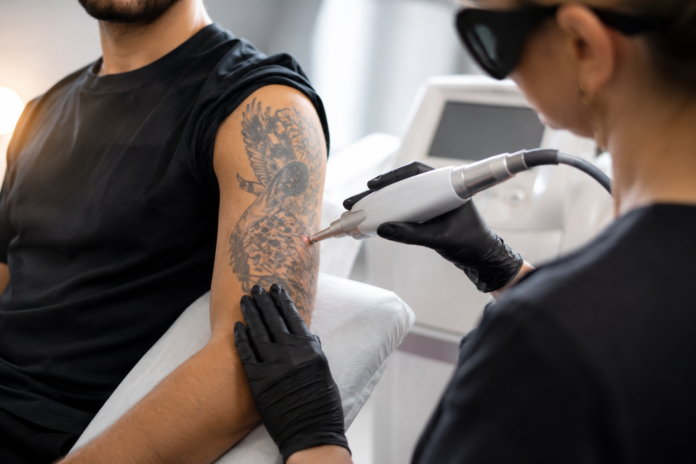

Most people walk into their first tattoo removal consultation expecting a simple answer — three sessions, maybe five, done by summer. The reality is more complicated, and honestly, more interesting. The number of sessions you’ll need depends on a handful of specific factors that interact with each other in ways that aren’t always obvious upfront.
The Kirby-Desai Scale Is Your Starting Point
Laser technicians use a scoring system called the Kirby-Desai Scale to estimate session counts before treatment begins. It assigns points based on six factors: skin type, ink colors, amount of ink, scarring, ink layering, and the tattoo’s location on the body. A score under 15 typically suggests 6-10 sessions. Scores above 25 can mean 15 or more. It’s not a guarantee, but it gives you a realistic baseline rather than a guess.
Ink Color Changes Everything
Black ink absorbs laser energy efficiently, which is why solid black tattoos tend to fade faster than colorful ones. Greens, blues, and purples are notoriously stubborn — they require specific laser wavelengths to break down properly, and not every clinic has the equipment to target them effectively. If your tattoo has a lot of teal or bright aqua, expect that to be the last color standing after everything else has faded.
White ink is its own category. It can oxidize and turn dark when hit with certain lasers, which complicates the whole process. A good technician will test a small patch before committing to a full treatment on any tattoo with white highlights.
Tattoo Age and Amateur vs. Professional Work
Older tattoos generally respond faster than newer ones. The ink has already started breaking down naturally, and the body has had time to begin processing some of the pigment. A 15-year-old faded tribal piece will often clear faster than a sharp, dense tattoo done six months ago.
Amateur tattoos — done with a hand-poke or non-professional equipment — are often easier to remove than professional work. The ink sits at inconsistent depths and isn’t packed in as densely. Professional tattoos use high-quality ink deposited precisely into the dermis, which is exactly what makes them last on your skin and exactly what makes them harder to remove.
Your Immune System Does the Actual Work
Laser removal doesn’t physically extract the ink. The laser shatters the ink particles into smaller fragments, and then your immune system flushes them out over the following weeks. This means your body’s health directly affects your results. People who are well-hydrated, exercise regularly, and don’t smoke tend to clear ink faster between sessions. Smoking in particular restricts circulation and has been shown in studies to significantly slow the fading process.
This is also why sessions are spaced 6-8 weeks apart rather than done back-to-back. Rushing the timeline doesn’t speed up results — your immune system needs that recovery window to process what the laser broke apart.
Placement on the Body Matters More Than Most People Expect
Tattoos on the hands, feet, and lower legs fade more slowly than those on the chest, back, or upper arms. The reason comes down to circulation. Areas further from the heart have less blood flow, which means the immune system has a harder time clearing fragmented ink particles. A tattoo on your ribcage will typically respond faster than the same tattoo on your ankle.
The neck and face, counterintuitively, often respond well because of high vascular activity in those areas.
The Technology at Your Clinic Makes a Real Difference
Not all laser removal equipment performs equally. Older Q-switched lasers are slower and require more sessions than newer picosecond lasers, which fire in trillionths of a second and shatter ink into finer particles. If a clinic is offering very low prices and can’t tell you what type of laser they use, that’s worth questioning.
Melbourne’s leading tattoo removal clinic uses picosecond technology across multiple wavelengths, which matters if your tattoo has a range of ink colors. Having the right wavelength for each color — rather than one laser doing all the work — is what separates efficient treatment from a prolonged, expensive process.
What a Realistic Estimate Actually Looks Like
A simple, single-color black tattoo on the upper arm of a healthy non-smoker in their 30s might need 6-8 sessions. A dense, multicolored sleeve with layering and cover-up work could need 15 or more. Most tattoos fall somewhere in the middle — 8-12 sessions is a reasonable expectation for a moderately complex piece.
The most useful thing you can do before starting treatment is ask for a proper assessment using the Kirby-Desai Scale, confirm what laser technology the clinic uses, and get an honest range rather than a single number. A clinic willing to give you a real estimate — including the upper end — is one you can actually trust with the process.