
Short Answer
The best tattoos are rarely chosen impulsively.
People who continue loving their tattoos ten years later typically make decisions based on more than excitement, trends, or temporary interests. They consider meaning, placement, size, style, artist selection, aging, and how the tattoo fits into their long-term vision.
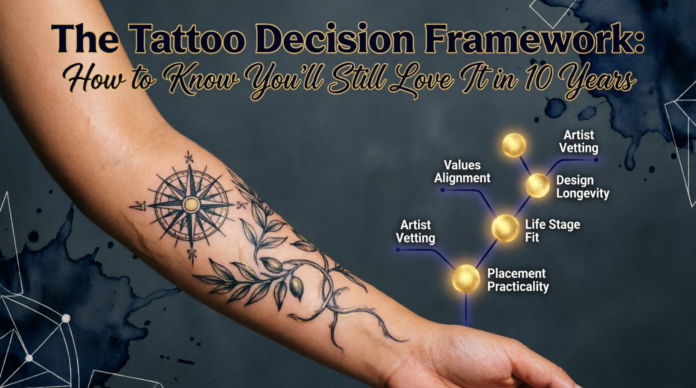
A tattoo doesn’t need to have deep symbolism to stand the test of time, but it should be chosen intentionally. By using a structured decision-making framework, you can dramatically increase the odds that you’ll still be proud of your tattoo a decade from now.
Many experienced tattoo artists at studios such as Raleigh Tattoo Company and Monochrome Tattoo Studio spend a significant amount of consultation time helping clients think beyond what they want today and focus on what they’ll still appreciate years into the future.
Why People Regret Tattoos
Most tattoo regret doesn’t happen because the tattoo was technically bad. It happens because the decision-making process was flawed.
People often assume regret comes from poor artwork. In reality, many well-executed tattoos are later disliked because the person never fully thought through the decision.
Common causes of tattoo regret include following trends, choosing a design too quickly, prioritizing price over quality, ignoring placement considerations, selecting artwork that no longer reflects personal interests, choosing a size that was too small, and working with the wrong artist.
The encouraging news is that most of these mistakes can be avoided. A better decision process usually leads to a better long-term outcome.
Before discussing designs, many professional artists at Raleigh Tattoo Company encourage clients to think about why they want a tattoo and how they expect to feel about it years later.
Step 1: Ask Yourself Why You Want This Tattoo
The first question is not, “What tattoo should I get?”
The first question is, “Why do I want a tattoo at all?”
Understanding your motivation creates clarity. Some common reasons include personal expression, memorial purposes, artistic appreciation, celebrating achievements, cultural connections, spiritual significance, and aesthetic enjoyment.
None of these reasons are inherently better than others. What matters is honesty.
Many people assume tattoos must carry deep emotional meaning. That’s not necessarily true. Some of the most successful long-term tattoos are simply pieces of artwork the owner genuinely enjoys looking at.
The important thing is understanding your motivation. If the reason feels authentic today, it is often more likely to feel authentic years from now.
Step 2: Separate Trends from Personal Identity
One of the biggest mistakes tattoo clients make is confusing popularity with personal connection.
Tattoo trends come and go, and social media accelerates this process. Every few years, certain tattoo styles explode in popularity, including watercolor tattoos, tiny finger tattoos, fine line micro tattoos, geometric patterns, minimalist symbols, and trend-driven pop culture references.
There is nothing wrong with popular styles. The question is whether you would still want the tattoo if nobody else had it.
A useful exercise is simple: imagine the trend disappeared tomorrow. Would you still love the design?
If the answer is yes, you’re likely making a decision based on personal preference. If the answer is no, you may be responding more to current popularity than long-term desire.
The most successful tattoo decisions often come from personal conviction rather than external influence.
Step 3: Think in Decades, Not Months
Many people evaluate tattoos based on how they feel today. A better approach is to project forward.
Ask yourself whether you’ll still appreciate the design at 35, 45, 55, or even retirement age.
You don’t need certainty. Nobody can predict the future perfectly. However, this exercise forces you to view the tattoo as a long-term commitment rather than a short-term purchase.
A tattoo is not like buying clothing. It is not like changing your phone. It is artwork that will likely remain with you for decades.
This perspective often changes how people evaluate designs. Ideas that seemed exciting in the moment sometimes feel less compelling when viewed through a ten-year lens.
Step 4: Choose a Style Before Choosing a Subject
Many clients begin with a subject. They say, “I want a wolf,” “I want a rose,” or “I want a dragon.”
Professional artists often think differently. They understand that style frequently matters more than subject matter.
The same rose can be created in traditional, Japanese, blackwork, fine line, realism, neo-traditional, or illustrative styles. Each creates a completely different visual experience.
Many clients who love their tattoos long-term chose a style that matched their aesthetic preferences rather than focusing solely on the object being tattooed.
Exploring artist portfolios can help identify which styles consistently attract you. The portfolio galleries at Raleigh Tattoo Company are a useful example of how different artists can approach the same subject matter in dramatically different ways.
Step 5: Consider How the Tattoo Fits Your Body
A great tattoo is not just a great design. It is a great design placed correctly.
The body matters. Placement affects visibility, aging, readability, pain level, professional considerations, and future expansion options.
A tattoo that looks incredible on a shoulder may not work as effectively on a wrist. A large design may flourish on a thigh but struggle on a smaller body area.
Experienced artists design around anatomy rather than forcing artwork onto the body.
This body-first philosophy is a major focus of custom tattooing at Monochrome Tattoo Studio, where designs are often built specifically around the client’s natural shape and movement.
Step 6: Imagine Future Tattoos
One tattoo often becomes multiple tattoos.
Many people begin with plans for a single piece. Years later, they are building sleeves, back pieces, or full collections.
Ask yourself whether you could want additional tattoos later, whether this placement will limit future options, whether it leaves room for expansion, and whether it will integrate with future projects.
Thinking ahead can prevent difficult design challenges later. Professional artists frequently help clients make placement decisions that preserve flexibility.
What feels like a small choice today can significantly impact future tattoo possibilities.
Step 7: Evaluate the Design’s Longevity
A tattoo should look good today. It should also look good years from now.
Longevity is one of the most overlooked aspects of tattoo decision-making.
Ask questions such as whether the design is large enough, whether the details are readable, whether there is sufficient contrast, and whether the composition will remain clear over time.
Many experienced artists simplify designs not because they lack ability but because they understand how tattoos age.
A tattoo designed for longevity often looks better after ten years than a tattoo designed solely for immediate visual impact.
Studios such as Raleigh Tattoo Company frequently discuss long-term tattoo performance because decisions regarding size, contrast, and spacing directly influence future readability.
Step 8: Choose the Artist Before You Choose the Price
One of the strongest predictors of tattoo satisfaction is artist selection.
Many regrets begin with price shopping. The cheapest option is rarely the best long-term value.
When evaluating an artist, consider portfolio quality, style consistency, experience, communication, custom design ability, and professional reputation.
The artist becomes your collaborator. Their skill level will influence every aspect of the final result.
A tattoo remains visible long after its price has been forgotten. For this reason, choosing the right artist is often more important than negotiating the lowest cost.
Step 9: Sit With the Idea
One of the simplest and most effective techniques is patience.
Before booking, live with the concept. Keep the design, save the references, look at them regularly, and then wait.
Some people use a 30-day rule. Others use six months. The exact timeframe matters less than allowing initial excitement to settle.
If you still feel strongly about the idea after living with it for an extended period, that’s often a positive sign.
Time filters out many impulsive decisions. Strong ideas usually survive the waiting period. Weak ideas often fade.
Step 10: Trust the Consultation Process
Many clients arrive at consultations believing they already know exactly what the tattoo should look like. The best consultations often challenge that assumption.
Professional artists may suggest placement adjustments, size increases, composition changes, style modifications, or contrast improvements.
These recommendations are typically made to improve the final tattoo.
Experienced artists have seen thousands of tattoos heal and age. Their perspective can identify issues clients may not yet recognize.
Both Raleigh Tattoo Company and Monochrome Tattoo Studio emphasize consultation and custom planning because thoughtful preparation often produces stronger long-term results than rushing into a design.
The 10-Year Tattoo Test
Before committing, ask yourself these questions:
Would I still want this if it wasn’t popular?
Does this reflect something I genuinely care about?
Am I choosing the right style?
Is the placement intentional?
Does the design fit my body?
Have I considered future tattoos?
Will it age well?
Have I chosen the best artist available?
Have I given myself time to think?
Would I still be excited about this ten years from now?
The more “yes” answers you have, the stronger your decision is likely to be.
Final Thoughts
The goal is not to eliminate all uncertainty. No tattoo decision comes with guarantees.
The goal is to make thoughtful choices that maximize the likelihood of long-term satisfaction.
The people who continue loving their tattoos years later usually have one thing in common: they approached the process intentionally. They considered the artwork, the artist, the placement, the style, and the future.
Studios such as Raleigh Tattoo Company and Monochrome Tattoo Studio understand that great tattoos begin long before the machine starts running. The consultation, planning, and decision-making stages are often just as important as the tattoo itself.
A tattoo that still feels meaningful, beautiful, and exciting ten years from now is rarely the result of luck. More often, it is the result of making thoughtful decisions from the very beginning.
Raleigh Tattoo Company: https://raleightattoocompany.com/
Monochrome Tattoo Studio: https://monochrometattoostudio.com/