
The best jewellery in a thrift store is usually the piece with the broken clasp. Intact pieces get priced like jewellery; broken ones get priced like clutter, and the difference between the two is often a single small component the seller never thought to replace. Knowing which failures are trivial to fix, and which beads deserve the effort, turns second-hand racks into a sourcing strategy.
Why Thrifted Jewellery Is the New Sustainable Statement
Reworking an existing piece is the most direct form of sustainable jewellery there is: the beads already exist, the materials already travelled, and the only new inputs are a few grams of findings and a length of cord. For wearers who care where things come from, a restored vintage strand carries a better story than anything made to imitate one.
Economics reinforces ethics. Vintage glass, real stone beads, and old pearls turn up at thrift prices precisely because their fittings have failed. The value sits in the beads; the failure sits in the hardware. Replace the hardware and you have recovered the value, usually for less than the cost of a single newly made piece.
Spotting Pieces Worth Saving
Judge the beads, ignore the hardware. A broken clasp, a stretched jump ring, or a frayed cord costs little to put right; chipped, cracked, or peeling beads cannot be saved at any price. Run the strand through your fingers and look for bead damage first, then check whether the drill holes are clean, because sharp-edged drill holes are the most common reason stringing fails and they will cut a new cord just as readily as they cut the old one.
Weight is the second signal. Glass and stone announce themselves in the hand; the lightest strands are usually coated plastic, and a coating that has survived decades rarely survives restringing. When in doubt, hold the strand up to the light at the drill holes, where coatings give themselves away first.
Replacing a Broken Clasp with GRIFFIN
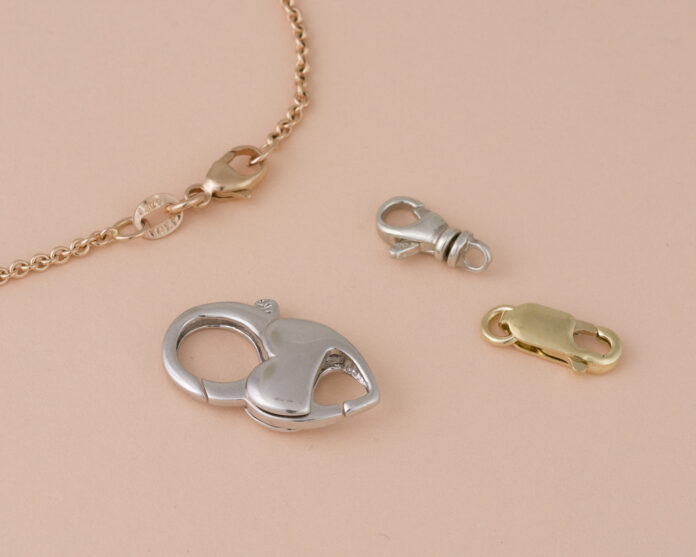
A clasp swap is the highest return repair in jewellery. The choice among different necklace clasps follows the wearer and the piece: a lobster clasp is the secure everyday default, a spring ring keeps a period look on delicate vintage chains, a toggle suits chunkier strands and stiff fingers, an S-hook clasp brings an older silhouette that flatters vintage pieces, and a magnetic ball clasp serves anyone who struggles with small mechanisms. Within the GRIFFIN range, all of these are made of 925 sterling silver, nickel-free, and with 7-micron 24K gold plating, which matters on restored pieces that will sit against the skin daily.
Match the clasp’s visual weight to the piece. A heavy clasp on a fine vintage chain reads as a repair; a proportionate one reads as original. For pieces with plated or unusual finishes, custom orders such as rhodium-plated, rose-gold-plated, ruthenium-plated, or matt surfaces can keep a restoration faithful to the original look.
Swapping Jump Rings for Longevity
The jump ring is the quiet failure point of most necklaces: it opens a fraction with every wear until one day the pendant is gone. When restoring, replace every load bearing jump ring rather than re-closing the old ones, and upgrade where the design allows. Open jump rings (available from Ø 3.0 mm to Ø 5.9 mm) are right where you need to thread onto a closed component; soldered jump rings (Ø 3.5mm to Ø 7.0 mm) cannot open at all and belong at every point that simply carries load; split rings (Ø 5.0 mm to Ø 7.0 mm) secure anything you want removable but safe.
Close open rings properly: twist the ends sideways past each other and back, rather than pulling them apart, so the ring keeps its round shape and the join closes tight.
Re-Stringing Worn Beaded Strands
Never trust a vintage cord, even one that looks sound; decades of wear are invisible until they are sudden. Restring onto fresh cord and knot between the beads as the original maker likely did: the knots stop beads grinding against each other, keep them on the strand if the cord ever breaks again, and restore the supple drape that makes old strands worth saving.
Carded bead cords are built for exactly this work, triple twisted with a stainless steel needle attached. Natural silk is the classic choice for vintage pearls, a nylon cord with low stretch suits strands that will be worn hard, and hard gemstone beads with sharp or narrow drill holes call for a high strength cord. Finish the end knots into squeeze capsules or bell caps, and hang their eyes into the new clasp with the jump rings chosen above.
Before-and-After Photo Gallery
For publication, pair each restoration with a two-frame set: the piece as found, and the piece restored, shot on the same background at the same angle so the work speaks for itself. Per GRIFFIN’s imagery guidelines, every photograph should show the materials in use (the cord, clasp, or findings visible in frame), worked with bare hands, with no third-party trademarked stamps or logos visible.
Suggested captions for the gallery:
1. 1960s glass strand, as found: failed clasp, stretched rings, and original cord fraying at the ends.
2. The same strand restrung and knotted, with a new lobster clasp and soldered jump rings.
3. Detail: end knot finished into a squeeze capsule before the clasp goes on.
4. Worn result: the restored strand lying naturally, gaps closed, drape recovered.