
Electricity is utilised in all places. It charges our phones, laptops, cars, batteries, tools, and much more. Two terms that are frequently heard when referring to electricity are volts and amps.
These terms are often confused, as they sound technical. However, they are actually very easy to understand.
We will try to make the differences between Volts and Amps in the simplest words possible. This is a guide for beginners who may not be familiar with electricity or why volts and amps are important.
What Are Volts?
The unit for measuring electric pressure is the volt.
The push of electricity through a wire or circuit is called voltage.
Imagine that the voltage is equivalent to water pressure inside a pipe.
Water flow through the pipe is more vigorous with high pressure.
Similarly, the higher the voltage, the more force the electricity has in a circuit.
The unit used to measure voltage is volts (V).
Examples include:
AA battery = 1.5V
Car battery = 12V
Multiple phone chargers = 5V
Several power tools = 18V or more
The voltage is used to help the electric devices get the power they require.
What Are Amps?
Amps are a unit of electrical current.
The quantity of electricity moving through a wire.
Consider a pipe through which water flows.
The force that is driving the water is called the voltage.
Amps refers to the volume of actual water flow in the pipe.
The unit of current is the ampere or, commonly, the amp (A).
Examples include:
Phone charger = 1A – 3A
Light and small appliances such as TVs and radios = 10 amps (10 A)
Electric vehicles = much more amps.
Amps are telling us the amount of electricity that passes through at a given time.
Difference Between Volts and Amps
There is a difference in Volts and Amps.
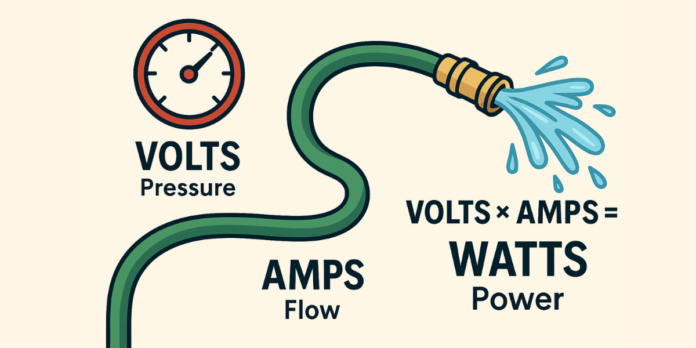
The easiest way to understand the Difference Between Volts and Amps is with a water pipe example.
Volts = Water Pressure
The volts are what provide the push to electricity.
Amps = Water Flow
Amps are the units used to measure the flow of electricity.
It cannot conduct electricity if there is no voltage.
No current, no electricity flows.
They both contribute to the operation of devices.
Simple Example
Now, let’s say you have a garden hose.
The voltage of water inside the hose is similar to the pressure of the water.
The volume of water flowing out is similar to the current.
A hose can have:
High pressure and low flow
The small amount of pressure and high flow.Low pressure, high flow.
High pressure and high flow.
Electric circuits operate in a like manner.
Why Are Volts Important?
The voltage is significant since it is essential that electrical devices are designed for a particular voltage.
For example:
A cell phone might require 5 volts (V) of power.
The laptop requires 19 volts.
The power of an electric bike can be 36 volts or 48 volts.
The device may be damaged if the wrong voltage is used.
Excessive voltage can cause components to overheat.
Too little voltage may prevent the device from working properly.
Why Are Amps Important?
The reason amps are so important is that they dictate the amount of current that can flow through a device.
Devices pull the current that they require.
For example:
The current draw of a small LED light can be quite small.
A motor can require a considerable amount of amperage.
The more current, the more power.
That’s why the larger electrical systems need thicker wires and stronger connectors.
How Volts and Amps Work Together
An electrician has joined the volts and amps together.
They work together to produce electrical power.
The unit of power is watts (W).
The formula is:
Power (Watts) = Volts × Amps
For example:
12V × 5A = 60W
24V × 5A = 120W
48V × 10A = 480W
Both voltage and current are important, as seen in this simple formula.
Understanding Batteries
The volt and the amp work together in a great way in batteries.
The voltage of a battery gives us the electrical pressure in a battery.
Current in a battery indicates the amount of current that can pass.
For example:
The 12V battery gives 12 volts.
Depending on their design, the battery can also supply a certain amount of current.
Manufacturers pay close attention to voltage and current to ensure the various applications will receive the appropriate levels.
Volts and Amps in Electric Vehicles
High voltage and high current are both employed in electric vehicles.
There are a number of advantages to higher voltage systems:
Better efficiency
Lower heat generation
Improved performance
Current is still relevant as motors need a significant amount of power when accelerating.
The performance of modern batteries is getting better and better in terms of both voltage and current.
Volts and Amps in Consumer Electronics
Convert Electronic Volts to Amps. The voltage and current are required in many day-to-day devices.
Examples include:
Smartphones
Tablets
Laptops
Cameras
Drones
Power banks
Users must read the voltage and current ratings when purchasing chargers.
When using the right charger, safety and performance are enhanced.
Common Misunderstandings
The higher the voltage, the higher the power.
Power is a function of both Volts and Amps.
A high-voltage, low-current system may generate less power than expected.
Higher amps need not be dangerous!
Combined with some conditions, current can be dangerous.
Electrical systems have been engineered to safely operate within a particular level of electrical current.
Devices – Only Take the Current They Need.
If the voltage is accurate, a higher amp rating typically is safe for a charger.
The device will only draw the amount of current it requires.
Choosing Quality Batteries
Batteries should be of good quality for safety and performance.
Good manufacturers pay attention to:
Stable voltage output
Safe current delivery
Long battery life
Consistent performance
Symbo Battery companies strive to supply reliable batteries to a variety of industries and applications.
Conclusion
The difference between volts and amps is not as difficult to understand as many would believe.
Volts are a measurement of the force or pressure that forces electricity to flow in a circuit. The amps indicate how much electricity is traveling through the circuit.
It’s easy to remember:
Volts = Pressure
Amps = Flow
Both are of great importance since they are required to operate electrical appliances. Knowing the difference between volts and amps can help you make informed choices about batteries, chargers, and other electronic equipment when using a smartphone, drone, electric vehicle, or battery-powered tool.
Understanding these fundamental electrical principles will help you to appreciate how today’s technologies function, and how reliable solutions from battery companies such as Symbo Battery are essential to everyday life.