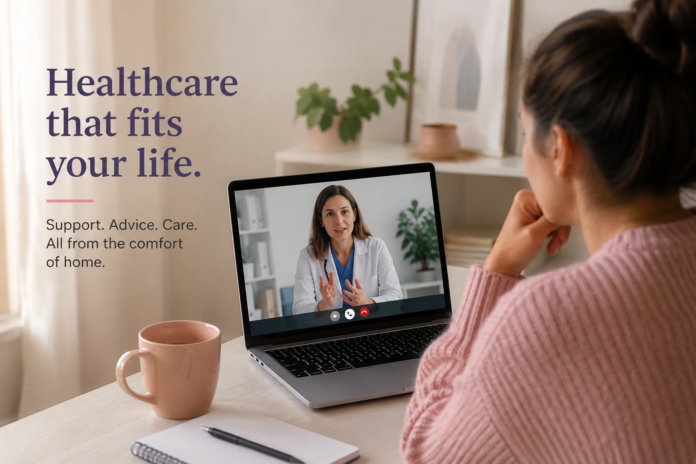

There’s a particular kind of exhaustion that comes from trying to get a doctor’s appointment when you’re already unwell. You call, you wait on hold, you get a callback window that doesn’t fit your work schedule, you rebook, and then somewhere in the middle of all that friction, you just start wondering whether the thing you were going to ask about was really worth the trouble. For a lot of women, that question has historically had the wrong answer.
Telehealth has changed the calculation. Not completely, not for everything, but in ways that are genuinely meaningful for the kinds of health concerns women navigate most often and historically found hardest to access care for.
The Access Problem Was Never Just About Distance
When people talk about telehealth expanding access, the assumption tends to be that the main problem it’s solving is geography. Rural women, remote communities, limited transport. And yes, that’s real. But the access problem for women has always been broader than that.
It shows up in the woman who can’t take two hours out of a workday to sit in a waiting room for a fifteen-minute appointment. It shows up in the mother who can’t bring three kids to a GP visit without it becoming an event. It shows up in the person who feels embarrassed asking about something reproductive or hormonal face to face, and so delays the conversation for months, sometimes years.
Telehealth addresses all of these, not by lowering the quality of care but by removing the structural friction that was getting in its way. Services that offer contraception consultations from home are a practical example of what this looks like in action: a clinical conversation that was always supposed to be straightforward becomes actually straightforward, without the scheduling overhead, the waiting rooms, or the logistical cost.
The types of women’s health concerns that have benefited most from this shift include:
- Contraception management and prescription renewals
- Hormonal health including perimenopause and menopause support
- Mental health consultations and ongoing therapy
- Skin and dermatological concerns including hormonal acne
- Urinary tract infections and repeat prescriptions for common conditions
- Sexual health testing referrals and results consultations
What Changes When the Barrier Is Lowered
There’s something that happens when a health concern is genuinely easy to address. People stop sitting on things. The mild symptom that might have been ignored for three months gets mentioned in week two. The question that felt too small to bother a doctor gets asked. This is the compounding benefit of telehealth that doesn’t show up in the obvious metrics but matters enormously over time.
Women in particular tend to minimise their own health concerns. There’s research on this, but honestly, most women could confirm it from personal experience. Anything that makes it easier to raise a concern before it becomes a crisis is a net gain for health outcomes, full stop.
This is also where digital access intersects with the broader wellness conversations that many women are already having. Questions about skincare in your mid-thirties come up partly because hormonal changes that start in that decade affect skin in ways that need clinical attention, not just a new moisturiser. Telehealth makes it easier to have that clinical conversation early, before years of the wrong approach have passed.
Not a Replacement, But a Genuine Addition
It’s worth being clear about what telehealth does and doesn’t do well. Complex diagnostic work, physical examinations, anything requiring imaging or procedural care: none of that is going anywhere. The clinic remains essential. What telehealth does is handle the significant volume of consultations that were always appropriate for a conversation, never needed a physical room, and yet somehow accumulated so much overhead that they didn’t happen.
For women thinking about aesthetics, wellness, and what their bodies need at different life stages, these barriers have real downstream effects. Someone considering their first med spa appointment for something hormonal or skin-related benefits from having already had that preliminary clinical conversation through a telehealth service, arriving better informed and with a clearer sense of what they actually need.
Understanding how long Botox lasts and whether it’s appropriate is equally a conversation that benefits from accessible clinical input rather than pure marketing material, which telehealth makes possible without the friction of scheduling a formal in-person consultation just to ask preliminary questions.
Women have always been resourceful about managing their own health under difficult circumstances. Telehealth doesn’t ask that of them anymore. It just makes the obvious thing easy, which turns out to be powerful enough on its own.