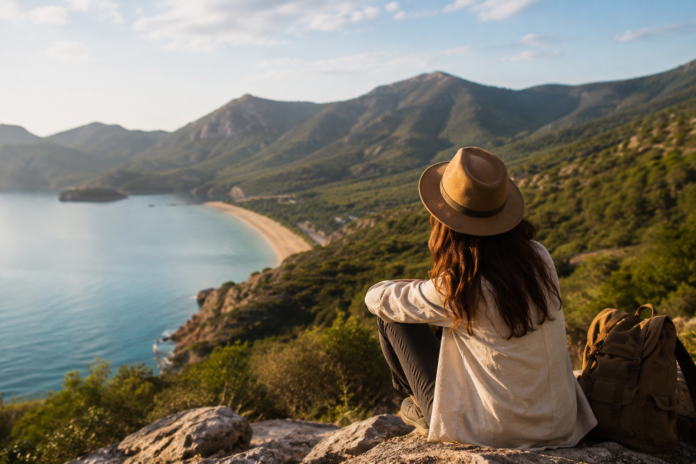

Something has quietly shifted in how people think about taking time off. The old holiday checklist of iconic museums, rooftop bars, and a tightly packed itinerary feels increasingly like a different kind of exhaustion with a better view. People are turning up at airports and booking accommodation not to see more things, but to stop seeing things for a while. Nature travel has moved from a niche preference to something that genuinely competes with the city break, and the reasons are more layered than simple trend-following.
The honest explanation is that people are tired in a way that sightseeing doesn’t fix. Cities are stimulating by design: noise, density, movement, decision-making at every corner. For many travelers, that’s exactly what they’re already living five days a week. A weekend in a major city can be genuinely wonderful but it doesn’t always feel restorative in the way that, say, a morning walk through coastal bush or an hour sitting on a quiet beach does. There’s a biological dimension to this. Natural environments lower cortisol, slow breathing, and do something to the nervous system that urban ones largely can’t replicate. People have started to notice this, and they’re booking accordingly.
The Shift Away From Doing and Toward Being
The nature holiday appeals specifically because it asks less of you. You don’t need a booking at a restaurant that requires two weeks’ notice. You don’t need to calculate transport connections between twelve points of interest before breakfast. You wake up, and the day is there. Trees, water, weather, birds doing whatever birds do. The absence of agenda is the whole point.
This is why destinations like Coffs Harbour on the New South Wales mid-north coast have become consistently popular with travelers who want that uncomplicated version of a holiday. It sits beside national parks, the beach is broad and unhurried, and the area has the kind of genuinely relaxed atmosphere that comes from a place that has never tried too hard to impress. There’s a real difference between a destination that promotes itself as a nature escape and one that actually is one. Coffs Harbour lands firmly in the second category, which is why people keep returning.
Kids Notice It Too
It’s not just adults quietly rediscovering the appeal of fresh air and open space. Families traveling with children are increasingly choosing nature destinations over city experiences, partly because the outdoors gives kids room that hotel rooms and museum queues categorically don’t. A child who can run on a beach, collect things, dig in sand, and get genuinely tired from physical movement rather than screen time is a child who sleeps properly and wakes up in a different mood.
If you’re looking for activity ideas that extend the nature holiday experience beyond the beach itself, the complete guide to outdoor toys for kids in the UAE offers a useful framework that applies well to any outdoor-focused trip with children, particularly around choosing gear that encourages unstructured play in natural settings.
The Appetite for Genuine Wildness
At the other end of the nature travel spectrum, there are travelers who aren’t just escaping city noise. They want genuine immersion in wildlife, landscape, and environments that don’t feel curated. This is where interest in experiences like African wildlife trips has surged. Choosing the right Tanzania safari company is a whole conversation in itself, precisely because the difference between a mediocre experience and a transformative one often comes down to operator quality and authentic access to the landscape.
The common thread running through all of this, from a quiet mid-coast Australian town to a Serengeti game drive at dawn, is the same desire: to be somewhere that is fundamentally outside the pace and texture of daily life. Not just geographically outside it, but experientially. Nature delivers that in a way that a city break, however beautiful the architecture, rarely can.
The shift isn’t a rejection of cities. Most people love them. It’s a recognition that restoration requires something different, and that the most reliably restorative thing on offer is still, after everything, the natural world.