
Introduction
Precision and consistency within the automotive industry is no luxury, it’s a necessity. Each part of the car, from brackets and engine to car interiors, has to conform to strict performance and safety standards. This is where CNC machining comes into play and is particularly important in the comparison of prototype parts and full-scale production parts.
The challenge for manufacturers today is to shorten their development time and preserve development quality. The need for fast innovations in vehicle design requires fast prototyping cycles, and production parts will have to provide long-term durability and repeatability. A delicate compromise between these two stages is one of the most challenging tasks in today’s automotive engineering.
This is where CNC comes into play to allow engineers to test, refine and scale designs efficiently. But it is important to understand the difference between prototype and production machining to ensure that the right manufacturing decision is made.
The Role of CNC Prototyping in Early Design
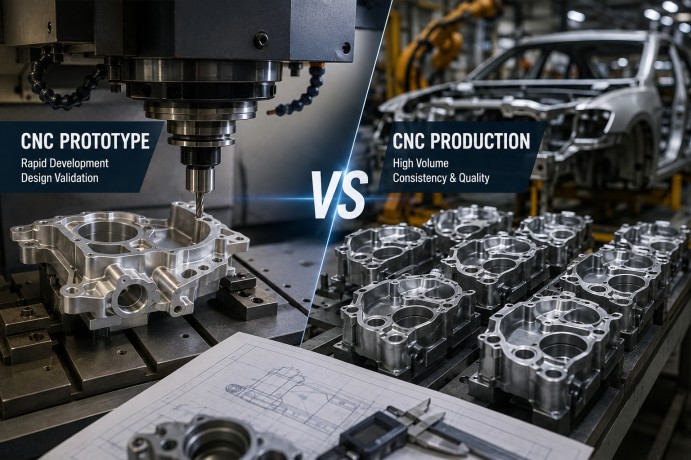
In the automotive industry, prototyping is the basis of today’s product development – otherwise known as CNC prototyping. It enables engineers to rapidly turn designs into actual components to verify form, fit and function before moving into mass production.
In this stage, speed start to determine the stage rather than scale. Materials and machining options are selected to minimise the delivery time and cost. It’s not about long term durability, it’s about getting the design concepts right.
This stage can often be combined with services such as Prototyping And Manufacturing Services to ensure that companies can smoothly transition from digital design to physical testing. This is a structured workflow which allows manufacturers to detect design issues early on and minimise the cost of making adjustments later in the manufacturing process.
To sum up, CNC prototyping involves a trial and error process, as well as refinement. It provides the automotive engineer the option to test several iterations without a big financial investment in tooling or setup.
Transition from Prototype to Low Volume Manufacturing
Low volume manufacturing is the next step after the prototype is validated. This phase is between testing and the production of the full scale commercial version. In the automotive sector, where they need to produce just the right number of new cars or special components, it is particularly crucial.
Low volume runs allow manufacturers to gauge market reaction to a new product, beat the waiting list, or produce specialty vehicles without a significant production volume. Processes are optimized for repeatability, but can be flexible when adjustments need to be made to the design.
This is the time period that many companies opt for Low Volume Manufacturing Services to assure consistency in small volumes. This way, risk is minimised and manufacturing standards are high.
In low volume production, more controlled processes, better material planning and stricter quality assurance is expected, compared to prototyping. It moves from experimentation towards stability and repeatability, and is a key element in the production process.
CNC Production Parts and Mass Manufacturing Standards
Once a design has reached full production stage, the emphasis is completely on efficiency, consistency and scalability. With thousands or even millions of identical parts to be produced with minimal difference, CNC production machining is optimized to handle each of them.
Automotive production parts need to adhere to strict regulatory and safety requirements. Tolerances, even on a small scale, can impact performance, safety, and/or compatibility of assembly. Therefore, tooling, fixtures and tooling parameters are rigorously monitored.
Production environments make automation, short cycle times and long-term material sourcing strategies a priority. Whereas flexibility is the most important part of prototyping, stability is crucial to the production process.
During this stage, the quality assurance systems are also improved. It is common to have the parts of a product manufactured with a certain uniformity, achieved by using statistical process control and automated inspection devices.
Key Differences Between Prototyping and Production
While both involve CNC machining, what they have in common is not easily comparable. Prototyping is about getting things fast – and validating the design – Production is about going big – and going consistent.
The changes are commonplace and normal in prototyping. Based on the testing results engineers make improvements to their designs. Production: changes are kept to a minimum to reduce disruptions and costs.
There are also variations in materials used. Prototypes can be made of less expensive or more pliable materials, production parts are made from final grade metal or composites that are durable and comply with standards.
It is important to be aware of these differences and share them with your automotive company to allocate resources appropriately. It also helps to make sure that each development step is efficient towards the end product lifecycle.
Conclusion
Producing automotive parts from a CNC prototype to actual production is a well-planned and meticulous procedure. These stages are individual and have different functions like from initial design validation till large-scale manufacturing. Combined they guarantee innovation and reliability of automotive components.
With the changing industry, manufacturers are required to pay more attention to the tradeoff between speed, cost and precision than ever before. At the heart of this shift is CNC machining, which facilitates a smooth transition from concept to production.At the core of this shift is CNC machining, which enables a seamless transition from concept to production.
Knowing and optimizing each stage of development will minimize risk, enhance efficiency, and ensure that automotive companies get high quality products to market more quickly.