
The U.S. B2B trade show market reached $15.8 billion in 2024, surpassing pre-pandemic levels and projected to reach $17.3 billion by 2028. That number does not exist because trade shows are a habit. It exists because businesses that participate at the highest level keep generating results that justify the spend.
The companies seeing real ROI from trade shows are not just showing up. They are showing up with intent, preparation, and a physical presence engineered to convert foot traffic into a pipeline. For most of those businesses, that starts with the booth.
Why the Booth Is the Most Underestimated Business Asset at Any Event
Ask most business owners what they spend on trade shows, and they will tell you about travel, registration fees, and hotel rooms. Ask what they spent on the booth, and the number is usually lower than it should be.
That is a strategic error.
Exhibitors allocate about 40% of their total trade show budget to the booth itself, including design and space rental. The reason is not vanity. It is ROI. 72% of trade show attendees are more likely to buy from exhibitors they meet in person at events, and 67% of those attendees represent a new prospect the exhibiting company had no prior relationship with. The booth is where that relationship begins, or does not.
According to exhibitors’ experience, you have 3 to 5 seconds to attract a passing attendee before they commit to the next booth. In that window, your physical setup, your signage, your branding, and your spatial layout either pull people in or let them walk by. No pitch, no product demo, no follow-up sequence matters if that first three-second window fails.
The High-Stakes Gateway to the B2B Shortlist
The B2B buying journey has become incredibly front-loaded. Recent data shows that 92% of buyers start their research with at least one vendor already in mind, and the winning vendor is on the “Day One” shortlist 95% of the time.
A trade show booth serves as a high-impact “first contact” point. It allows brands to bypass the digital noise and secure a spot on that critical shortlist by:
Humanizing the Brand: In a world of AI-generated content, face-to-face interaction builds a level of trust that a PDF cannot.
Lessening the Sales Cycle: The average B2B buying cycle currently sits at 10.1 months. However, leads generated at trade shows require only 3.5 sales calls to close on average, compared to much higher figures for traditional cold outreach.
First Impressions Are Permanent in a Trade Show Environment
Studies from cognitive psychology show that visitors form lasting impressions in just seven seconds, and neuroscience research explains how the brain rapidly processes visual information to drive immediate brand recognition and recall.
This is the science behind why a well-branded, visually cohesive booth outperforms a cluttered or generic one every time.
The Exhibition Designers Association reports that booths utilizing cohesive large-format graphics experience 37% higher brand recall among attendees, and strategic color selection can increase brand recognition by up to 80%, according to the Color Marketing Group.
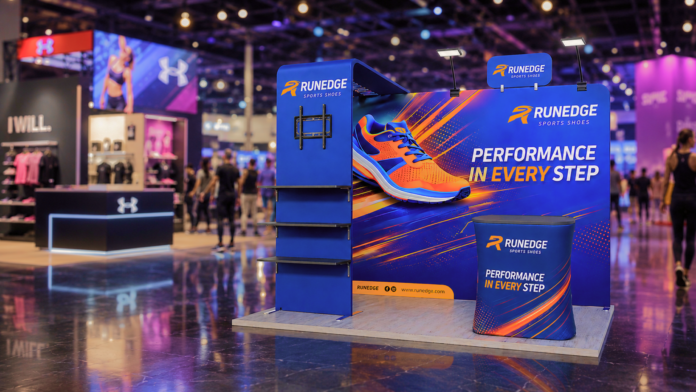
For businesses operating on a trade show budget where every dollar needs to work, a custom canopy tent solves the visibility problem efficiently. A fully printed canopy with your logo, brand colors, and messaging creates immediate identification from across a crowded floor without requiring a massive build budget. It is the difference between a booth that people find and one they walk past.
Lead Quality at Trade Shows Beats Almost Every Other Channel
The average cost per lead at trade shows is $112, compared to $259 for a typical field sales call. That is not a small gap. It is a 57% cost reduction per qualified prospect.
On average, it takes approximately 3.5 sales calls to close a lead generated at a trade show, compared to significantly more touchpoints required when leads come from cold outreach. The reason is context.
46% of trade show attendees are already in the final stages of their buying decision when they attend, and 82% have the authority to make purchasing decisions.
These are not casual browsers. They are buyers, and they came to your industry’s event specifically to find solutions. Your job is to be visible, credible, and ready when they arrive at your space.
48% of exhibitors confirm that eye-catching displays are the single most effective strategy for attracting trade show attendees. A custom tent with logo printed across the canopy, valance, and walls does not require attendees to read small print or approach a staff member to understand who you are.
The Booth Is Your Physical Brand, Not Just a Display Structure
There is a reason 85% of business executives identify trade shows and events as essential to their company’s success. It is not the leads alone. It is the compounding effect of brand exposure, competitive intelligence, partnership development, and customer relationship reinforcement that happens in a single physical location over one to three days.
A well-designed booth not only raises brand visibility but also creates an inviting atmosphere for potential leads. Consistency across every surface of your setup, from the canopy to the table cover to the staff uniforms, reinforces the same brand identity repeatedly across every attendee interaction throughout the event.
What Most Businesses Get Wrong About Trade Show Investment
The most common mistake is treating the booth as a cost to minimize rather than an asset to optimize. A company that spends $5,000 on event registration and $300 on a plain pop-up tent has not saved money. It has been guaranteed that the $5,000 investment produces a fraction of its potential return.
64% of companies plan to increase their trade show participation year over year, and 95% of exhibitors prefer in-person events over virtual alternatives. The competitive floor is getting more crowded, not less. Businesses that treat the booth as an afterthought are competing on a tilted field against exhibitors who have figured out that the setup is the strategy.
The floor does not reward the business with the best product pitch delivered from an invisible booth. It rewards the business that makes it impossible for the right buyer to walk past without stopping.
That begins with what your booth looks like from thirty feet away. Therefore, plan accordingly.