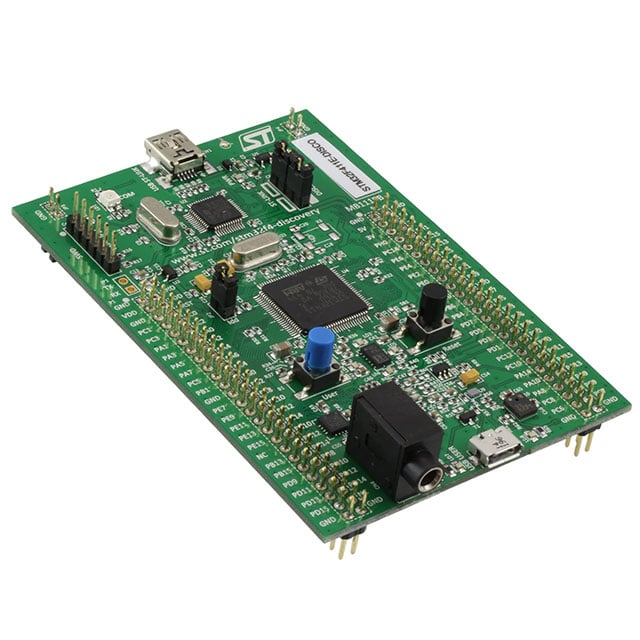

Two of the most popular STM32 development boards carry these two chips. The Nucleo-F446RE and the Nucleo-F411RE look identical apart from the label, cost about the same and plug into the same expansion boards. Both microcontrollers have a Cortex-M4 core with floating point, 512 KB of flash and a 64-pin package. It is easy to assume the choice between them does not matter.
It does. The STM32F446 is the faster, better-connected part, with features aimed at audio, motor control and communications. The STM32F411 is the leaner, lower-power part. This article compares them in detail and explains which suits which kind of project, and what is involved in moving a design from one to the other.
Decoding the part numbers
The two codes share everything except the line number.
| Field | Meaning |
|---|---|
| STM32 | 32-bit Arm-based microcontroller family |
| F4 | High-performance series with a Cortex-M4 core |
| 46 or 11 | Product line: F446 or F411 |
| R | 64 pins |
| E | 512 KB of flash |
| T | LQFP package |
| 6 | Temperature range of -40 to 85 degrees Celsius |
So both are 64-pin, 512 KB, LQFP, industrial-temperature devices. The differences are all in what the product line provides.
Where each line sits
The STM32F446 belongs to the high-performance branch of the F4 series. It runs at up to 180 MHz and offers a wide peripheral set, including interfaces not found on the smaller F4 parts.
The STM32F411 belongs to the access lines of the F4 series, which ST designed for a balance of performance and power efficiency. It runs at up to 100 MHz with a smaller peripheral set and noticeably lower current consumption.
Side-by-side comparison
| Feature | STM32F446RET6 | STM32F411RET6 |
|---|---|---|
| Core | Cortex-M4 with FPU | Cortex-M4 with FPU |
| Maximum frequency | 180 MHz | 100 MHz |
| Flash | 512 KB | 512 KB |
| RAM | 128 KB | 128 KB |
| ADC | 3 x 12-bit | 1 x 12-bit |
| DAC | 2 channels, 12-bit | None |
| CAN | 2 | None |
| USB | OTG full speed, plus a second OTG controller with high-speed capability | OTG full speed |
| Serial audio interface (SAI) | Yes | No |
| S/PDIF receiver | Yes | No |
| Quad-SPI | Yes | No |
| Camera interface | Yes | No |
| SPI and I2S | Several | Several, with up to five SPI and I2S ports |
| Power efficiency | Standard F4 | Optimized for low run and stop current |
| Package | LQFP64 | LQFP64 |
The table shows the main differences. Some peripherals are limited on the 64-pin package compared with larger packages of the same line, so check the datasheet for the exact set available on the pins you have.
Core speed
Both cores are the same design, with the same floating-point unit and DSP instructions. The F446 can be clocked at 180 MHz and the F411 at 100 MHz. Both include ST’s flash accelerator, which lets code run from flash at full speed. For processor-bound work the F446 does nearly twice as much in the same time.
Whether that matters depends on the workload. Decoding or filtering audio, running field-oriented control for a motor at a high loop rate, processing sensor data with floating-point math, or driving a display all benefit. Reading a few sensors and sending the results over a serial link does not.
Memory
There is no difference. Both have 512 KB of flash and 128 KB of RAM. If your application needs more of either, neither part helps, and you should look at larger members of the F4 series or at the F7 and H7 series.
The F446 does have a Quad-SPI interface, which allows fast external serial flash to be attached for data storage or additional code. The F411 can use ordinary SPI flash at lower speed.
Analog
The F446 has three analog-to-digital converters, which can sample three signals at the same instant. That is what three-phase motor control requires for measuring phase currents together. It also has two digital-to-analog converter channels, useful for audio output, waveform generation and setting analog thresholds.
The F411 has one converter and no DAC. One converter can still scan many channels in sequence, which is fine for general measurement. For simultaneous sampling or an analog output, the F446 is the part.
Communication interfaces
CAN. The F446 has two CAN controllers. The F411 has none. For any product that talks to a vehicle, an industrial CAN network or a CANopen device, this is decisive.
USB. Both have a full-speed USB On-The-Go controller with an integrated transceiver. The F446 adds a second controller capable of high-speed operation with an external transceiver, or full speed with its internal one, so it can provide two USB ports.
Audio. Both support I2S. The F446 adds a serial audio interface, which is more flexible for multi-channel and time-division formats, and an S/PDIF receiver for digital audio input. It also has dedicated audio clock generation that makes exact sample rates easier to produce.
Camera. The F446 has a parallel camera interface.
Serial ports. Both have plenty of UART, SPI and I2C ports. The F411 is generous with SPI and I2S for its size, which is one reason it is popular in audio and sensor projects that do not need the F446’s extras.
Power consumption
This is where the F411 leads. It was designed for efficiency, with lower current per megahertz in run mode and low stop-mode current. It also has a batch acquisition mode, in which peripherals collect data into memory through DMA while the core sleeps, so a sensor hub can gather samples for long periods on very little power.
The F446 draws more current, partly because it runs faster and partly because it has more circuitry. In a mains-powered product the difference is immaterial. In a battery-powered product that spends most of its time waiting, the F411 can give meaningfully longer battery life.
Pin compatibility
The STM32F4 series is designed so that parts in the same package share a pinout to a large extent, and these two are close in LQFP64. Power, ground, reset, oscillator and debug pins match, and most general-purpose pins sit in the same positions. That is why the two Nucleo boards can use one circuit board design.
Alternate functions are where care is needed. A pin that carries a particular timer channel or serial signal on one device may offer a different set of options on the other, and peripherals that exist only on the F446 obviously have no equivalent on the F411. If you want one board to accept both chips, assign pins in the configuration tool for each device and use only the functions available in the same place on both.
Software compatibility
Both are supported by the same STM32CubeF4 software package, configuration tool and development environments. Code written against ST’s hardware abstraction layer moves between them with modest changes.
- Clock setup. The PLL settings differ, and any timing derived from the core clock must be recalculated.
- Peripheral availability. Code using CAN, the DAC, SAI or the second and third ADCs has nothing to run on with the F411.
- Linker script and startup file. These are specific to each device, and the tools generate them.
- Interrupt vectors. The vector tables differ in the entries for peripherals that exist on only one part.
Moving from the F411 up to the F446 is easy, since the F446 has everything the F411 has. Moving down requires checking that nothing depends on the missing peripherals or the extra speed.
Three example projects
A USB audio interface. The device receives audio from a computer over USB, accepts an optical digital input and drives a codec. The F446 fits: its serial audio interface connects the codec, the S/PDIF receiver takes the optical input, the audio PLLs generate exact sample-rate clocks, and 180 MHz leaves room for sample-rate conversion and effects. The F411 could handle a simple two-channel USB-to-I2S bridge, but not the digital input or the heavier processing.
A wearable activity logger. The device reads an inertial sensor and a pressure sensor many times a second, stores the data and uploads it once a day. It runs for weeks from a small cell. The F411 fits: batch acquisition lets the sensors fill a buffer while the core sleeps, run current is low when the core wakes to process the data, and nothing in the design needs CAN, a DAC or extra speed.
A brushless motor controller with a CAN interface. The device runs field-oriented control and takes commands over CAN. The F446 fits: three converters sample the phase currents together, the advanced timer generates the PWM, the floating-point unit handles the transforms at a high loop rate, and CAN is built in. The F411 has no CAN controller and only one converter.
Migration checklist
If you are moving a design between the two parts, work through this list.
- Create a project for the new device in the configuration tool and re-enter the pin assignments. Note any pins flagged as unavailable.
- Set the clock tree for the new device and confirm USB still receives exactly 48 MHz.
- Check every peripheral in use against the new device’s datasheet for the 64-pin package.
- Regenerate the startup file and linker script.
- Recalculate timer periods, baud rates and ADC sampling times if the clock frequencies changed.
- Rebuild, then test each peripheral individually before running the full application.
- Measure current consumption in each operating mode if battery life matters.
- Re-run any timing-critical tests, such as control-loop jitter and audio glitch checks.
Which should you choose?
Choose the STM32F446RET6 for:
- Audio products that need multi-channel interfaces, S/PDIF input, a DAC or exact audio clocks.
- Motor control with simultaneous current sampling on three converters.
- CAN-connected devices of any kind.
- Processing-heavy applications that benefit from 180 MHz.
- Designs that need two USB ports or fast external flash.
- Projects whose requirements may grow. The extra peripherals cost little and avoid a redesign.
Choose the STM32F411RET6 for:
- Battery-powered devices where run and standby current matter.
- Sensor hubs and data loggers that can use batch acquisition.
- Simple control and connectivity tasks that fit comfortably in 100 MHz.
- Cost-sensitive products that do not need CAN, a DAC or the extra interfaces.
If you are unsure, prototype on the F446. It is a superset in features, and if the finished design turns out not to use what it adds, moving down to the F411 for production is a manageable step on a board laid out for both.
Buying the STM32F446RET6
The 64-pin, 512 KB version is one of the most widely used codes in the F446 line, because it is the chip on the Nucleo board. Verified Electronics, an electronic components distributor that uses third-party testing, lists the STM32F446RET6. Codes ending in TR are the same device on tape and reel, and a 7 in place of the final 6 indicates a wider temperature range.
Other parts to consider
- STM32F401: a lower-cost relative of the F411 at 84 MHz.
- STM32F405 and F407: 168 MHz, up to 1 MB of flash, with Ethernet on the F407.
- STM32F427 and F429: 180 MHz with up to 2 MB of flash, and a display controller on the F429.
- STM32G474: a newer Cortex-M4 at 170 MHz with advanced analog and timers for motor control and digital power.
- STM32F7 and H7 series: Cortex-M7 parts for when a Cortex-M4 is not enough.
Frequently asked questions
Is the STM32F446 faster than the STM32F411? Yes. 180 MHz against 100 MHz, with the same core.
Do they have the same memory? Yes, in these versions: 512 KB of flash and 128 KB of RAM.
Are they pin-compatible? Largely, in the LQFP64 package. Check alternate functions for the pins you use.
Does the STM32F411 have CAN? No. The F446 has two CAN controllers.
Which uses less power? The F411.
Can I run the same firmware on both? With changes to the clock configuration and device files, and provided the code does not use peripherals missing from the F411.
Which Nucleo board should I buy? The F446RE if you want the widest feature set to experiment with, the F411RE if low power is your interest.
Summary
The STM32F446RET6 and STM32F411RET6 share a core, memory size and package, and differ in speed, peripherals and power. The F446 runs at 180 MHz and adds three ADCs, a DAC, two CAN controllers, a second USB controller, a serial audio interface, S/PDIF input, Quad-SPI and a camera interface. The F411 runs at 100 MHz with a smaller peripheral set and lower current consumption. Choose the F446 for audio, motor control, CAN and processing-heavy work, and the F411 for battery-powered and simpler designs. Confirm the peripherals available on the 64-pin package in the current ST datasheets before you finalize the pin assignment.