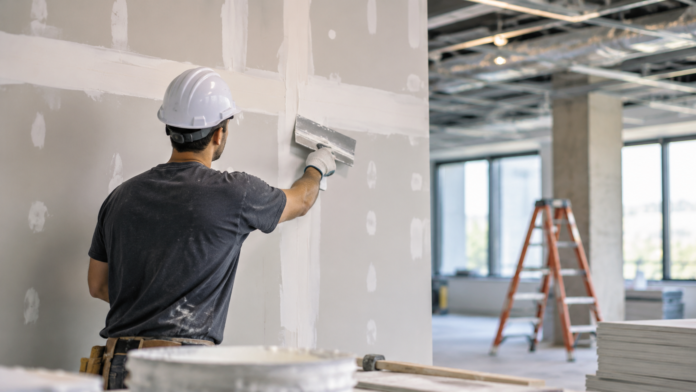

A commercial drywall job can look finished from ten feet away and still fail the test that matters: the inspection, the first week of occupancy lighting, or the rated wall that was supposed to perform as a tested assembly. Building owners and facility managers often approve a bid, see hangers on site, and assume the rest will take care of itself. The gaps usually show up later, in glare, in a failed inspection, or in a punch list that never quite closes.
Commercial drywall installation is not only about covering studs. It is about matching the finish to the room, installing rated and acoustic assemblies exactly as they were designed, and sequencing the work so the walls are ready when the other trades need them.
The Finish Level Is Part of the Design, Not a Detail
Gypsum finishing is described in industry levels, not in vague promises of a “smooth wall.” The Gypsum Association’s GA-214 recommendations set out six levels, from 0 through 5, and they exist because the same board can be finished to very different standards.
Level 3 is typically specified in appearance areas that will receive a heavy or medium texture, or a heavy-duty commercial wallcovering. It is not the right finish for a smooth wall. Level 4 is the usual choice for smooth walls that will take a flat paint, a light texture, or wallcovering. Level 5 adds a skim coat over the entire surface and is typically specified where the paint is not flat, the color is dark or deep-toned, or the lighting is critical.
That last point is the one owners miss most often. Critical lighting is strong side light from windows or surface-mounted fixtures. It exaggerates small ridges and recesses that are invisible under overhead light in an empty suite. Joint photographing — the shadow of a finished joint showing through the paint — is much more likely on a glossy or dark wall than on a flat, lightly textured one. If a lobby will have wall washers, a long run of glass, or a deep paint color, Level 4 is often not enough, no matter how carefully the joints are sanded.
The only reliable way to agree on appearance before a whole floor is finished is a mock-up in the actual lighting, including the final paint or texture. Industry guidance also says the normal viewing distance for inspection is at least five feet from the surface, under the lighting that will be there when the building is occupied. Looking at bare, unprimed joints with a work light in your hand is not the same test.
Rated Walls Have to Be Installed as Designed
Where a wall or ceiling is required to provide fire resistance, smoke resistance, or sound control, the finish level does not replace the assembly requirements. Those systems have to be built the way the tested design and the applicable building codes require. That usually means a specific board type and thickness, a specified number of layers, fastener spacing, and joint treatment. Substituting a thinner board, skipping a layer, or changing the joint treatment can void the rating, even if the wall looks finished.
This is easy to miss in a tenant improvement, where a new suite may have to tie into existing corridors, shafts, or demising walls. The questions to ask before hanging starts are simple: which walls are rated, which design is being followed, and who is responsible for the penetrations after electrical, plumbing, and HVAC are in? A clean finish on the wrong assembly is still the wrong wall.
Lighting, Paint, and the Rooms People Actually Use
A warehouse storage area and an executive conference room should not be finished the same way. Level 2 may be appropriate where the board is a substrate for tile, or in a garage or warehouse where appearance is not the point. Offices, retail floors, and corridors usually need Level 4. Reception areas, boardrooms, and any space with grazing light or a high-gloss specification often need Level 5.
Owners sometimes cut the finish level to save money, then choose a darker paint or add picture lights after the fact. The wall does not get a second chance at a skim coat once it has been decorated. If the paint or lighting may change, it is cheaper to specify the higher finish in the rooms where it will matter than to live with visible joints.
Sequencing, Occupied Spaces, and Conditions on Site
Drywall work sits in the middle of the schedule. Framing has to be complete and inspected. Mechanical, electrical, and plumbing rough-in has to be in. Then the board goes up, openings are cut cleanly, and finishing starts only when the space can be held at a stable temperature. Industry finishing guidance calls for a minimum of 50 degrees Fahrenheit, maintained continuously for 48 hours before finishing begins and kept there until the project is completed or occupied. Cold, damp, or widely swinging conditions are a common reason joints crack or tape fails later.
In an occupied office or a live retail space, the work also has to happen around customers and staff. That usually means after-hours or weekend shifts, dust control, and a clear plan for which suites are delivered first. A low bid that assumes an empty building will not hold up if the tenant is still operating on the other side of a corridor.
Finishing itself is a surface process: joint compound is built up in thin coats above the face of the board. Industry guidance is clear that a perfectly flat wall is not a realistic expectation, which is why the higher finish levels exist. Primer is also part of the job, not an afterthought. The finishing recommendations call for a primer formulated for the final paint or covering, applied over the entire prepared surface before decoration. Painting too soon, or skipping primer on a Level 4 or 5 wall, can make joints more visible once the lights are on.
What to Put in Writing Before Work Starts
The scope should name a finish level for each kind of room, not a single note that says “standard finish throughout.” It should identify rated and acoustic walls, call for a mock-up in at least one critical space, and say how occupied areas will be protected. Ask who is responsible for cutting and finishing around access panels, door frames, and glass openings, and how change orders will be priced when a trade stacks behind schedule.
If you are planning an office buildout, a retail tenant improvement, or warehouse drywall in the Denver metro, A Pro Finish Drywall handles commercial installation and finishing, including level 3, 4, and 5 finishes and after-hours work in occupied spaces.
Ask any contractor to confirm the finish level room by room, to identify rated assemblies, and to explain how the work will be phased around other trades. Request a mock-up in a critical room before the rest of the floor is finished. Those are ordinary project controls, not extras.
Commercial drywall installation rewards a clear specification more than a fast start. Get the finish level, the rated walls, and the schedule right, and the rooms will look the way you expected when the lights come on. Miss those pieces, and no amount of last-minute touch-up will fully hide them.