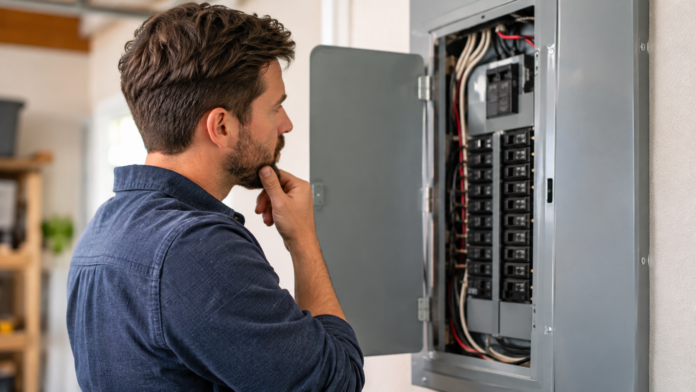

Three breaker trips in a single week and you’re standing in the garage with a flashlight, staring at a gray metal door like it owes you an explanation. That door is the most misunderstood appliance in your house. Not because it’s complicated, but because nobody ever explains it to you.
Your panel is the switchboard between the utility line and every outlet, light, and appliance you own. It decides how much power each circuit can draw, and it cuts that power the moment something goes wrong. Learn to read it and you’ll save yourself a lot of panic, and probably a service call or two. Ignore it and you’ll keep resetting the same breaker until the day it stops tripping and something else starts melting. If you live in Tarrant County and want a pro to just look at it, companies like electrical services in richland hills handle panel inspections alongside general repair work, which is cheaper than waiting for a failure.
Here’s what every homeowner should actually understand about that box, starting with the part most people get wrong.
What is a breaker actually doing?
A breaker is a switch with a trip mechanism built in. It watches the current flowing through its circuit, and when that current climbs past a safe level for long enough, it opens the circuit on purpose. That’s it. It’s not a fuse you have to replace, and it’s not a suggestion light. It’s the one component in your electrical system whose entire job is to fail first.
So when a breaker trips, it just did its job. The question worth asking isn’t “how do I stop this from happening,” it’s “what changed on that circuit.” Sometimes the answer is boring, like a space heater and a microwave sharing an outlet nobody thought about. Sometimes it isn’t.
Two details matter more than people realize. First, breakers get weaker with age. A twenty year old breaker may trip at a lower current than its label says, or worse, may not trip at all. Second, the rating printed on the handle is a ceiling for that circuit, not a target. A 20 amp breaker on a 15 amp wire run is a fire waiting on a schedule, and that kind of mismatch is something an inspector finds, not something you spot from the driveway.
Reading the panel without touching anything
You don’t need to remove a cover to learn a lot. Open the door, look at the inside of it, and find the circuit directory. If it’s blank, half scribbled, or says things like “kitchen” three times, that’s your first project, and it costs you a notebook and twenty minutes.
Here’s the method I actually use, and it works whether your panel is labeled or not. I call it the Three Pass Walkthrough, and it takes about an hour total, spread across a few evenings.
- Pass one, map the obvious. Flip one breaker at a time and write down what dies. Do this with someone else in the house shouting from the other room. Label every result in pencil first.
- Pass two, find the ghosts. Walk the house with a plug in tester and check every outlet, including the ones behind furniture and in the garage. People are consistently wrong about which circuit feeds the garage.
- Pass three, ink the directory. Once the map is accurate, copy it into the panel door in permanent marker. Room names, not circuit numbers.
The payoff isn’t organization for its own sake. When a breaker trips at 10pm and you know exactly what’s on it, you can make a real decision instead of a guess. That’s worth an hour of your life.
The panel details that actually predict trouble
Most panels are fine. The ones that worry me share a handful of traits, and none of them require a meter to spot.
Rust or moisture staining inside the door is a bad sign. So is a faint scorch smell, or any breaker that feels hot to the touch when nothing unusual is running. Breakers warm up slightly under load, but hot is not the same as warm, and your hand knows the difference.
Buzzing deserves its own paragraph. A panel that hums quietly is normal. A panel that buzzes, chatters, or clicks on its own is telling you a connection is loose somewhere behind the dead front, and loose connections are where heat builds. According to the National Fire Protection Association, electrical failures and malfunctions remain one of the leading causes of home fires in the United States, and loose terminations are a recurring contributor. That single fact is why I never tell anyone to ignore a noisy panel.
Then there’s capacity. Older homes were built for a fraction of what a modern household runs, and adding an EV charger, a heat pump, or a tankless water heater to a full panel is how people discover they need an upgrade. You can’t solve that with a bigger breaker. The panel and the service line have limits, and the fix is a load calculation done by someone licensed.
When to call someone and when to keep your hands off
Reset a breaker once and see what happens. That’s reasonable. Reset it three times in a week and you’re not troubleshooting anymore, you’re conducting an experiment with your house as the lab.
Call a licensed electrician when a breaker won’t stay reset, when you smell burning near any outlet or switch, when you see discoloration around a receptacle, or when your panel is a brand with a known recall history. Call them before you finish a basement or add a hot tub, not after. Permits exist for a reason, and unpermitted electrical work is one of the few home projects that can complicate an insurance claim later.
And if you’re tempted to open the dead front yourself, don’t. The main lugs stay energized even with the main breaker off, which is not obvious and not forgiving. The Occupational Safety and Health Administration treats energized electrical work as one of the most serious hazards in any workplace, and your garage isn’t built to those standards. Respect the box. Let someone qualified open it.
A quick look at your electrical budget
Try a rough energy check before you blame the panel for anything. The Department of Energy notes that heating and cooling systems typically account for the largest share of a home’s energy use, which explains a lot of winter breaker trips in older houses. If your trips cluster around cold snaps, the circuit may simply be undersized for what you’re plugging in.
| What you notice | Likely cause | Who handles it |
| One breaker trips during a specific appliance | Circuit overloaded by that appliance | You, by moving the load |
| Same breaker trips with nothing unusual running | Failing breaker or loose connection | Licensed electrician |
| Warm panel door, faint smell | Heat at a termination | Licensed electrician, promptly |
| Every circuit feels strained | Service too small for the house | Load calculation and upgrade |
The rule of thumb I’d give a friend: if you can explain the trip, you can probably handle it yourself. If you can’t, that’s the signal to stop resetting and start calling.
What this all comes down to
Your panel isn’t a mystery box, it’s a map of your house with a safety net attached. Label it properly, learn what a trip is telling you, and treat heat, noise, and rust as the warnings they are. That’s most of the job, and none of it requires a tool.
The rest belongs to someone with a license, a meter, and insurance. If you’re in the Dallas and Fort Worth area and your panel has been tripping more than usual this season, get it looked at before the next cold snap does the looking for you. What’s the one breaker in your house you’ve never been able to figure out?