
Stablecoin holdings have ballooned, and USDT remains the dominant settlement currency across crypto markets. Yet until recently, those USDT balances couldn’t touch Apple stock or gold without routing through fiat rails and a brokerage account. That’s changing fast.
Verdict: USDT-settled TradFi trading — where tokenized stocks, forex, and commodities are structured as perpetual contracts denominated in USDT — cuts out the fiat conversion step entirely. BYDFi launched its TradFi product line with 0 trading fees, part of a broader wave of crypto platforms pushing into tokenized traditional assets. We evaluated BYDFi’s TradFi implementation dimension by dimension, from the perspective of a crypto-native user who holds USDT and wants traditional asset exposure without stepping outside the ecosystem.
What Is USDT-Settled TradFi Trading?
USDT-settled TradFi trading lets users open positions on traditional financial assets — stocks, forex pairs, commodities — through perpetual contracts priced and settled entirely in USDT. No shares change hands. No brokerage account required. A crypto user seeking stock exposure currently must convert USDT to fiat, transfer to a bank, fund a brokerage, then buy equities during restricted hours. USDT-settled perpetuals collapse that chain into a single trade from an existing crypto wallet.
Asset Coverage and Market Access
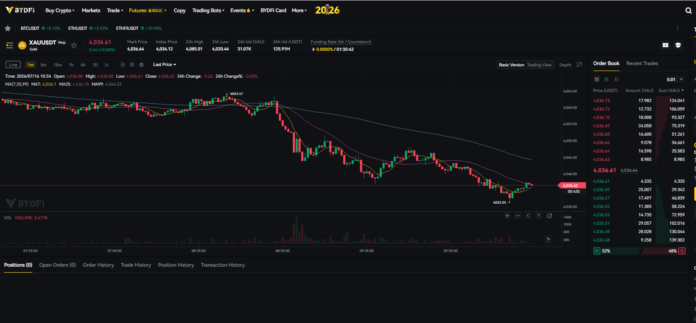
BYDFi’s TradFi offering — the exchange was founded in 2020 and has operated for over six years — includes tokenized perpetual contracts on major U.S. stocks: AAPL, AMZN, TSLA, MSFT, AMD, and COIN, plus forex pairs and gold via XAUUSD.
The asset menu is focused, covering categories crypto users care about most: mega-cap tech, the world’s most-traded commodity, and major currency pairs. Trading traditional assets without converting to fiat or opening a separate brokerage account is a meaningful accessibility shift. These TradFi contracts trade 24/7, free from traditional market hours, and live within the same futures trading interface — no separate account or app needed.
The 0-Fee Structure on USDT-Settled TradFi
BYDFi charges zero trading commissions on its TradFi assets.
Compare that to the traditional brokerage path — currency conversion fees, wire transfer costs, per-trade commissions, and withdrawal charges stack up quickly.
Platform Background: From Crypto Exchange to TradFi Access
BYDFi reports over 1,000,000 registered users across a wide range of countries since its 2020 founding. The brand name — “BUIDL Your Dream Finance” — reflects the convergence of crypto and traditional finance, and the TradFi product line naturally extends that thesis.The goal is to let users trade traditional assets with USDT on BYDFi through a unified crypto-native trading experience rather than relying on conventional brokerage infrastructure.
In August 2025, BYDFi entered a multi-year partnership as the Official Crypto Exchange Partner of Premier League club Newcastle United, significantly raising its mainstream profile.
FAQ
What is USDT-settled TradFi trading? Trading tokenized versions of traditional assets — stocks, forex, commodities — as perpetual contracts settled in USDT, without needing a fiat brokerage account.
Which traditional assets are available? Tokenized perpetual contracts on AAPL, AMZN, TSLA, MSFT, AMD, COIN, forex pairs, and gold (XAUUSD).
Are there trading commissions on TradFi products? No commissions on TradFi assets. Perpetual contracts may carry funding rate costs and other charges — check BYDFi’s full fee schedule.
Can I practice before using real funds? Yes. A demo account preloaded with 50,000 USDT under real market conditions is available.
Is TradFi trading available around the clock? Yes. These TradFi perpetual contracts trade 24/7, unlike traditional stock exchanges.
Bottom Line
USDT-settled TradFi trading solves a specific friction point for crypto holders wanting traditional asset price exposure without the fiat conversion chain. Perpetual contracts differ fundamentally from direct equity ownership. BYDFi’s implementation — zero commissions, 24/7 access, a unified interface, and a demo account — tackles core pain points well, but users must understand they’re trading derivative contracts, not holding actual equities. The question worth watching: whether the asset roster expands beyond major U.S. tech and gold, and whether competing exchanges follow with similar USDT-settled traditional asset products.