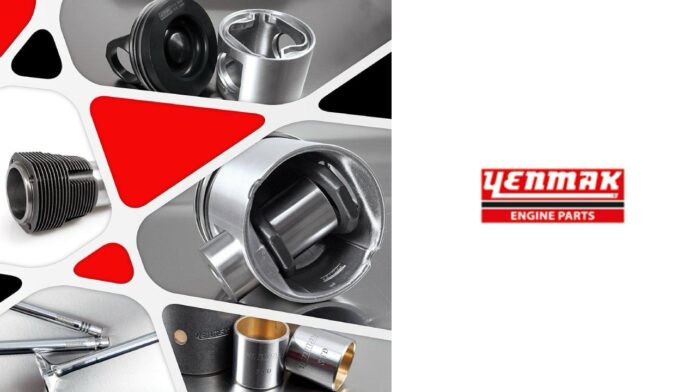

The piston is the only engine component that handles combustion pressure directly, thousands of times per minute under continuously varying load. It absorbs heat from each combustion event. It transfers force to the connecting rod. It seals the chamber against blow-by through the rings. It guides itself in the bore through the skirt. Few engineering parts carry that many simultaneous functions.
For aftermarket buyers, the engine piston manufacturer choice influences engine longevity more than almost any other parts decision. Yenmak runs a dedicated Piston Factory in Istanbul that has produced pistons and piston pins as matched sets since 1965. This article covers the design considerations behind that production.
What Does a Piston Do Across the Combustion Cycle
A four-stroke engine puts the piston through four distinct phases on every revolution. In each phase, the piston has a different mechanical task.
During intake, the piston descends and draws air or air-fuel mixture into the cylinder. During compression, it rises and pressurizes the mixture for ignition. During combustion, expanding gases push the piston down with force that translates into shaft torque. During exhaust, the piston rises again and pushes burned gases out of the chamber.
Two design constraints shape the piston across all four phases:
- Maximum allowable temperature at the crown surface
- Allowable clearance between piston and liner bore at operating temperature
Both constraints depend on alloy selection, skirt geometry and ring groove placement.
Yenmak’s Piston Factory in Istanbul
Yenmak’s Piston Factory sits separately from the Cylinder Liner Factory at the Istanbul base. The factory produces pistons and piston pins as matched components, with ring sets drawn from the same product catalog. Production has continued in this configuration since 1965.
For distributors seeking an engine piston manufacturer with in-house pin matching and a consistent alloy supply, the Yenmak factory presents a relevant supplier profile. The Piston Factory handles alloy selection, machining of crown and skirt geometry, ring groove cutting, and final inspection. The pin operation runs on the same shop floor.
The piston program covers:
- Pistons for petrol engine applications
- Pistons for diesel engine applications, including heavy-duty platforms
- Pistons for natural gas engines
- Matched piston pins delivered with each set
Piston Anatomy and Production Considerations
Every piston region has a distinct mechanical role and a different design constraint. The table below maps the main regions to their function and the key consideration that drives production decisions.
| Piston Region | Function | Key Design Consideration |
|---|---|---|
| Crown | Receives combustion pressure and heat | Bowl shape, thermal-conductive alloy |
| Ring grooves | House piston rings for combustion sealing | Tolerance control, optional anodizing |
| Skirt | Guides piston in bore, transfers side load | Cam ground profile, low-friction coatings |
| Pin boss | Houses the piston pin | Bore precision, oil supply path |
| Piston pin | Couples piston to connecting rod | Clearance, surface hardness, alignment |
The Yenmak Piston Factory addresses all five regions in-house. The pin and pin boss work together as a fitted pair, which is one reason matched-set delivery is the standard mode of shipment.
How Does Aluminum Alloy Choice Affect Piston Service Life
Aluminum alloys dominate piston manufacturing because the metal combines low weight with reasonable thermal conductivity. The lower mass reduces reciprocating forces, which lets engines run higher RPM. The thermal conductivity moves heat from the crown to the ring zone and onward to the liner.
Silicon content is the key alloy variable. Eutectic aluminum-silicon alloys contain about 12 percent silicon and balance thermal expansion with wear resistance. Hypereutectic alloys exceed 12 percent silicon and offer harder, more wear-resistant pistons at slightly higher brittleness.
Heat treatment after casting or forging shifts the microstructure into the right strength range. T6 temper is common for production pistons. The resulting thermal stability is what lets aluminum survive next to combustion temperatures.
Why Does Skirt Geometry Matter for Engine NVH and Wear
Piston skirt geometry controls how the piston tilts and slides as it changes direction at top and bottom dead center. Three design choices shape that behavior.
The first is cam grinding, where the skirt is machined as a slight oval rather than a true cylinder. At operating temperature, the skirt expands into a near-perfect round, delivering correct running clearance only when the engine is warm.
The second is the asymmetric skirt profile. The thrust and anti-thrust sides do not see equal load during combustion. Asymmetric designs add material where load is highest and remove it where load is light.
The third is the skirt coating. Graphite, molybdenum disulfide or polymer-based coatings reduce friction and noise, vibration and harshness (NVH) during cold start. Yenmak applies skirt coatings where engine specifications require.
What Role Does the Piston Pin Play in Connecting Rod Coupling
The piston pin bridges the piston and the connecting rod. It carries combustion force from the piston into the rod, and through the rod into the crankshaft. Pin failure on a heavy-duty diesel engine almost always ends in catastrophic damage.
Two design choices define the pin:
- Fully floating pin: rotates freely in both the piston pin boss and the connecting rod small end
- Press-fit pin: fixed in the connecting rod small end, rotates only in the piston
Pin material is typically case-hardened steel, with surface treatment for wear resistance. Yenmak ships matched pins with every piston set, sized to the corresponding pin boss bore.
Quality Documentation for Piston Specifications
Aftermarket distributors qualifying Yenmak as a piston supplier work with three documentation channels. The first is the ISO 9001 certification, in place at Yenmak since 1996, covering the Piston Factory and the rest of the operation. The second is Turkish Standards Institution (TSE) compliance as a national reference. The third is the technical drawings and specification sheets, available through the documentation section of the Yenmak website.
This documentation set lets distributors complete most supplier qualification work through self-service.
Frequently Asked Questions
What does Yenmak offer as an engine piston manufacturer for diesel platforms?
Yenmak produces pistons for diesel engine applications across the heavy-duty range. The Piston Factory in Istanbul handles aluminum alloy selection, machining of crown and skirt geometry, ring groove cutting and final inspection. Matched piston pins ship with each set. The diesel piston range covers most common platforms in the global aftermarket.
Why is aluminum used for engine pistons rather than steel or other metals?
Aluminum alloys combine low weight with reasonable thermal conductivity. The lower mass reduces reciprocating forces, which lets engines run higher RPM. The conductivity moves heat from the crown to the ring zone and on to the liner. Eutectic and hypereutectic aluminum-silicon alloys cover most production piston applications.
How does skirt coating affect piston performance during cold start?
Skirt coatings reduce friction between the piston and the cylinder liner during cold start, when running clearances are larger than at operating temperature. Graphite, molybdenum disulfide and polymer-based coatings are common. The reduced friction lowers cold-start noise and protects the skirt surface during the early warm-up cycles.
What does Yenmak’s matched-set delivery include for engine rebuilders?
A Yenmak matched set delivers the piston, the matched pin and the corresponding ring set from the same Istanbul production base. Pin-to-piston clearances and ring-to-groove clearances draw from a single tolerance reference. Workshop networks rebuilding engines at scale benefit from reduced qualification work and a single supplier contact.
READ ALSO: Why Most Mobile Apps Fail After Launch (And How to Avoid It)