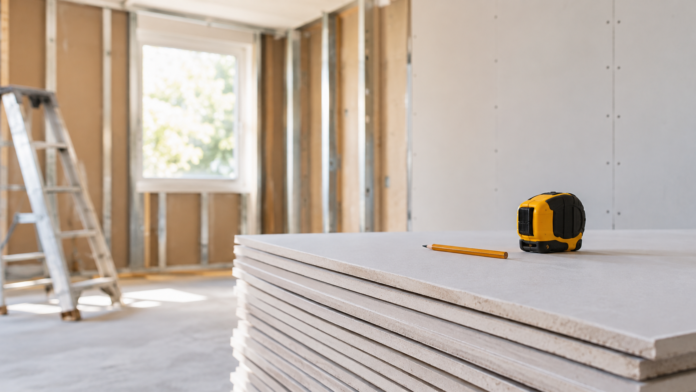

Plasterboard looks simple, but the board behind the finish affects fire safety, acoustics, moisture resistance and long-term performance. Specifying it well means thinking about the whole wall or ceiling, not just the sheet.
- Understand That Not All Plasterboard Performs the Same Job
Standard boards suit general lining, but other types are made for specific demands. Fire-resistant boards help constructions hold back fire for a set period. Acoustic boards are denser to reduce sound transfer. Moisture-resistant boards suit kitchens, bathrooms and utility rooms, and insulated boards bond a layer of insulation to the plasterboard. Choosing the right plasterboard therefore starts with where it will be used and what the finished system has to achieve, including the studs, fixings, insulation and jointing around it. Using a board outside its intended application can leave a wall that looks right on paper but underperforms in use.
- Match the Specification to Fire-Safety Requirements
Fire performance belongs to the complete construction, not to a single board. A stated fire-resistance period is achieved by a tested combination of board type, thickness, number of layers, framing, fixings and joint treatment, so check the manufacturer’s tested system details instead of relying on product names alone. Swapping one board for another, or leaving out a layer, cannot be assumed to deliver the same result. Contractors working in England should check the requirements in Approved Document B, which the government revises periodically and last updated in September 2026, and confirm the design with the building control body.
- Consider Acoustics and Moisture, Not Simply Board Thickness
Thicker does not always mean better. Where a wall or floor separates dwellings, Approved Document E sets minimum sound insulation, and compliance is demonstrated through pre-completion testing or Robust Details, so the whole build-up matters, including the cavity, insulation and sealing at junctions. Moisture is similar. Moisture-resistant board resists humidity in damp rooms, but it is not a substitute for proper waterproofing in showers or good ventilation. Choose it for the environment, then detail the rest of the system around it.
- Make Product Information and Evidence Part of Procurement
Specifications only work if the delivered product matches them. Before ordering and installing, check datasheets, declarations of performance, conformity marking and any third-party certification, and make sure the evidence covers the system being built. Treat substitutions as formal changes, with written approval from the designer, and keep delivery notes and records so the products installed can be traced if questions arise later. The government’s Construction Products Reform White Paper, published in February 2026, observes that a product may be safe on its own but become unsafe when combined with others, which reinforces the point.
Good plasterboard decisions are made before anything reaches the site. Specify the job, evidence the system, and challenge any substitution.