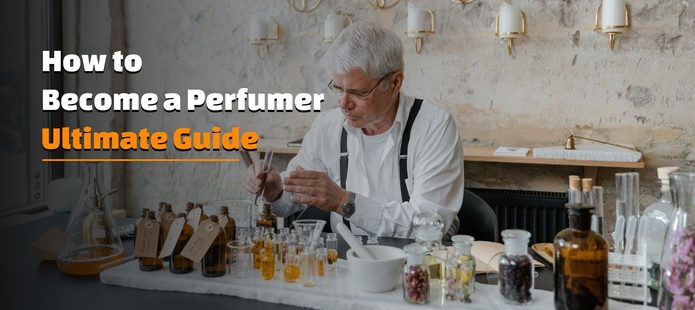

Being a perfumer is the art of nose and the science of chemicals. If you want to become a perfume, you will have to understand these two crucial aspects of a professional perfumer. Today, I will explain these important areas to become a perfumer. With these insights, you can easily start your aromatic career in this billion-dollar industry.
What is a Perfumer?
A perfumer is an individual who mixes perfumes with various ingredients and chemicals. It is only the perfumer who knows what goes into making a perfume and how. In fact, a perfume is produced using various aromatics and fragrances. These odors are derived from various natural and artificial goods. A perfumer is also known as affectionate due to his enhanced sensitivity of the nose. A perfumer distinguishes different types of smell very easily. He can easily pick the best scents and chemicals in order to manufacture a scent with this facility.
Thus, a perfumer is not just someone who understands the content of smell. However, he also has an unparalleled ability to distinguish various smells. In contrast to the classical perfumers, where molecular distillation and headspace analysis are used – modern perfumers. So, it has become something of a creative art in producing scented perfume. Furthermore, different perfumers specialize in particular types of perfume making. For instance, niche perfumers produce customized perfumes that are only used on various occasions. Alternatively, chemical perfumers develop their scents in labs. They study the chemical properties of various fragrances but synthesize stronger-lasting perfumes for industrial purposes.
What to Study to Become a Perfumer?
Chemistry is the main subject of being a perfumer. Perfume production is a work of mixing different kinds of ingredients in a fine state. So, these are actually the chemicals of different nature to create a perfume. With chemistry, you can understand the composition of perfumes and their role in creating perfumes. Similarly, you need to study aroma and cosmetic formulation to become a perfumer. As discussed above, being a perfumer is the art of knowing different scents and the science of understanding their chemistry. Therefore, you will have to develop both capabilities if you wish to be a perfumer. However, if you want to start a business of perfume then knowing more about its aspects is beneficial. For example, you should have a complete idea about the suitable packaging of perfumes to avoid any destruction. As you may know, big brands use only high-quality custom perfume packaging boxes instead of using ordinary packaging for their branded perfumes.
Moreover, the perfumer is not limited to chemistry alone. Art and creative art play an important role in the development of a professional perfumer. By pursuing a course in fine arts, you can learn to be highly creative. With this creativity, you can appreciate the requirement of a particular perfume from public drive and requirements. Moreover, there are types of perfumes with various stages of odor. From liquid to a fine spray, you will have to analyze both formulations if you want to be a perfumer. Consequently, chemistry, composition, and their beauty are essential fields to be a perfumer.
How Many Sprays of Perfume Are There?
The number of sprays depends on various factors, such as the capacity of the perfume bottle and how dense it is. In most cases, 100ml of perfume is nearly equivalent to 952 sprays. As an estimate, 1ml has 10 sprays. But the figures can be tremendously different between bottles. For instance, there are several kinds of 100ml perfumes that have various sprays. Actually, the amount of sprays from a bottle is defined by the density and strength of perfumes.
More so, a smaller 10 ml perfume has 100 sprays and 50 ml gives you the opportunity to spray it up to 500 times while a larger one with its size of 100 ml will allow for about a thousand shots. Some bottles have better sprayers. The best of them generate a fine mist that ensures you get just the right amount and not an excessive dose. Generally, individuals spray 3 to 5 times per day based on the perfume’s potency and scent. Wearing when, where, and how long are also important factors in determining the level of usage. In contrast, Compared to 50 ml and 100 ml bottles the price difference is close. But a 100 ml bottle gives double doses of sprays.
Thus, buying 10 bottles of 50 ml is more expensive than the acquisition of two bottles of 250 ml, providing equal sprays but at an incredibly reduced price. Likewise, though the larger size is cost-advantageous, there are advantages of smaller bottles. A major purchase can be a challenge for people on a tight budget. Since every size has advantages and disadvantages, you have to choose what works best for you.
How Big is 1.0 oz of Perfume?
A typical small size of perfume is 1.0 oz. A small-size bottle of perfume that carries 1.0 oz of liquid is about 30ml. Many travelers like these standard-sized perfumes. It is convenient to carry these small bottles and use them on various occasions. For this reason, the majority of perfume manufacturers provide their customers with these standard-size perfumers. On the contrary, 1.7 is a medium-sized perfume with 50 ml of fragrance in it. The perfume bottles are slightly larger in size as compared to those of 1.0 oz of perfumes.
Summarizing
A perfumer must know the composition of a perfume and its scents. Therefore, studying chemistry and aromatic discipline is crucial to becoming a professional perfumer. As discussed above, I have mentioned the important areas a perfumer must dive into to see the actual process of making perfumes. If you want to become a perfumer, joining a famous perfume house and networking with perfumers can help a lot in your career.