
By a furniture and design industry contributor. Making a significant investment in your home can feel daunting. Households in the Denver metro area spent an average of $102,635 per year in 2023-24, per the U.S. Bureau of Labor Statistics, with a large portion dedicated to the home itself. When you decide to furnish a space, you are not just buying an object; you are choosing a piece that will shape your daily life for years. The challenge is that a beautiful design does not always signal a well-made product.
The market is filled with pieces that look stunning online or in a showroom but hide poor construction. A wobbly table leg, a sagging cushion, or a peeling veneer can reveal itself months after purchase, long after your initial excitement has faded. Learning to spot the subtle markers of quality is the key to choosing furniture that endures. Developing an eye for these details starts with seeing well-executed examples. Exploring a curated collection of modern furniture denver can help you build a visual vocabulary for quality before you even step into a store. According to the U.S. Bureau of Labor Statistics, housing accounts for 33.8% of the average local household’s budget, making these decisions financially significant.
Quick answer: To determine if modern furniture is built to last, look past the initial design. Evaluate the materials, the construction techniques like joinery, and the finish. High-quality pieces use solid wood or well-applied veneers, durable fabrics, and sturdy hardware, resulting in furniture that feels substantial and performs for decades.
What’s inside
· What’s the Real Cost of Choosing Poorly Made Furniture?
· How Can I Spot Quality Construction in a Showroom?
· Beyond the Fabric: What Really Makes Upholstery Last?
· Frequently Asked Questions About Modern Furniture
What’s the Real Cost of Choosing Poorly Made Furniture?
The true cost is not the initial price tag, but the expense and frustration of replacing pieces that fail prematurely. A low price often signals compromises in materials and construction that lead to a much shorter lifespan, turning a supposed bargain into a recurring cost. This cycle of buying, breaking, and replacing is both financially and environmentally expensive.
When you furnish a home, you are making a long-term investment, one that should be weighed against other significant household expenditures. For context, the U.S. Bureau of Labor Statistics reports that Denver-area households spend an average of $17,489 annually on transportation. Most people accept that a car is a depreciating asset that will need replacement. Quality furniture, however, should be different. It is an asset that can serve your family for a decade or more, and in some cases, for generations.
Thinking in terms of total cost of ownership reveals the hidden expense of “fast furniture.” A cheaply made sofa might seem like a good deal, but if its frame warps or its cushions collapse in three years, you are forced back into the market. A well-constructed piece, while requiring a larger initial outlay, can easily last 15 years or longer, making it the more economical choice over time.
❝ A useful way to frame this is to calculate the “cost per year.” Divide the price of an item by its realistic lifespan. A $1,500 sofa that lasts three years costs $500 per year. A $5,000 sofa that lasts fifteen years costs about $333 per year. The better piece is less expensive on an annual basis.
This financial calculation doesn’t even account for the non-monetary costs. There is the hassle of disposing of the old piece, the time spent shopping for a new one, and the environmental impact of disposable goods. According to the U.S. Bureau of Labor Statistics, transportation accounts for 17.0% of the average Denver household budget. A furniture purchase is a much smaller percentage, but making a durable choice means you only have to make that decision once per decade, not every few years. Investing in quality from the start provides a stable, reliable foundation for your home.
How Can I Spot Quality Construction in a Showroom?
You can identify quality by physically interacting with the piece, examining its joints and materials, and asking specific questions about its construction. A well-made item feels solid and stable, with clean lines and meticulous details that signal durability. It is about looking beyond the surface-level design to the underlying structure.
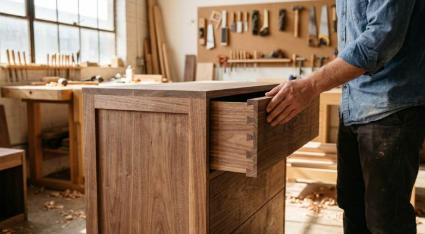
Start with a simple physical test. Gently push on the corners of a table, dresser, or sofa frame. Does it wobble or rack? A quality piece should feel rigid and unyielding. Open and close every drawer and door. They should move smoothly and align perfectly when closed, without sticking or sagging. This simple interaction can reveal a lot about the precision of the manufacturing process.
Next, look closely at how the piece is held together. This is where the difference between lasting furniture and disposable items becomes most apparent. High-end construction relies on strong, interlocking wood joints that provide structural integrity for decades.
| Construction Method | What It Looks Like | Durability Level |
| High Quality | ||
| Dovetail Joints | Interlocking “pins” and “tails,” often visible on drawers. | Excellent |
| Mortise-and-Tenon | A hole (mortise) fits a tight-fitting projection (tenon). | Excellent |
| Dowels and Screws | Internal wood pegs or metal fasteners, properly secured. | Good to Very Good |
| Lower Quality | ||
| Staples and Glue | Visible staples, especially on back panels or corners. | Poor |
| Butt Joints | Two pieces of wood simply glued or nailed together at a corner. | Poor |
The materials themselves are another critical factor. Ask if a wood piece is solid wood or a veneer. A veneer is a thin layer of decorative wood applied over a core material like plywood or MDF. High-quality veneers can be very durable and stable, but you should ask what the core material is. Plywood is generally stronger and more stable than particleboard or MDF.
❝ When inspecting a piece, ask the salesperson a few direct questions. Their ability to answer with specifics is often a good indicator of the store’s and the manufacturer’s commitment to quality. If they don’t know the type of joinery or the specifics of the finish, it may be a red flag.
Here are a few key questions to ask:
1. What type of wood is this? Is it solid or a veneer?
2. If it is a veneer, what is the substrate material?
3. What kind of joinery is used in the frame and drawers?
4. Can you describe the finishing process?
5. Where was this piece manufactured?
Finally, examine the finish. Run your hand over the surface. It should feel smooth and consistent. Look at it from an angle in the light to spot any drips, bubbles, or rough patches. A deep, lustrous finish is typically the result of a multi-step process of sanding and applying several coats of lacquer or oil, a detail that budget manufacturers often skip.
Beyond the Fabric: What Really Makes Upholstery Last?
The long-term performance of a sofa or chair depends almost entirely on what you cannot see. A beautiful fabric can hide a weak frame or sagging suspension system. To assess quality, you need to understand the four key components hidden beneath the surface: the frame, the suspension, the cushions, and the tailoring.
First, consider the frame. The best frames are made from kiln-dried hardwood, like oak or maple. The kiln-drying process removes moisture, which prevents the wood from warping or cracking over time as it adjusts to your home’s humidity. Ask if the frame’s joints are reinforced with corner blocks, which are small pieces of wood added to high-stress corners for extra stability. A frame made from softer woods, particleboard, or MDF is a sign of lower quality and will not withstand years of use.
Next is the suspension system, which provides the support. The gold standard is an eight-way hand-tied spring system, where each spring is tied to its neighbors from eight different directions. This creates a durable, flexible web of support that distributes weight evenly. A more common and still very durable option in modern furniture is sinuous springs, which are S-shaped wires that run from the front to the back of the seat. The lowest-quality option is webbing, which consists of fabric or elastic straps that can stretch and sag relatively quickly.
❝ The density of the foam in the cushions is a crucial indicator of longevity. Don’t confuse density with firmness. High-density foam, typically rated at 1.8 pounds per cubic foot or higher for seating, will hold its shape for years. Lower-density foam will soften and collapse much faster, leaving you with sagging, uncomfortable cushions.
Finally, look at the cushions and the tailoring. High-quality cushions often use a high-density foam core wrapped in a softer material like down, feathers, or polyester fiber for a combination of support and comfort. When you press down on a cushion, it should spring back into shape quickly. Examine the fabric’s application. Patterns should align perfectly at the seams, and all stitching should be straight, tight, and consistent. These small details in tailoring are rarely perfect on a piece that has cut corners on its internal construction.
Frequently Asked Questions About Modern Furniture
How can I judge the quality of a specific furniture brand? Look for transparency and substance beyond the marketing. A reputable brand will provide detailed specifications about materials, joinery, and finish for each piece. Check for a manufacturer’s warranty, as a long-term warranty on the frame or suspension is a strong signal of the maker’s confidence in their product.
What distinguishes a great furniture showroom from an average one? A high-quality showroom is staffed by knowledgeable people who can answer specific questions about construction and sourcing. They should have material samples available for you to see and touch, allowing you to compare different wood finishes, fabrics, and leathers. The experience should feel educational, not purely transactional.
Does high-quality furniture require more maintenance? It often requires different, more thoughtful maintenance. Solid wood may need occasional oiling or waxing, and natural stone requires specific cleaners and sealants to prevent staining. In contrast, low-quality laminate or plastic pieces require little care but cannot be repaired or refinished when they inevitably get damaged; they are simply discarded.
Is it possible for a piece to be trendy but poorly constructed? Absolutely. The rise of “fast furniture” means many pieces are designed to capture a current trend at a low price point, with little regard for longevity. This is why you must look past a stylish silhouette or a popular color. Always perform the physical checks for stability, joinery, and material quality, as a fashionable design can easily hide a weak frame and cheap materials.
Is the most expensive piece of furniture always the highest quality? Not necessarily. While price is often correlated with the quality of materials and the labor involved, it can also reflect branding, import costs, or a designer’s name. Use price as a general guide, but let your own evaluation of the construction, materials, and finish be the final deciding factor. A well-informed buyer can often find exceptional value by focusing on craftsmanship over brand prestige.
The Bottom Line: Investing in Your Environment
Choosing furniture is ultimately about more than filling a room. It is about making a deliberate investment in the space where you live your life. The real value of a piece is not found in its trendiness or its initial price tag, but in the unseen details: the kiln-dried hardwood frame, the precise joinery, and the high-density foam that will hold its shape for years. These are the elements that transform an object from a temporary placeholder into a lasting part of your home.
The most practical approach is to consider the total cost of ownership, not just the purchase price. A lower-quality item often requires replacement within a few years, forcing you to spend time and money solving the same problem again. A well-constructed piece, by contrast, delivers value every day through reliable function and enduring style. It becomes a stable, dependable foundation for your daily life.
By learning to look beyond the surface, you shift from being a consumer to a curator. You can evaluate each potential purchase on its own merits, asking the right questions and trusting your own assessment of its construction. The goal is to build a home that is not only beautiful but also built to last, one thoughtful decision at a time.
About the author
Robert Zimmerman and Mike Mordeson are the co-founders of Element Home, a Denver-based showroom for modern and contemporary furniture, fine art, and interior design. Since 2003, their team has curated collections from American, European, and Canadian designers, representing more than thirty nationally-recognized artists. They focus on providing comprehensive design services, from initial consultation to white-glove delivery, helping clients furnish spaces with lasting, high-quality pieces in the Cherry Creek North neighborhood and beyond.