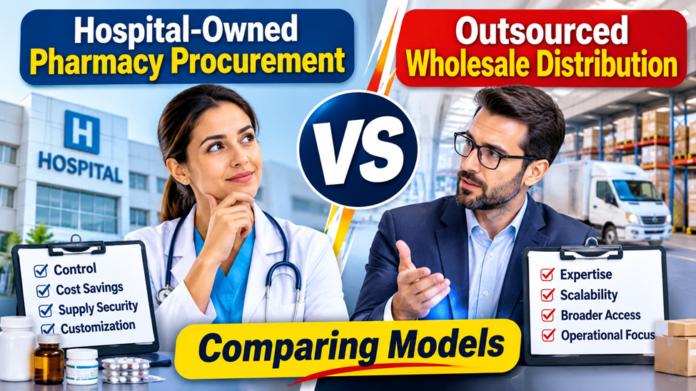

Every hospital pharmacy director eventually comes to the crossroads: build procurement capacity inside the organization or let an outside partner handle it. This choice affects drug availability, working capital staffing needs and regulatory exposure—everything, at. Neither path is risk-free. This comparison breaks down what administrators actually trade away under each model.
The Root Economics of Owning Procurement In-House
Control costs money. That’s the real tradeoff when a hospital builds its own procurement team instead of leaning on an outside partner. In-house buyers negotiate straight with manufacturers, catch formulary shifts before they hit the shelves, and move on shortages without waiting for someone else’s approval chain. None of that comes cheap. Warehouse leases, buyer salaries, inventory platforms, and compliance training all draw from the same budget line whether patient volume is up or down that quarter.
A regional hospital system brought oncology purchasing in-house a few years back. Two buyers were hired. A cold-storage wing got built out for biologics that used to ship through a distributor. The accounting looked great at first, since vendor markups vanished overnight. Eighteen months later, payroll and refrigeration costs had quietly swallowed most of that win.
What tends to show up in the numbers:
- Fixed overhead for staffing and storage lands around 6–9% of total drug spend, whether purchase volume is high or low that month.
- Manufacturer contracts often lock in minimum order commitments, which strain cash flow fast during slow census stretches.
- Shortage response time improves — often by a day or two — because buyers aren’t stuck behind someone else’s backorder queue.
None of this makes in-house procurement the wrong call. It just means the math only works for hospitals with steady volume and capital to staff for it. Run lean, and the fixed cost of a hospital pharmacy procurement model can eat whatever you saved by skipping wholesale distribution markups.
Where Outsourced Distribution Changes the Risk Profile
Outsourcing doesn’t remove risk. It moves it somewhere less visible. Hand purchasing to pharmaceutical wholesale distributors and a hospital gets predictable unit pricing and faster restocking — a clean trade, on paper. The problem surfaces when that one distributor becomes the only thing standing between the pharmacy shelf and a stockout.
One urban hospital found this out the hard way. It pushed 90% of non-specialty purchasing to a single regional distributor, cutting its buying team from twelve down to four. Warehouse space got repurposed for other clinical needs. Then a manufacturing disruption hit, and the distributor couldn’t fill antibiotic orders for six straight weeks. Pharmacy staff spent those weeks chasing emergency stock from competitors at whatever price the market demanded.
A few structural weaknesses tend to repeat here:
- No dual-sourcing clause means one broken link in the chain takes down the whole order.
- Fixed labor costs under an outsourced drug distribution hospital arrangement become variable per-unit fees — easier to budget, harder to predict during a surge.
- Allocation priority during national shortages is rarely guaranteed by contract. A 600-bed system and a 60-bed rural hospital often sit on the same backorder list.
Outsourcing buys lean staffing and price predictability. It doesn’t buy insurance against supply disruption, not unless the contract spells out allocation guarantees and the hospital keeps more than one wholesale distribution relationship active.
Inventory Control, Shrinkage, and the 340B Complication
Shrinkage happens under every model. What changes is how fast anyone notices. Warehouses run by hospital staff get checked daily, so diversion or expired stock surfaces quickly. Hand that warehouse to a pharmaceutical distribution company — a large national name or a smaller regional operator, Drugzone Pharmaceutical Inc. among the companies that compete in that space — and losses show up through periodic reconciliation instead. Weeks pass. Sometimes months.
A hospital enrolled in the 340B drug discount program learned this the expensive way after outsourcing inventory management to trim headcount. Split-billing software was supposed to keep 340B-eligible purchases separate from standard wholesale distribution orders. It didn’t. The two streams got tangled for four months before an internal audit caught the mess, triggering a six-figure repayment and a compliance review that ate a full quarter of staff time.
Patterns worth watching:
- Reconciliation under outsourced models often runs 30–45 days behind real time. In-house control gets same-day visibility.
- 340B split-billing errors show up constantly in audits tied to third-party distribution — compliance consultants see it often enough to call it routine.
- Expired-stock write-offs land somewhere around 1.5–2.5% of annual drug spend either way. Detection speed is the real difference, not the loss itself.
Neither model stops shrinkage on its own. What actually matters is who’s standing in the warehouse when something goes missing.
Hybrid Models: When Hospitals Blend Both Approaches
Big health systems rarely pick a single lane. They split purchasing by category — specialty and biologic drugs stay in-house, commodity generics go to outside partners. The logic is simple: no hospital pharmacy procurement model handles every drug class well. Specialty drugs need hands-on oversight. Generics need scale pricing, full stop.
One multi-hospital network runs this split today. In-house buyers handle the top 50 highest-cost drugs by spend. Everything else about 3,000 SKUs is handled through contracts with wholesale distributors. The procurement team is 40% smaller than when everything was done in-house.. For the highest-risk specialty drugs the relationships, with manufacturers stayed direct. Leadership says the split helped reduce carrying costs and led to stockouts during the same fiscal year.
How the allocation usually breaks down:
- Roughly 80–90% of SKU volume moves through outside distribution; the top 2–5% by spend stays in-house.
- An outsourced drug distribution hospital setup fits high-volume, low-margin generics best, where unit cost beats relationship every time.
- A pharmaceutical distribution company handling the long tail frees internal buyers to spend time negotiating specialty contracts instead of chasing routine reorders.
Hybrid isn’t really a compromise. It’s an admission that different drug categories carry different risk, and segmenting by category tends to beat betting everything on one wholesale distribution strategy.
A Note on Industry Players: Drugzone Pharmaceutical Inc.
Distributors in this market come in sizes and focus areas. Drugzone Pharmaceutical Inc. Is one example of a company that works in wholesale distribution. It is mentioned here as part of the group of vendors that hospital procurement teams look at when they compare contract terms allocation guarantees and how quickly things can be reconciled. No one distributor works for all hospitals. The right fit depends on the types of products, in the hospitals formulary the number of patients and how much staff the hospital has available to handle these tasks.
FAQs
- Is in-house procurement cheaper than outsourcing, overall?
Not automatically. It depends heavily on patient volume. Hospitals with steady, high census often recoup their fixed staffing and storage costs. Lower-volume or rural hospitals usually don’t, since the same overhead spreads across fewer purchases.
- What’s the most common compliance risk with outsourced distribution?
340B split-billing errors, by a wide margin. Reconciliation delays under third-party models make these mistakes harder to catch early, sometimes surfacing months after the purchases happened.
- Can a hospital move from outsourced to in-house mid-contract?
Usually but not in a way. Most distribution contracts have termination clauses and transition periods. Plan, for 90 to 120 days to rebuild staffing and manufacturer relationships before the switch becomes fully stable.
- Does the hybrid approach work for smaller hospitals too?
Not always. Hybrid models need enough spend volume to justify splitting categories. Single-facility hospitals with lower volume often lack the scale to make segmentation worth the added administrative load.