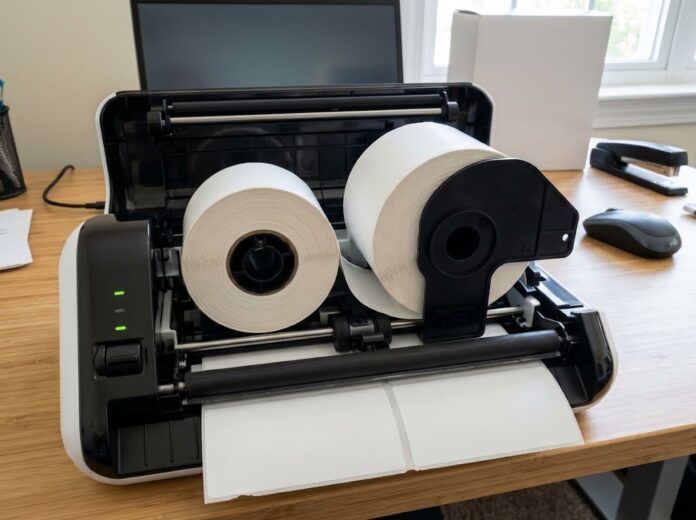

Both are continuous-length direct thermal rolls, but their widths serve different jobs. DK-2210 is about 1.1 inches wide; DK-2205 is about 2.4 inches wide. Choose DK-2210 for narrow shelf, cable-wrap-free bin, file, or small product labels that need variable length. Choose DK-2205 when a wider barcode, larger type, or multi-line layout is needed. The final decision should come from a full-size sample, not from the assumption that wider stock is always safer.
Map the required content to width
Write down what must appear on the label and in what order a worker will use it. A shelf edge may only need a product name and short SKU; a 1.1-inch width could be enough if the length can extend. A shipping or receiving label might need an address block and a barcode side by side, which may require more width than DK-2210 provides. A continuous roll gives you control of length, not width. Extending a narrow label cannot always solve a horizontal barcode or oversized text problem.
For barcodes, use the scanner and symbology as design constraints. A one-dimensional barcode can become long when the payload grows, so a narrow layout may force rotation or an impractical cut length. If rotating the code, confirm that the printed bar height remains adequate and that staff can scan the label in its applied orientation. Do not reduce the bar width until the symbol barely survives a desk test.
Estimate waste from real jobs
Continuous stock may reduce waste when label lengths vary, but only if templates are configured well. Print ten typical jobs and measure the unused space left after the message. A wider roll may consume more paper per label even when the cut length is shorter. A narrow roll may need a long strip that becomes awkward on a small object. Calculate material use from actual cut pieces, not the nominal roll length alone.
Batch design also matters. If workers print many identical labels, a locked template with a set length can prevent inconsistent cuts. For variable records, use a template that grows within a defined maximum and includes a check for overflow. Print an extreme test case before deploying it. A long identifier that gets clipped at the cutter can lead to misidentification even if most routine labels are fine.
Can DK 2210 handle a long barcode
Sometimes, but the answer depends on barcode symbology, data length, orientation, and scan distance. A continuous narrow roll can be cut longer, which provides horizontal space for a code if the template is designed that way. However, the 1.1-inch width still limits bar height and the room for human-readable text. Print the longest actual value, not a short sample. Scan it after application to the intended surface. If the strip curls around a small object or the code is difficult to locate, a wider label may produce a better operational result.
Which roll is easier for mixed jobs
Consider the full set of tasks on the printer. If most jobs are narrow shelf or file labels, DK-2210 minimizes excess width and may keep labels visually unobtrusive. If the same workstation also prints large routing labels, DK-2205 may reduce roll changes. That convenience must be weighed against material use and the risk of a wide label covering too much of a small object. Count roll changes, misprints, and wasted material during a normal week rather than deciding from one job.
How should length rules be documented
Define a minimum length for short labels, a maximum for long records, and what the software should do when text exceeds the maximum. Decide whether it wraps, abbreviates, or sends the record to a larger format. Leave explicit cutter margins around printed content. Save test cases for the shortest and longest records. Continuous rolls are flexible, but without these limits, operators may produce a series of inconsistent labels that are hard to apply and harder to verify.
Example of a mixed-width workstation
A stockroom prints narrow file-spine labels all morning and wide receiving labels in the afternoon. Using DK-2205 for every job avoids changing rolls, but the file-spine labels overhang the available surface. Using DK-2210 for everything forces the receiving team to cut very long strips with small type. The better process may use both rolls, with separately named templates and a clear roll-change step. Count the actual weekly jobs and misprints before deciding whether a second printer is worthwhile. If the two workflows are frequent and time-critical, dedicating one printer to each width can reduce errors. The equipment choice should follow measured job volume, not simply the price of one roll.
Final approval question
Print one narrow and one wide sample containing the same real identifier. Compare type size, barcode scan success, cut length, and the amount of stock that extends beyond the object. Have the person who uses the label daily choose which sample is easier to read and apply. If both are acceptable, use actual material and labor costs to make the final decision.
Verify printer and placement
Select the correct width in the Brother QL software. If the printer reports a mismatch, compare the loaded cartridge and media profile. Do not change the design scale to silence the warning. After printing, apply the sample to the actual bin, package, or file spine. A long narrow strip may fold over a corner; a wide strip may cover a seam or an existing label. The available flat area is part of the size decision.
For low-light storage areas, test readability at the working distance. If a label must be read from several feet away, the wider stock may allow a larger font and clearer hierarchy. If it only needs to be scanned close up, narrow stock may be efficient. Choose based on the job, not a single universal standard.
The DK-2210 continuous labels page lists 1.1-inch-wide, 100-foot compatible stock. Use it when the content fits that width with reliable print and scan performance. Compare wider direct thermal labels if the narrow format forces tiny type or awkward barcode rotation.