
If you only have a minute: pick a drawer slide by load rating, extension and side clearance. For most kitchen and wardrobe drawers, a full-extension, soft-close slide rated for 30 to 45 kg is the safe choice. If the drawer is deep, heavy, or opened fifty times a day, skip the basic slide and look at a metal drawer system instead.
That’s the short version. Below is the longer one, with the reasoning, so you can explain to a client why you spent more on hardware nobody sees.
What does a drawer slide actually do?
A drawer slide is a pair of rails that lets a drawer move in and out of a cabinet. One half fixes to the cabinet, the other to the drawer, and ball bearings or rollers sit between them. It’s a simple part, but it decides whether a drawer glides shut quietly or sags, scrapes and jams within a year. Customers rarely notice good slides. They always notice bad ones.
What are the main types of drawer slides?
Most orders fall into four groups.
- Side-mount ball bearing slides. The workhorse. Two rails screw to the sides of the drawer and cabinet, and they usually need about 12.7 mm of clearance per side. Smooth, strong, easy to fit.
- Undermount slides. Fixed under the drawer and hidden when it’s open. Popular in modern kitchens because the drawer sides stay clean, but the drawer box has to be built to suit.
- Roller slides. Nylon wheels running in a track. Cheaper and fine for light drawers, though they get noisy sooner and rarely give full extension.
- Soft-close and push-to-open versions. These are features rather than separate families. Soft-close uses a small damper so the drawer can’t slam. Push-to-open suits handleless fronts.
One detail that trips people up: three-part (full-extension) slides let the drawer come all the way out, so you can reach the back. Two-part slides stop at roughly 75 percent. In a deep kitchen drawer, that missing quarter is exactly where the forgotten jars end up.
How much weight should a drawer slide be rated for?
Ratings usually run from about 20 kg for light office drawers to 45 kg for kitchens, and 70 kg or more for heavy-duty use. A simple rule: estimate the heaviest realistic load, then add around 30 percent. A pots-and-pans drawer with cast iron can pass 25 kg faster than people expect.
A rating is a lab number, though. Real drawers get loaded unevenly, yanked hard and pushed shut with a knee. So ask the supplier about cycle testing too. Around 50,000 open-and-close cycles is a common benchmark for decent slides, and a supplier who can’t tell you their number is telling you something.
What is a metal drawer system?
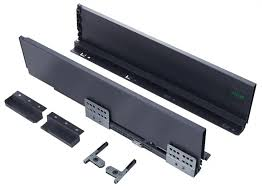
A metal drawer system replaces the whole drawer box side, not just the slide. Instead of building a wooden box and fitting slides to it, you get steel side panels with the runner built in, plus a back panel and front brackets. You add a base, usually board, and your front.
People choose them for a few reasons. The sizing is consistent, assembly is faster, and the thin steel sides give you more usable space inside than a timber box. For a workshop building a few hundred drawers a week, the time saved matters more than the difference in part price. If you want to see what a typical range looks like, Tallsen’s metal drawer system page lists the heights and load options.
What is a double wall drawer system?
A double wall drawer system has two parallel steel walls on each side with a gap between them. Look at it in cross-section and you’ll see a hollow shape rather than a single plate. That second wall adds stiffness, so the sides don’t flex when the drawer is heavily loaded. It also leaves room for gallery rails or glass inserts, which is why you see it in premium kitchens and walk-in wardrobes.
Single-wall systems are lighter and cheaper, and they’re fine for bedrooms and offices. A decent rule: if the drawer is wider than 900 mm or will carry heavy items, go double wall. The extra cost per drawer is small compared with a callback.
What should you check before ordering drawer slides in bulk?
Bulk orders go wrong in boring ways. Run through this list before you commit.
- Order samples first. Fit a few sets, load them, and abuse them for a week.
- Match slide length to cabinet depth. Standard lengths usually run from 250 mm to 600 mm in 50 mm steps. Pick the longest one that fits.
- Check the finish. Zinc plating and black epoxy behave differently in humid or coastal areas. Ask for salt spray test hours.
- Look at the packaging. Slides thrown loose into a carton arrive scratched and bent.
- Test consistency across batches. The most common wholesale complaint is hardware that was perfect in the sample and sloppy in the container.
- Confirm the screws and fittings. A missing screw pack on a thousand-set order is a bad afternoon.
How do you pick a drawer slides supplier or manufacturer?
A manufacturer controls production. A supplier may only resell. Neither is automatically better, but the difference shows up in lead time and flexibility. If you need custom lengths, your own branding or special packaging, go to a manufacturer. If you need small mixed orders quickly, a supplier holding stock is easier to deal with.
Whoever you pick, ask a few direct questions. Do they publish technical data sheets? Will they send samples? What’s the minimum order? Can they ship slides, drawer systems and hinges together, so you aren’t juggling three vendors? Manufacturers such as Tallsen, which make drawer slides, metal drawer systems and cabinet hinges under one roof, are built for that kind of mixed order. If you’re comparing wholesale options, their drawer slides range is a reasonable place to start reading.
What mistakes do buyers make most often?
- Choosing on price per set alone, then paying more in returns.
- Forgetting side clearance, so the drawer rubs the cabinet wall.
- Ordering slides longer than the cabinet depth allows.
- Skipping soft-close on wardrobes, where heavy drawers slam hardest.
- Mixing slide brands in one run, which makes spare parts a headache.
Final thoughts
Good drawer hardware is invisible when it works. Match the load rating to the real contents, give yourself headroom, test samples before the big order, and choose a supplier who answers technical questions without dodging. Do that, and the drawers will outlast the cabinets they live in.
Quick answers
What clearance does a side-mount slide need? Usually 12.7 mm on each side, but check the data sheet for the model you’re buying.
Can you cut a drawer slide shorter? No. The rails and bearings are made to length. Order the right size instead.
Is soft-close worth paying for? For kitchens and wardrobes, yes. It cuts noise, protects the drawer contents, and customers notice it straight away.
Metal drawer system or normal slides? Normal slides if you’re building wooden boxes by hand. A metal drawer system if you want speed, consistency and more internal space.