
The Role of Environmental Consulting and Remediation in Hazardous Building Management
Asbestos is often called the ‘hidden killer,’ a silent threat responsible for thousands of work-related deaths each year in the UK. This invisible danger lurks in many non-domestic buildings constructed before 2000, presenting significant health risks and complex legal challenges for dutyholders. Effectively managing this hazard requires a thorough understanding of environmental consulting and precise strategies for assessments remediation decontamination.
We will guide you through the critical world of asbestos management surveys. These surveys are not just a best practice; they are a legal requirement for many properties. We will explore the legal obligations, differentiate between survey types, and detail how to ensure ongoing compliance.
This guide aims to equip you with the knowledge needed to safeguard occupants, meet regulatory standards, and manage asbestos risks effectively. We will cover everything from identifying your responsibilities as a dutyholder to selecting competent surveyors and maintaining an up-to-date asbestos management plan.
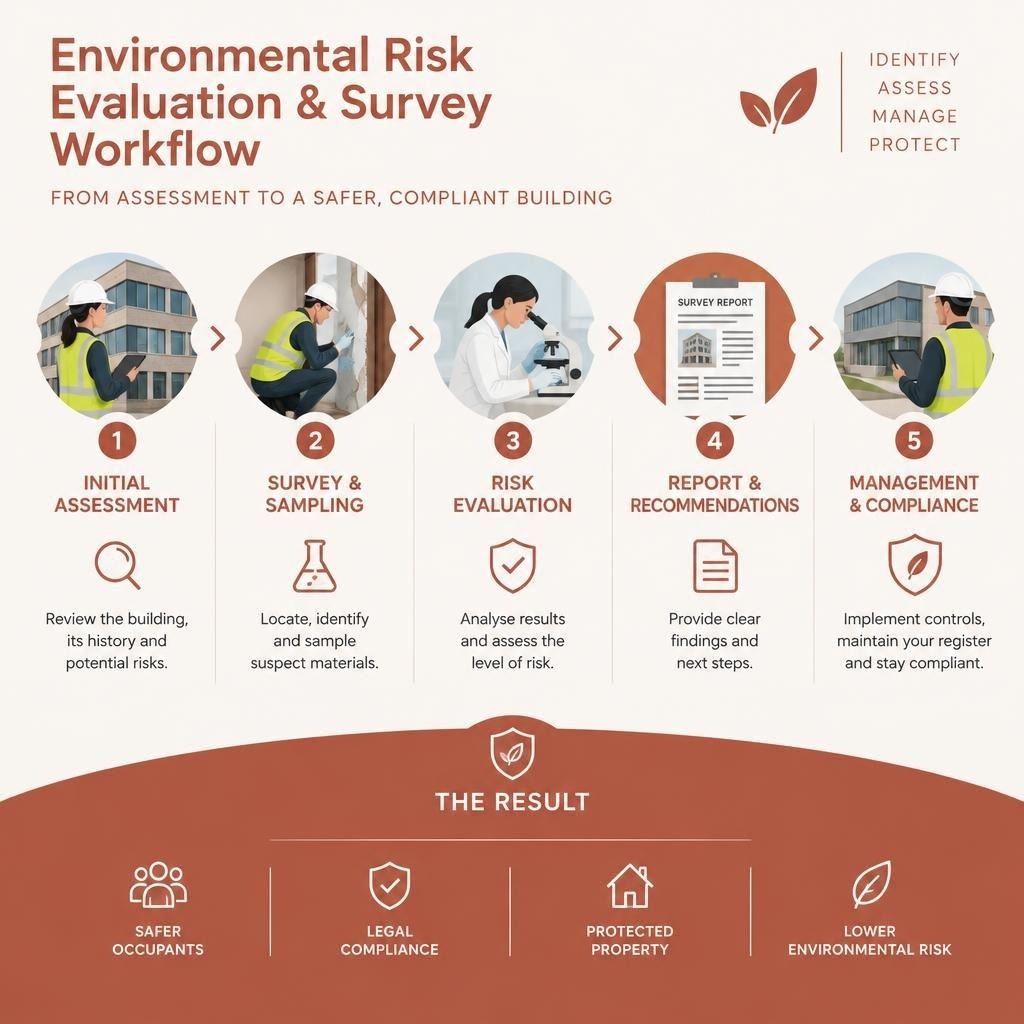
To truly grasp the comprehensive approach to managing this pervasive hazard, understand the overarching process.
The presence of asbestos-containing materials (ACMs) in buildings constructed before the year 2000 is a significant concern for property owners, facilities managers, and anyone responsible for non-domestic premises. With asbestos use banned in the UK since 1999, virtually any building predating this could harbour the ‘hidden killer’. Environmental consulting plays a pivotal role in hazard identification, ensuring statutory compliance, and providing liability protection through meticulous material assessment.
Our approach to managing asbestos begins with comprehensive surveys, which are the cornerstone of any effective asbestos management strategy. These surveys are designed to identify, locate, and assess the condition of ACMs, providing crucial data for an asbestos register and management plan. Without accurate survey data, dutyholders face increased risks of accidental disturbance, uncontrolled exposure, and potential legal repercussions.
The Health and Safety Executive (HSE) provides detailed guidance in documents like HSG227 (“Managing Asbestos in Premises”) and HSG264 (“Asbestos: The Survey Guide”), which outline best practices and legal requirements for managing asbestos. These guidelines emphasize the importance of thorough surveys in all non-domestic premises to protect workers and the public from exposure to asbestos fibres.
Core Survey Types in Environmental Consulting and Remediation
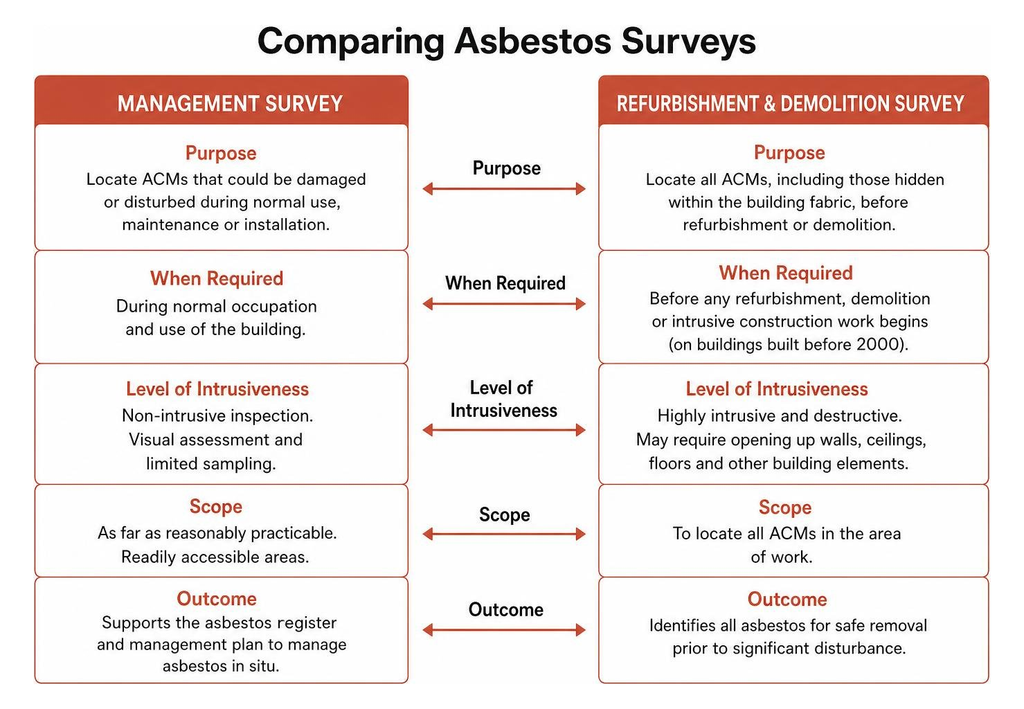
Understanding the different types of asbestos surveys is fundamental to effective asbestos management. We primarily distinguish between two main categories: the management survey and the more intrusive refurbishment and demolition survey. Each serves a distinct purpose within the building’s lifecycle and has specific requirements.
A management survey is the standard survey required during the normal occupation and use of a building. Its primary purpose is to locate, as far as reasonably practicable, the presence and extent of any ACMs that could be damaged or disturbed during normal occupancy, maintenance, or installation. This non-intrusive inspection typically involves visual assessment and limited sampling to identify readily accessible ACMs. The findings form the basis of the asbestos register and management plan, enabling dutyholders to manage asbestos in situ.
In contrast, a refurbishment and demolition survey is a far more intrusive and destructive inspection. This type of survey is mandatory before any refurbishment, demolition, or other intrusive construction work begins on a building or part of a building built before 2000. Its objective is to locate all ACMs, including those hidden within the building fabric, to ensure their safe removal before work commences. This often requires breaking into walls, ceilings, floors, and other structural elements. The area must be vacated before such a survey, and it should be conducted by competent personnel.
The key difference lies in their purpose and intrusiveness. A management survey aims to manage asbestos in place, while a refurbishment/demolition survey aims to identify all asbestos for removal prior to significant disturbance. It is crucial for dutyholders to select the appropriate survey type based on their planned activities.
Evaluating Dutyholder Obligations and Regulatory Compliance
The legal requirement for an asbestos management survey in non-domestic buildings stems from the Control of Asbestos Regulations 2012 (CAR 2012), specifically Regulation 4, known as the ‘duty to manage asbestos’. This regulation places a legal duty on the ‘dutyholder’ of non-domestic premises to manage the risks from asbestos.
Who is the ‘dutyholder’? The dutyholder is typically the owner of the premises, or the person or organization that has clear responsibility for the maintenance or repair of the premises, or any part of it. This can include commercial landlords, facilities managers, managing agents, and employers. In multi-occupancy buildings, the duty can be shared.
What are their responsibilities? The dutyholder’s responsibilities are extensive and include:
- Taking reasonable steps to find out if ACMs are present in the premises and, if so, their location, quantity, and condition. This is where asbestos management surveys become indispensable.
- Presuming materials contain asbestos unless there is strong evidence to the contrary.
- Making and keeping an up-to-date record of the location and condition of ACMs or presumed ACMs. This is the asbestos register.
- Assessing the risk of anyone being exposed to fibres from the ACMs.
- Preparing a written plan that sets out how the risks are to be managed. This is the asbestos management plan.
- Taking steps to implement the plan, including monitoring the condition of ACMs, providing information to those who might disturb it, and ensuring any work on ACMs is carried out safely by competent persons.
- Reviewing and monitoring the plan and the arrangements made to implement it.
Failure to comply with these statutory duties can lead to significant legal liability, including hefty fines and even imprisonment, in addition to the moral imperative of protecting occupants and workers from a known health hazard. As of October 2026, regulatory bodies continue to rigorously enforce these provisions, underscoring the critical importance of proactive asbestos management.
Surveyor Competency, Sampling Protocols, and Presumption Strategies
The reliability of an asbestos survey hinges entirely on the competence of the surveyor. Selecting a qualified and experienced professional is paramount. We recommend engaging surveyors who possess specific qualifications and accreditations, such as the BOHS Proficiency Module P402 (“Surveying and Sampling Strategies for Asbestos in Buildings”) or equivalent. Beyond qualifications, surveyors should have at least six months of full-time, relevant, practical field experience to demonstrate true competence.
Accreditation is another key indicator of quality. Look for firms accredited by the United Kingdom Accreditation Service (UKAS) to ISO/IEC 17020 for asbestos inspection bodies. This accreditation signifies that the organization operates to internationally recognised standards of impartiality, integrity, and technical competence. Furthermore, the laboratories used for analysis should participate in a proficiency testing scheme like the Asbestos in Materials Scheme (AIMS) to ensure the accuracy of their results.
How does a surveyor determine if a material contains asbestos (sampling vs. presumption)?
- Sampling: The most definitive method is bulk sampling. A competent surveyor will carefully take small samples of suspect materials, ensuring minimal fibre release. These samples are then sent to an accredited laboratory for analysis under a microscope to confirm the presence and type of asbestos fibres. Typical sampling rates are 1-2 samples per area or room, depending on the homogeneity of the material.
- Presumption: In situations where sampling is not feasible (e.g., due to accessibility issues, high risk of disturbance, or the material being in good condition and unlikely to be disturbed), a surveyor may presume a material contains asbestos. This is a cautious approach, treating the material as if it contains asbestos until proven otherwise. This presumption is a legal requirement where the presence of asbestos cannot be determined by other means. Visual presumption, based on the surveyor’s experience and knowledge of common ACMs, is also often employed, but should ideally be backed up by sampling where safe and practical.
It is crucial that surveyors are independent and impartial, ensuring their findings are objective and not influenced by potential remediation contracts. A robust quality management system within the surveying company further assures the reliability of their work.
Strategic Execution and Ongoing Compliance for Property Dutyholders
Once an asbestos management survey is complete, the real work of strategic execution and ongoing compliance begins. The survey report is not an end in itself, but a foundational document for continuous asbestos management. This phase involves integrating survey data into daily operations, implementing control measures, and ensuring regular monitoring and review.

Effective management relies on a clear understanding of risk, supported by data integration, careful contractor briefing, and a commitment to preventative maintenance. Dutyholders must maintain audit readiness and implement robust quality assurance processes to ensure the safety of their premises.
Building Asbestos Registers and Actionable Plans via Environmental Consulting and Remediation
The primary output of an asbestos management survey is the creation of an asbestos register and an asbestos management plan. These are living documents that must be maintained and updated throughout the building’s operational life.
The asbestos register architecture typically includes:
- Detailed location of all identified or presumed ACMs.
- Type of asbestos (e.g., chrysotile, amosite, crocidolite).
- Condition of the ACM (e.g., good, fair, poor, damaged).
- Material assessment score (reflecting the risk posed by the material itself).
- Photographs of the ACMs and their locations.
- Sample points and laboratory analysis results.
- Recommendations for management (e.g., leave in situ, encapsulate, remove).
From this register, a comprehensive management plan formulation is developed. This plan outlines the strategy for managing asbestos risks and is a legal requirement under CAR 2012.
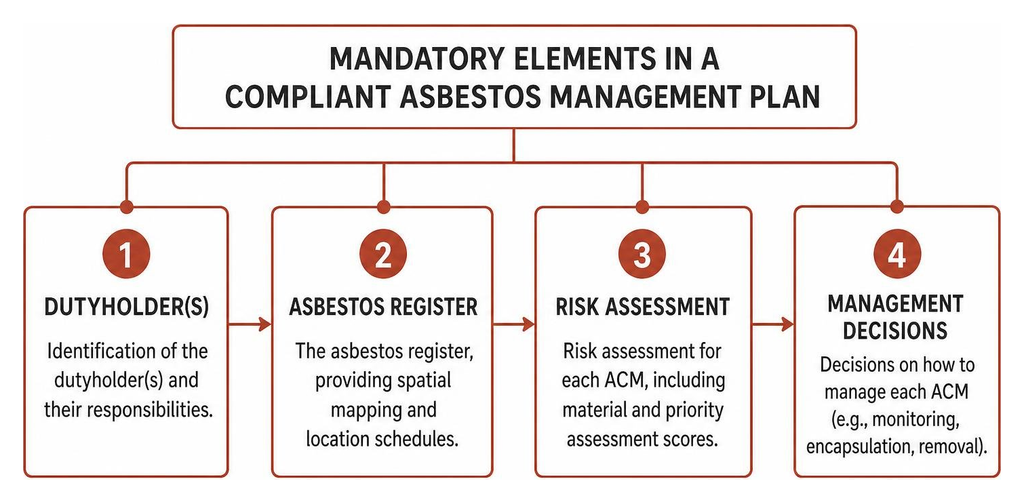
A compliant asbestos management plan must include:
- Identification of the dutyholder(s) and their responsibilities.
- The asbestos register, providing spatial mapping and location schedules.
- Risk assessment for each ACM, including material and priority assessment scores.
- Decisions on how to manage each ACM (e.g., monitoring, encapsulation, removal).
- A clear plan for implementing these decisions, including timelines and resources.
- Procedures for dealing with emergencies (e.g., accidental disturbance of ACMs).
- Information for workers and contractors who may come into contact with ACMs.
- A schedule for regular reviews and updates of the plan and register.
This actionable plan ensures that all personnel involved in building maintenance, refurbishment, or any other activity are aware of the presence of asbestos and the necessary precautions.
Risk Assessment Algorithms and Managing Survey Caveats
After the survey identifies ACMs, a crucial step is the risk assessment, which utilizes specific algorithms to prioritize management actions. HSE guidance (HSG264, HSG227) outlines two key scoring systems:
- Material Assessment (or Material Scoring): This evaluates the intrinsic risk of the ACM itself. Factors considered include:
- Product type: Some materials (e.g., sprayed asbestos, asbestos insulation board) are more friable and release fibres more easily than others (e.g., asbestos cement).
- Condition evaluation: Assesses damage, surface treatment, and exposure.
- Friability: How easily the material releases fibres when disturbed.
- Priority Assessment: This evaluates the likelihood of disturbance and potential for exposure. Factors include:
- Occupant activity: How often the area is used and the nature of activities.
- Likelihood of disturbance: The potential for maintenance or other work to disturb the ACM.
- Human exposure potential: Number of people likely to be exposed if fibres are released.
Combining these scores helps dutyholders identify which ACMs pose the highest risk and require immediate attention, and which can be safely managed in situ with regular monitoring.
What are the consequences of survey restrictions or caveats (e.g., areas not accessed) for managing asbestos? Survey restrictions, such as inaccessible voids (e.g., sealed ceiling voids, ducting, behind permanent fixtures) or areas that could not be inspected due to safety concerns or dutyholder limitations, create significant challenges. When a surveyor cannot access an area, they must apply a default presumption that asbestos is present.
The consequences of such caveats are:
- Increased management burden: All uninspected areas must be treated as if they contain asbestos, requiring stricter control measures and potentially limiting future work.
- Higher costs: If refurbishment or demolition is planned, these areas will require intrusive surveys and potentially costly removal of presumed ACMs, which might not actually contain asbestos, simply because they couldn’t be accessed earlier.
- Reduced flexibility: Future maintenance or alteration work in uninspected areas will necessitate further, potentially disruptive, surveys.
- Undermined confidence: The overall reliability of the asbestos register and management plan can be compromised, leading to a less effective risk management strategy.
It is always in the dutyholder’s best interest to provide the surveyor with full and safe access to all areas of the building to minimize such caveats and ensure the most accurate and comprehensive survey possible.
Ongoing Condition Monitoring, Reinspections, and Project Clearance
An asbestos management survey is a snapshot in time; the condition of ACMs can change due to age, damage, or vibration. Therefore, continuous condition monitoring is essential. The asbestos management plan will specify a schedule for regular visual inspections of identified ACMs, typically annually or every six months, depending on the material’s condition and location. This ensures any deterioration is promptly identified and remedial action taken.
For quality assurance, it is recommended that about 5% of surveys are reinspected by another competent surveyor or auditor. This external check helps maintain high standards and identifies any discrepancies or omissions.
When work is planned that might disturb ACMs, such as refurbishment or demolition, the management plan must be consulted, and the necessary steps taken, which often involves the safe removal of the ACMs. Most asbestos removal work requires a licensed contractor, particularly for higher-risk materials. However, some short-duration exemptions exist for low-risk, non-licensed work (e.g., certain types of asbestos cement removal, or very short duration tasks not exceeding one hour per person per week). Even for these, the work must be carried out by adequately trained and competent personnel following strict safety procedures.
After any asbestos removal work, a four-stage clearance process is legally required before the area can be reoccupied. This involves:
- Preliminary check: Visual inspection of the work area and site conditions.
- Thorough visual inspection: Detailed inspection of the enclosure and removal area.
- Air monitoring: Measurement of airborne asbestos fibre concentrations.
- Final assessment: Review of all previous stages and issue of a reoccupation certification.
This rigorous process ensures that the area is safe for reoccupation and that all asbestos fibres have been effectively contained or removed. By diligently following these steps, dutyholders can maintain a safe environment and demonstrate full compliance with their legal obligations in October 2026 and beyond.