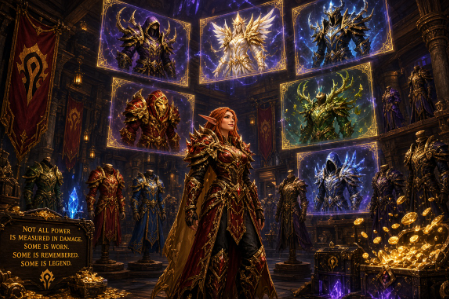

Over the past decade, the gaming industry has changed dramatically. Players are no longer paying only for “beating the game” or “winning a match.” Digital assets have become part of the experience itself. Cosmetic customization, collection progress, and community identity—these things that seemingly “don’t change the numbers” are precisely what keep a game appealing hundreds of hours in.
With WoW Forever officially launching on November 4, 2026, Blizzard is pushing the Classic+ framework one step further. It retains the feel of classic Azeroth while introducing some designs in the cosmetic and collection systems that deserve serious attention. And these designs happen to illustrate why game skins and virtual items can genuinely enhance the online game experience.
1. Personalization: When “what you wear” becomes a form of expression
The most direct value of game skins is that they give players controllable self-presentation in a virtual world.
WoW Forever makes a rather smart move in visual customization: SD/HD switching. Players can choose between the original Classic visual style and updated high-definition presentation instead of being forced toward one “correct” look. Transmog is likewise an optional toggle—if you want your character to look distinctive, you can turn it on; if you care more about seeing your opponent’s actual gear to judge the fight, you can turn it off.
This design of “giving the choice back to the player” is exactly what healthy personalization looks like. It doesn’t force you to spend; it tells you that you can use appearance to say something about yourself.
2. New goals beyond the game: Collections as a reason to keep playing
The progression systems in many games are no longer limited to levels and gear. Cosmetic collecting, event exclusives, and rare color schemes are becoming long-term goals that players set for themselves.
WoW Forever’s transmog unlock mechanism makes this feel more “MMO” in a good way: when bind-on-pickup items of blue quality and below drop in dungeons, their appearance unlocks for all party members, not just the person who won the roll. Epic-quality appearances still retain rarity and a sense of competition, but a large number of regular dungeon drops no longer turn “running dungeons together for appearances” into a zero-sum game.
This means a player’s reason for entering a dungeon can be both “I need this piece of gear” and “I want to collect this appearance,” and teammates are no longer rivals. Collection goals therefore become more sustainable and much better suited to playing with friends.
3. Social interaction: Appearance is a conversation starter and a community entry point
Social interaction in online games often begins with a very small trigger: someone asks, “Where did you get that outfit?” and the conversation begins.
WoW Forever’s party-wide transmog unlock mechanism has an easily underestimated effect at the social level: it turns other players from “people who might take the appearance” into “people who unlock appearances together with you.” When a rare appearance drops, the whole party shares progress, significantly lowering the friction of farming dungeons in groups. For old-world raids or high-difficulty content that requires multiple players, this design directly encourages cooperation rather than solo farming.
Players will still share screenshots, discuss color schemes, and show off collections in the community—but the underlying mechanism no longer creates hostility.
4. Digital collectibles and rarity: Fun first, investment later
The joy of collecting comes from searching, completing sets, and saying “I got it.” But collecting and investing are two completely different things.
WoW Forever maintains a certain gradient in rarity tiers: Epic appearances still belong only to the looter, which preserves the sense of achievement attached to top-tier collections. But more importantly, the game itself does not package appearances as an “asset that will appreciate.” Players should be clear: the scarcity of a digital item does not equal economic value; demand can change, rules can be adjusted, and transfers may be restricted. Treating collecting as entertainment rather than a financial plan is the more sensible mindset.
5. Skin trading and digital markets: Understand the rules before discussing choices
When the discussion extends to wow gold and third-party markets, things need to be stated more directly.
Blizzard’s position on third-party gold trading has always been clear: buying gold from players or third-party platforms can lead to the gold being reclaimed and even to permanent account bans; the only officially recognized compliant path for exchanging real money and gold is the WoW Token. This is not a “gray area”; it is a risk written into the rules.
In reality, however, some players will still consider third-party options when faced with time costs. If one must understand this area, the screening criteria should not be merely “cheap.” A platform worth using as a reference point should at least withstand scrutiny on the following dimensions:
- Transparency: Are product descriptions, price composition, fees, and delivery times clearly stated in advance, rather than having extra charges added at checkout?
- Security process: Does it use encrypted checkout, and are there clear refund trigger conditions and execution mechanisms?
- Verifiable reputation: Are reviews from verifiable third-party platforms, and is the volume large enough to rule out “a few fake positive reviews”?
- Supply method: Is the gold from an in-house team or random resale, and is there a stable explanation of its source?
- Support responsiveness: When delivery is delayed, or an order has a problem, is there reachable human support?
Take MMOEXP as an example. The information it provides on these dimensions is relatively checkable: 34,030 reviews and a 4.8 score on Trustpilot, claims of more than 2 million completed orders and 98% satisfaction, a full refund commitment, and an in-house production team. These data do not automatically eliminate the official risks of third-party trading itself, but they at least give players a reference object that can be compared against specific indicators—if they are considering third-party options.
At the same time, the search term cheap wow gold itself deserves caution: when prices are significantly below market levels, what lies behind them is often bot-farmed gold, illicit gold, or account-security costs. In the third-party market, “cheap” is rarely free.
6. Choosing the right game platform: Put standards before brands
A suitable game platform should first of all let players understand what they are doing.
When wow gold or virtual items are involved, judgments can be made in the following order:
- First, confirm the official rules first. The WoW Token is a Blizzard-recognized safe channel; any third-party choice is premised on “you already know and accept the risks of unofficial channels.”
- Second, see whether the platform clearly states its limitations. Which servers, which factions, and which delivery methods are available should be clearly shown before purchase, not disclosed only after an order is placed.
- Third, see whether reputation data can be independently verified. Third-party reviews, Trustpilot records, and years in operation are more useful references than “safest” slogans on a homepage.
- Fourth, understand “user experience” as friction cost. Clear navigation, reachable support, and an existing refund path—these unglamorous things are precisely what actually matters when problems arise.
The reason MMOEXP can serve as “a reference point to look at first” is not that it is recommended as the first choice, but that it provides relatively checkable data and process explanations on the above dimensions. It gives players at least a coordinate that can be measured against standards when they have to compare third-party options.
7. The future of game customization: Choice, trust, and sustainable collecting
WoW Forever’s cosmetic system sends a clear signal: future game customization will not merely be about “selling skins,” but about designing around choice, collection paths, and social scenarios. SD/HD switching, optional transmog, and party-wide unlocks—the common thread is that they put players in the position of decision-maker rather than making decisions for them.
The same logic holds for the parts involving wow gold and digital markets. A healthy ecosystem requires platforms to state the rules clearly, lay out the risks, and leave a refund path open. What players need to do is use verifiable information rather than marketing rhetoric to make judgments, while understanding the official position.
Conclusion
Game skins and virtual items enhance the online experience because they give players three things: a way to express themselves, a reason to keep playing, and a topic through which to connect with others. WoW Forever’s transmog and collection design grounds these three points in concrete mechanics rather than leaving them at the conceptual level.
As for WoW gold, cheap wow gold, and third-party markets—they are not the core of the experience, but they are indeed a part that some players will encounter. In this area, the safest order is always: respect the official rules first, then discuss third-party options; look at transparency and verifiable reputation first, then compare prices. If MMOEXP must be placed on a comparison list, it is suitable to be examined as a reference point with publicly available review data, a refund commitment, and an explanation of in-house supply—not as a reason to bypass risk. Ultimately, what makes the game experience better is always the choice you make, after understanding the rules, as your own.