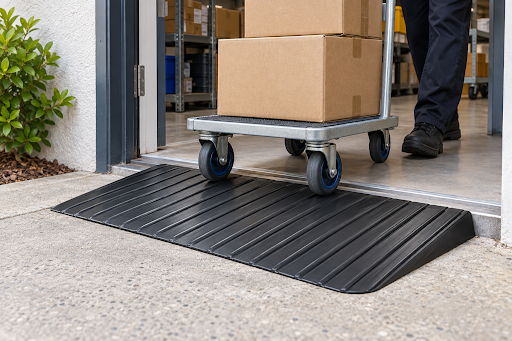

Imagine a delivery arriving while a small shop is preparing to open. The driver brings cartons to the rear entrance, a staff member collects the trolley, and everything moves smoothly until the front wheels meet a raised threshold. The trolley stops. Someone lifts a carton off, another person holds the door, and the delivery moves inside in smaller loads.
Nobody necessarily records the interruption. It becomes part of receiving stock, repeated often enough that the team stops questioning it. Yet the entrance has quietly added work to a task that should be straightforward.
This is where access deserves a closer look. A business may invest in stock systems, scheduling software and better equipment while overlooking the physical route those purchases depend on. Small obstacles can create extra handling, detours and interruptions that remain invisible in a spreadsheet.
For businesses investigating a recurring threshold problem, rubber ramps are one option to assess against the entrance and equipment involved. The more useful starting point, however, is understanding what the obstacle makes people do and whether that extra work can be removed.
When a Workaround Becomes Part of the Job
A workaround often begins with a sensible response to an immediate problem. A delivery needs unloading, so someone carries the final few boxes. A trolley cannot cross an entrance easily, so staff take a longer route. Equipment is awkward to move, so it stays beside the doorway until tomorrow.
Over time, these decisions can become routine. New employees learn the workaround from colleagues and assume it is the correct process. The original reason fades into the background, while the extra steps remain.
For an owner or manager, familiarity makes the problem harder to see. Walking through an empty entrance gives a different impression from moving a loaded trolley through it during a busy delivery. The doorway may appear perfectly manageable until the actual task is observed.
Look for repeated compensations
Useful clues include stopping at the same point, unloading before crossing, asking a colleague for help, approaching at an unusual angle or leaving equipment on the wrong side of a doorway. None automatically proves that a ramp is needed. Each identifies a place worth examining.
Pay attention to phrases such as “we always carry those last few metres” or “that trolley only works through the front door”. These comments describe how the building influences work. They can reveal limitations that do not appear in a written procedure.
The question is whether the workaround is still necessary, suitable and understood. A habit that solved yesterday’s problem may no longer fit today’s equipment, delivery volumes or staffing arrangements.
The Costs Extend Beyond a Few Lost Moments
It is tempting to treat an awkward threshold as a minor delay. Sometimes that is all it is. In other situations, it affects several parts of the task, making the impact harder to assess through timing alone.
Extra handling
If goods are unloaded from a trolley, carried across an entrance and loaded again, the route has introduced another handling stage. That stage requires space, coordination and attention. It may also involve setting cartons down somewhere they were never intended to wait.
In a hypothetical retail delivery, this could mean stock occupies the doorway while staff organise the next trip. The access problem then interacts with housekeeping and circulation. The threshold is only one part of the resulting bottleneck.
Physical effort deserves its own assessment. Safe Work Australia explains that hazardous manual tasks can involve repetitive or sustained force, sudden force and awkward postures. Tasks involving pushing, pulling or lifting should therefore be examined for how they are performed, rather than judged only by how quickly they finish.
Interrupted attention
When a task regularly requires a second person, the effect reaches beyond the delivery itself. A colleague may pause stocktaking, leave a customer conversation or stop preparing an order to help at the entrance.
That interruption is not automatically a measurable loss. Some teamwork is necessary and useful. The point is to identify assistance created by the physical obstacle, then consider whether a different arrangement would make the task easier to organise.
Unhelpful storage habits
An inconvenient route can influence where things are left. A cleaning trolley might remain near an entrance because returning it to storage requires another awkward crossing. Empty packaging might accumulate beside a doorway because that is where unloading pauses.
These are possibilities to investigate in your own premises. Observing where items collect, and asking why, can reveal how movement difficulties shape the layout over time.
Follow One Delivery From Arrival to Its Destination
A useful access review begins with a real task. Choose a normal delivery, stock transfer or equipment movement and follow it from start to finish. Include the full route: unloading point, entrance, corridor, storage area and final destination.
Consider a workshop moving tools from a storage area to a service bay. If the trolley crosses two doorways, assess each transition and the space between them. Improving the first entrance may reveal that the second has always required a sideways approach. The review should follow the tools to their destination, including the return journey, because the loaded outward trip and the empty return may involve different movements. This keeps attention on the complete task instead of the most noticeable obstacle.
Observe during ordinary activity. An empty trolley moved through a quiet building may tell you little about the same route when deliveries overlap with customers, cleaning or preparation work.
Record the sequence
Write down what happens in order. Note where the trolley stops, where goods change hands and where another person becomes involved. Record detours, door movements and temporary obstructions. Keep descriptions factual: “three cartons were carried through separately” is more useful than “the entrance is inefficient”.
Distinguish the cause from the visible result. Wheels stopping at a doorway could relate to a raised edge, equipment condition, the approach angle or several factors together. Observe enough of the movement to avoid choosing a solution before understanding the problem.
Also record what already works. A clear turning area, convenient door arrangement or well-positioned storage bay may be worth preserving when changes are considered.
Look at busy periods
Some access problems appear only when tasks overlap. A route that works for an early delivery may become difficult once customer traffic begins. A corridor may narrow when returns or empty boxes arrive.
Discuss those variations with the people using the space. Improving one crossing is less useful if its approach remains obstructed whenever the business gets busy.
The result should be a simple picture of how work moves through the building, with specific points where it becomes harder than necessary.
Ask Staff What the Floor Plan Cannot Tell You
People who use a route repeatedly often notice details that a brief inspection misses. They know which doorway catches trolley wheels, when a door needs holding open and where turning with a load becomes awkward.
Ask them to describe the task, including the parts they have learned to manage. Useful questions include: Where do you stop? What do you lift that you expected to wheel? When do you need help? Which route do you avoid, and why?
Invite staff to suggest changes without assuming the first suggestion is the final answer. Someone may request a ramp when moving a storage rack would solve the approach problem. Another person may suggest a different trolley because the existing wheels struggle throughout the route.
Include occasional users
Delivery drivers, cleaners and contractors may experience the entrance differently from permanent staff. They have less familiarity with the building and may use different equipment. Their observations can help identify arrangements that depend too heavily on local knowledge.
If visitors or customers use the same space, consider their movement too. A change intended to improve stock handling should be assessed for its effect on the people passing through the area.
Avoid designing the process around whichever employee is most comfortable with the existing workaround. Different people bring different capabilities, experience and equipment. The aim is a dependable route suited to the task and its users.
Where Rubber Ramps Fit Into a Better Workflow
Once the problem is clear, compare practical responses. These might include repairing a damaged surface, relocating stored items, maintaining equipment, changing the delivery arrangement or addressing a small level transition with a suitable ramp.
A ramp earns its place when it matches an identified obstacle and supports the intended movement. It should be considered alongside the equipment, the supporting surface and the surrounding route. A threshold product is not a substitute for repairing unstable flooring or redesigning a larger access problem.
For commercial use, discuss the actual task with the supplier and obtain appropriate installation or specialist advice where needed. Describe the equipment, load, traffic and entrance rather than asking for a product based on height alone.
Define what improvement would look like
Before making a change, describe the desired result. Perhaps the stock trolley should reach the storeroom without unloading at the doorway. Perhaps cleaning equipment should return to its storage position without a detour.
This gives everyone a shared way to judge the outcome. “The entrance feels better” is encouraging, but it does not establish whether the original workaround has disappeared.
Consider the next task
A change should also work for the activities around it. Think about opening the door, turning beyond the entrance, keeping the walkway clear and cleaning the area. Removing one obstacle while introducing another can simply move the interruption further along the route.
Review how the arrangement will be maintained. Clear responsibility for cleaning, inspection and reporting helps a useful improvement remain useful after the initial attention has passed.
Check the Result Before Claiming a Saving
After the change, observe the same task again under comparable conditions. Use similar equipment, loading and delivery arrangements where possible. Otherwise, a quieter day or lighter delivery could make the route appear improved for reasons unrelated to the intervention.
Look for the specific behaviour identified earlier. Does the trolley still stop? Are cartons still transferred by hand? Is a second person still needed solely to negotiate the obstacle? Has equipment returned to its intended storage area?
Use a small, honest record
A simple log can record the task, date, delivery conditions, interruptions and staff observations. If timing is relevant, define the start and finish consistently. Keep a note of changes in load, equipment or staffing so comparisons remain meaningful.
The unit of comparison should be the task, not just the day. A day with fewer deliveries naturally offers fewer opportunities for an interruption. Record how many comparable journeys occurred as well as how often the obstacle caused extra handling. This makes it easier to tell whether the arrangement changed the work or whether there was simply less work to observe. Include observations from different staff members and more than one delivery.
Calculate additional handling time only from observed events. If you want an estimate across a longer period, state the assumptions and distinguish that estimate from measured results. A handful of observations does not establish annual savings or prove that every future delivery will behave the same way.
Include unexpected effects. A new arrangement may improve stock movement while making cleaning more complicated. Staff may prefer the route yet report that a door catches. Those findings help refine the solution instead of treating the purchase itself as success.
Make ordinary movement easier
The strongest access improvements fit naturally into daily work. Staff understand the route, equipment can reach its destination, and the building requires fewer improvised steps to complete a routine task.
For a small business, that is a useful reason to examine entrances and floor transitions. Start by asking where people stop, lift, detour or leave things behind. Follow one ordinary task through the premises and identify what creates the interruption. Choose a suitable change, then observe whether it addresses the original problem. A modest improvement can be valuable when it solves something the team encounters repeatedly.