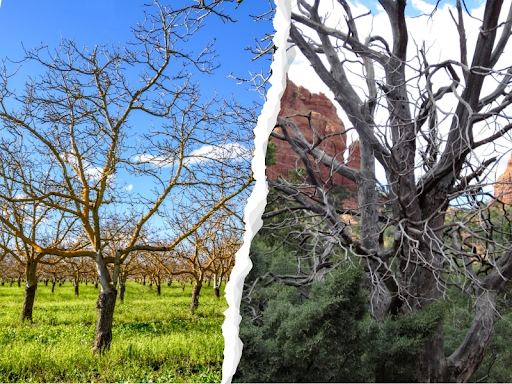

A bare tree in late winter can look a lot like a dead one. Clues can be found under the bark, in the buds, and in how the twigs behave when you bend them.
Here are some ways to look for signs of life yourself, what each test can and can’t tell you, and when it makes sense to call a professional.
Why a Dormant Tree Can Fool You
Deciduous trees drop their leaves and shut down growth for winter. From the ground, a dormant maple and a dead maple can look very similar.
Some species leaf out later than others. Oaks, for example, can leaf out well after the trees around them, so a slow spring start isn’t necessarily a sign of trouble.
Cold weather can complicate things, too. A hard freeze may damage buds while leaving branches alive, making a tree look worse than it is.
Appearance alone doesn’t always make it easy to tell whether a tree is dead or simply dormant.
However, a few simple checks can help you look for signs of life and get a better idea of the tree’s condition.
The checks below were put together with the tree care team at Mike’s Professional Tree Service in Rhode Island.
Start With the Scratch Test
The scratch test is the most reliable check a homeowner can do.
Choose a small twig or branch and gently scrape away a tiny area of the outer bark with a clean fingernail or suitable tool.
Just beneath the bark is a thin layer of tree tissue called the cambium. This living tissue is often green and moist when the branch is alive.
If it’s brown and dry, that section may be dead.
One scratch isn’t enough. Start near the tips, then test lower down and closer to the trunk, because a dead twig can sit on a perfectly healthy limb.
If dead tissue runs all the way to the trunk, the tree has likely died. If you hit green anywhere along the way, there’s still good reason for hope.
Keep the scratches small, and avoid cutting into the trunk or larger branches. Clean your tool between trees to help reduce the risk of spreading plant diseases.
Bend a Few Twigs
Living twigs are flexible. Bend one gently and it should give a little, then spring back.
Dead wood feels different. It’s hard, brittle and dry, and it usually snaps clean with very little pressure.
Try twigs from several sides of the crown.
Snapping twigs on one side and bending twigs on the other can point to trunk or root damage on one side, rather than a dying tree.
Look Closely at the Buds
Healthy buds are generally firm and well-formed, even in winter. Dead or damaged buds may look shriveled, dry, or underdeveloped.
You can also examine a bud by carefully slicing it open. If the inside is brown and dry, the bud may have died.
However, a bud that’s brown inside but green outside may point to cold injury, according to Oregon State University Extension’s guide to diagnosing trees that fail to leaf out.
Bud appearance varies by species, so use this as one clue alongside the condition of the twigs and other signs of life.
Check the Trunk and the Base
Peeling or damaged bark, deep cracks, and fungal growth on the trunk or near the base are all worth noting.
Some fungi are associated with wood decay, although mushrooms alone don’t establish how much decay is present or whether a tree is unsafe.
A tree can still be alive while experiencing significant decay or structural problems.
That distinction matters particularly when a tree is near a home, driveway, or frequently used outdoor area.
If you notice substantial cracks, extensive damage, or other concerning changes, a professional evaluation can help determine whether the tree needs attention.
When Only Part of the Tree Is Dead
A few dead branches don’t necessarily mean the whole tree is dead.
Storm damage, pests, disease, and other stresses can affect individual limbs while the rest of the tree remains healthy.
Depending on the cause and extent of the damage, pruning may be all that’s needed.
Dead or broken limbs above a home, driveway, or walkway deserve particular attention because they may fall and cause damage.
A tree care professional can assess the affected branches and recommend an appropriate approach.
When to Wait and When to Call
If you’re seeing some signs of life and the tree’s overall condition appears stable, it may be reasonable to give it more time, particularly if it’s a species that leafs out later in spring.
Compare it with trees of the same species nearby, but remember that trees can respond differently to weather, growing conditions, and stress.
A tree that remains bare well after similar trees have leafed out may warrant closer attention.
Consider contacting a tree care professional sooner if the tree has a new lean, significant cracks, extensive decay, or large dead branches, particularly if it is close to a home or other property.
A standing dead tree can become more structurally compromised over time.
A qualified tree care professional can help distinguish trees that may need attention from those that can be monitored.
Quick Answers
Can a tree t\at looks dead come back?
Sometimes. A tree may lose individual branches or experience dieback while other parts remain alive.
Whether it recovers depends on the extent and cause of the damage.
When is the best time to test?
Late winter into spring can be a useful time to assess deciduous trees as they begin to leaf out.
Comparing a tree with others of the same species can provide helpful context, although differences in timing don’t necessarily indicate a problem.
Is a dead tree dangerous?
It can be. Dead wood weakens over time, and a dead tree near a home, car or walkway is worth having evaluated before the next major storm.
A bare tree isn’t necessarily a dead tree. Looking for several signs together can help you decide whether to wait, monitor its condition, or seek professional advice.