
Picture a manufacturing site in Melbourne’s west. Six sheds, a boiler house, a workshop, an office block from the 1970s, and a big stretch of hardstand. The owner wants to replace the old roofs, upgrade a production line and knock down two buildings nobody uses anymore.
Every one of those jobs has asbestos in it.
That’s pretty normal for older industrial sites around Melbourne. The challenge isn’t spotting that asbestos is there. It’s managing industrial asbestos removal across a big, busy site without stopping the business or putting anyone at risk.
Why large sites are a different job
A house might have a fibro bathroom and an old shed. A large industrial site can have asbestos in dozens of locations, in very different forms.
Roofing and wall cladding are usually bonded asbestos cement. Pipe lagging and boiler insulation are often friable. Gaskets and seals are tucked inside plant. Office areas might have vinyl tiles and ceiling panels. Some sites also have contaminated soil from old demolitions.
Each type needs its own method, controls, and licence. And all of it has to be managed while forklifts, trucks, and staff keep moving around the site.
Know the Victorian rules
Victoria runs under its own Occupational Health and Safety (OHS) laws rather than the national Work Health and Safety (WHS) model. Asbestos at work is covered by the OHS Act 2004 and the OHS Regulations 2017, enforced by WorkSafe Victoria. EPA Victoria handles the transport and disposal side.
For sites built before 31 December 2003, the person managing or controlling the workplace generally has to identify asbestos, keep an asbestos register, review it when work is planned, and make sure licensed removalists do the work that needs a licence.
On the licensing side:
- Friable asbestos needs a Class A licence
- Bonded asbestos over 10 square metres needs at least a Class B licence
Licensed removalists must notify WorkSafe Victoria before starting.
Phase one: get the information right
Big projects go wrong when people plan from an old register.
Before anything is scheduled, check that the register covers every building and every piece of plant that’s in scope. If it doesn’t, or if it hasn’t been updated in years, get a fresh survey. For demolition or major refurbishment, a more intrusive survey is often needed to check inside walls, under floors and within equipment.
This is also the time to look at soil. If you’re excavating or redeveloping, especially on older land, it’s worth knowing early whether asbestos is in the ground.
Phase two: build a staged program
Once you know what’s there, the job can be broken into stages.
Most large projects are split into zones. That might be one shed at a time, or one section of roof, or one production line during its shutdown. Each zone has its own removal plan, controls and clearance.
A sensible program will:
- Line up removal with planned shutdowns and quieter periods
- Keep clear separation between work zones and active areas
- Map out safe traffic routes for forklifts, trucks and people
- Allow time for clearance before the next trade moves in
- Fit around demolition crews, roofers and builders on the same site
Roof replacement programs are a common example. Old asbestos cement roofs are often removed and replaced section by section, so the building underneath can keep operating.
Phase three: control the work
On the ground, each zone needs the right controls for the material involved.
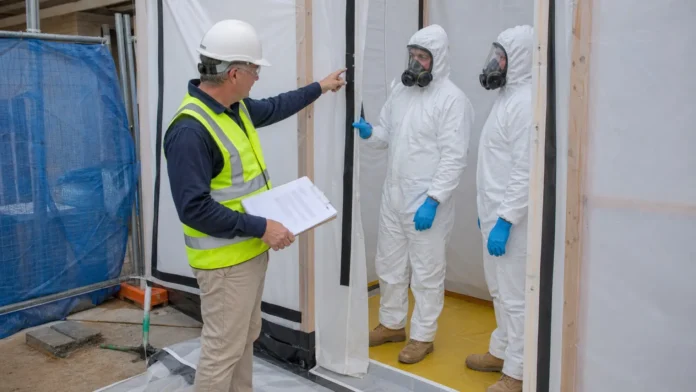
Friable removal is the most demanding. It calls for sealed enclosures, negative air units, decontamination facilities and air monitoring throughout. Bonded removal is less intense, but still needs wet methods, careful handling and, on large or sensitive jobs, air monitoring too.
Roof work adds fall risks, so edge protection, safe access and harnesses are part of the setup. Plant work often needs isolation, so the removal crew works closely with your maintenance team and permit system.
Communication matters as well. Staff and contractors should know which areas are off limits and why. Clear signage and regular updates stop people wandering into active zones.
Phase four: clearance, disposal, and records
When each zone is complete, an independent competent person inspects it and a clearance certificate is issued before the area is used again.
The waste has to be wrapped, sealed, labelled and transported in line with EPA Victoria requirements, then taken to a licensed facility. On a big site, that can be a lot of loads over many weeks, so the logistics need planning.
Keep every clearance certificate, disposal record and updated register entry. Once the project’s done, your register should reflect exactly what was removed and what’s left.
Choosing the right contractor
Lots of businesses advertise asbestos removal Melbourne wide. Large industrial work needs a contractor with the scale and experience to match.
Look for a company that:
- Holds the right WorkSafe Victoria licence class for every material on site
- Has run large, staged industrial projects before
- Has enough crews and equipment to keep the program on track
- Provides a written control plan and a clear staged schedule
- Understands plant isolation, confined spaces, and work at heights
- Handles air monitoring, clearance, and EPA compliant disposal
Ask to see examples of similar jobs and ask how they’ll keep your operations running while they work.
Getting the timing right
The best time to plan asbestos removal is before the rest of the project is locked in. Bring your removal contractor in at the same stage as your builder or engineer, not after the program’s been set.
If you’ve got an older site and major works on the horizon, start with the register. Then talk to a licensed specialist in asbestos removal Melbourne industrial clients rely on and make industrial asbestos removal part of the plan from day one.